
Now Reading: Hot Jupiter exoplanet has cloudy mornings and clear evenings
-
01
Hot Jupiter exoplanet has cloudy mornings and clear evenings


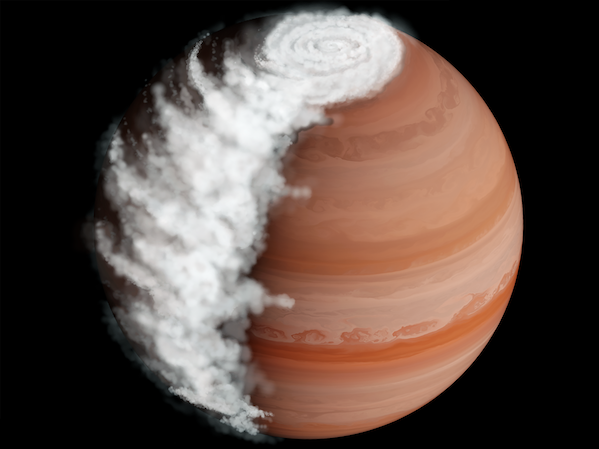
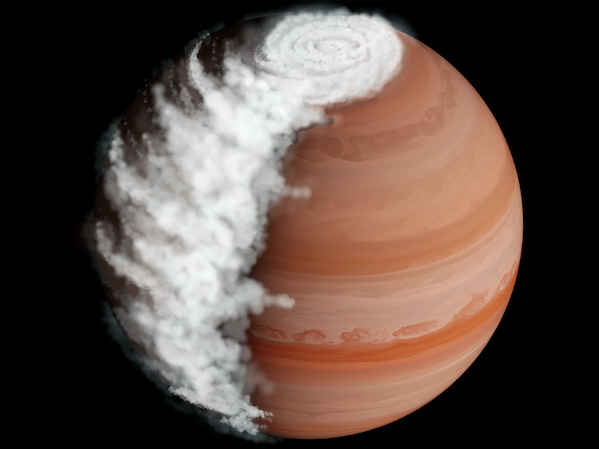
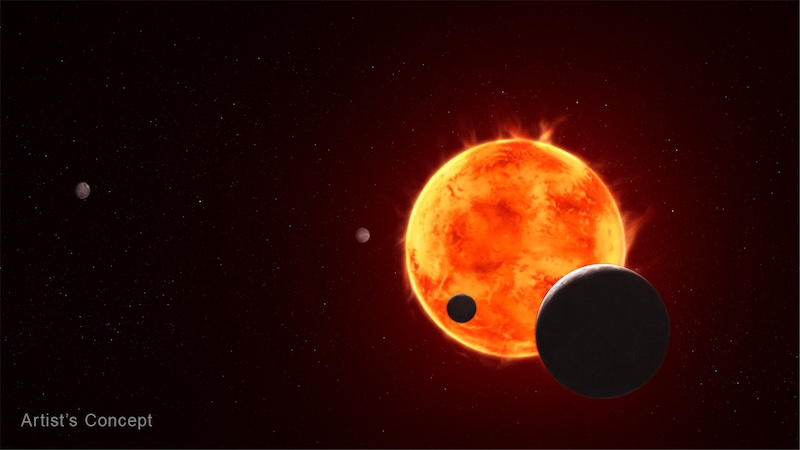
- WASP-94A b is a hot Jupiter exoplanet about 700 light-years from Earth. Astronomers recently performed more observations of it with the James Webb Space Telescope.
- The planet has cloudy morning and clear evenings, Webb found. Clouds of sandy particles form in the mornings and the dissipate by the evening.
- The cloud-free evenings also allowed Webb to analyze the atmosphere itself more clearly, without clouds contaminating the data.
Cloudy mornings on a hot Jupiter exoplanet
On a hot Jupiter-type exoplanet about 700 light-years away, sand clouds build up every morning, but then dissipate by nightfall. That’s the amazingly precise finding of a team of researchers at Johns Hopkins University, announced on May 21, 2026.
The planet – WASP-94A b – is tidally locked to its star. So it always keeps a single side facing its star, which is a little hotter, larger, and more luminous than our sun. No one has directly measured the rotation period of WASP-94A b. But its orbital period is about four Earth days. So it probably rotates once in that amount of time (much as our moon takes about a month to orbit Earth, while rotating once on its axis).
The clouds appear to form on the cooler nightside of WASP-94A b. They circulate toward this world’s dayside and ultimately evaporate in the intense heat. Why so intense? Because WASP-94A b is orbiting super-closely to its star, only about 5 million miles (8 million km) away. That’s in contrast to Earth at 93 million miles (150 million km), or the sun’s innermost planet, Mercury, which gets no closer than 29 million miles (47 million km) to our star.
And, by isolating the clouds in their analysis, the researchers said they could better determine the composition of the planet’s atmosphere.
This is one of just a handful of times that astronomers have detected cloud cycles on a hot Jupiter. The researchers made the observations with the James Webb Space Telescope.
They published the new peer-reviewed findings in the journal Science on May 21, 2026. There is also an earlier preprint version of the paper from last year available.
Observing the transit of WASP-94A b
The Webb telescope observed the planet as it transited – passed in front of – its star. The researchers took measurements as the planet started to transit, and as it finished the transit. At the leading edge, the atmosphere flows from the nightside to the dayside. This makes it the morning. But at the trailing edge, the atmosphere flows from the dayside to the nightside, making it evening.
The observations revealed that the morning atmosphere is filled with clouds made of magnesium silicate – aka talc – a common mineral found in rocks on Earth. The evening atmosphere, though, is clear and cloud-free.
Cloudy Mornings And Clear Evenings On Giant Extrasolar World WASP-94A bastrobiology.com/2025/05/clou… #astrobiology #exoplanet #atmosphere
— Astrobiology (@astrobiology.bsky.social) 2025-05-19T17:22:22.927Z
Now on @sciam.bsky.social: NASA's JWST just delivered a fascinating weather report for the distant exoplanet WASP-94A b, finding the gas-giant world has partly cloudy skies. By @krcallaway.bsky.social.www.scientificamerican.com/article/jwst…
— Lee Billings (@leebillings.bsky.social) 2026-05-21T18:21:32.933Z
What is causing this?
So, what is the reason for this interesting atmospheric phenomenon? Right now, the researchers have two main hypotheses:
First, powerful winds could be lifting clouds higher up on the cooler nightside of the planet. Then, the clouds plunge back down on the hotter dayside. This buries the clouds much deeper in the atmosphere where they remain hidden.
Or, another possibility is that this process is similar to when fog burns off on Earth. The clouds form on the cooler nightside of the planet. Then, they drift into the hotter dayside. Because it is so hot, the chemicals in the clouds boil away and the clouds vaporize.
As co-author and program principal investigator David Sing at Johns Hopkins University said:
It was a huge surprise. People have expected some differences, like it’s cooler in the morning than the evening; that’s something natural that we experience here on Earth. But what we saw was a real dichotomy between the weather on both sides of the planet, and huge differences in cloud coverage, and that changes our whole picture of the planet.

Cloud-free evenings
The evenings being free of clouds gave the researchers an opportunity. They could study the atmosphere itself more clearly with Webb. The Hubble Space Telescope isn’t able to do this. Lead author Sagnick Mukherjee at Arizona State University explained:
With the Hubble telescope, when we used to do this type of observation, we got an average view of the whole planet with data from the clouds and the atmosphere squished together and indistinguishable. This approach with the JWST lets us localize our observations, which helped us see the cloud cycle.
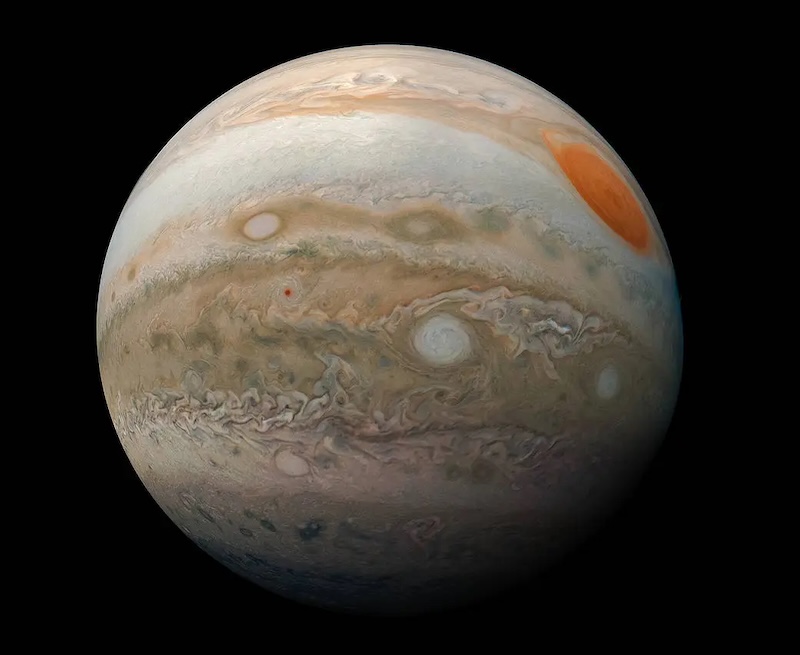
And what did the observations show? That WASP-94A b is actually more like Jupiter than first thought. Earlier observations suggested that WASP-94A b had hundreds of times more oxygen and carbon than Jupiter. But now the newer, cleaner analysis shows that really only has five times more. That fits much better into current planetary formation models.
A clearer view of the atmosphere
The new observations are a big step in being able to study both clouds and the atmosphere on exoplanets. Sing said:
I’ve been looking at exoplanets for 20 years, and general cloudiness has been a thorn in our side. We’ve known for quite a while that clouds are pervasive on hot Jupiter planets, which is annoying because it’s like trying to look at the planet through a foggy window. Not only have we been able to clear the view, but we can finally pin down what the clouds are made out of and how they’re condensing and evaporating as they move around the planet.
Bottom line: New observations with the Webb space telescope of the hot Jupiter exoplanet WASP-94A b show that sandy clouds fill the morning skies, but dissipate by evening.
Source: Cloudy mornings and clear evenings on a gas giant exoplanet
Source (preprint): Cloudy mornings and clear evenings on a giant extrasolar world
Read more: Double hot Jupiters: How do these rare gigantic worlds form?
Read more: A hot Jupiter exoplanet’s dark side revealed
The post Hot Jupiter exoplanet has cloudy mornings and clear evenings first appeared on EarthSky.










Related Posts
Stay Informed With the Latest & Most Important News

Advertisement
-
 01Two Black Holes Observed Circling Each Other for the First Time
 -
 02From Polymerization-Enabled Folding and Assembly to Chemical Evolution: Key Processes for Emergence of Functional Polymers in the Origin of Life
 -
 03Astronomy 101: From the Sun and Moon to Wormholes and Warp Drive, Key Theories, Discoveries, and Facts about the Universe (The Adams 101 Series)
 -
 04True Anomaly hires former York Space executive as chief operating officer
 -
 05Φsat-2 begins science phase for AI Earth images
 -
 06Hurricane forecasters are losing 3 key satellites ahead of peak storm season − a meteorologist explains why it matters
 -
 07Binary star systems are complex astronomical objects − a new AI approach could pin down their properties quickly