
Now Reading: An Organics-forward Approach To Searching For Life On Mars
-
01
An Organics-forward Approach To Searching For Life On Mars


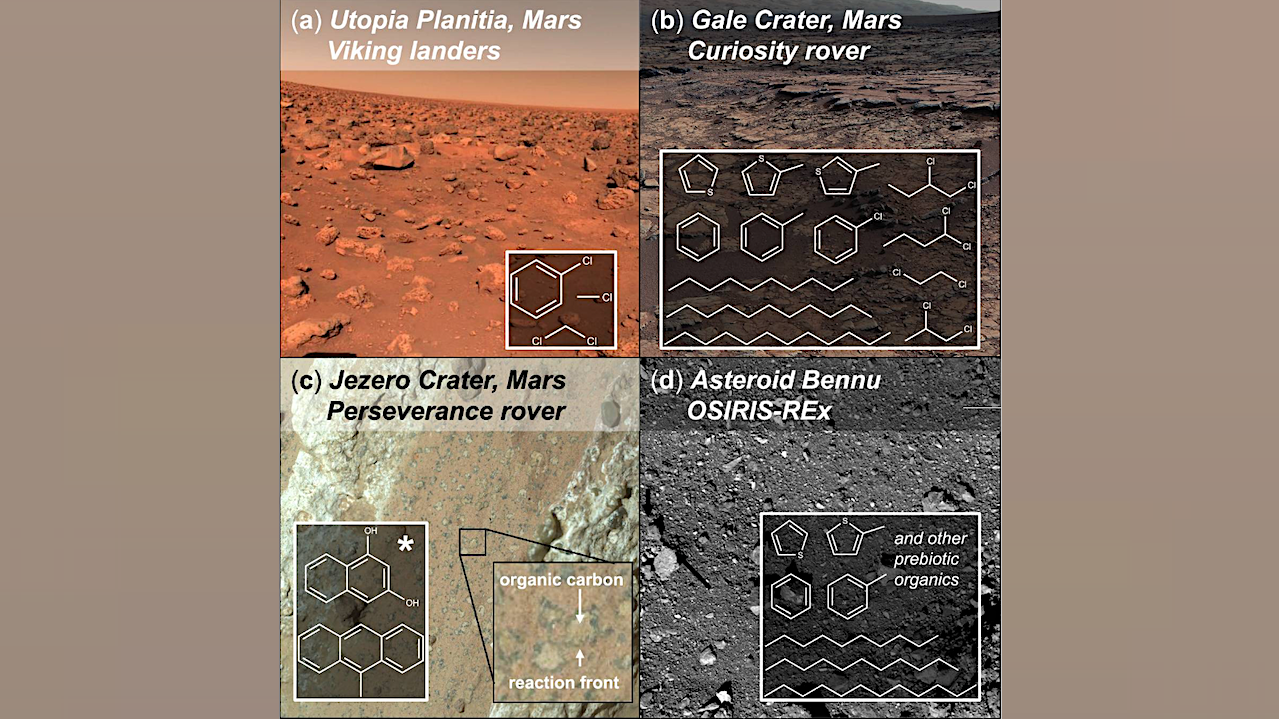
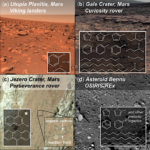
a The Viking 1 & 2 landers detected chlorinated breakdown products likely formed through interactions between organics and oxychlorine anions during thermal volatilization utilized for analysis11,12, b the Curiosity rover identified various functionalized organic fragments and long-chain n-alkanes (for simplicity, a subset is illustrated here)13,15, and the Perseverance rover measured redox-driven organo-mineral associations and polycyclic aromatic hydrocarbons (PAHs); * indicates that PAHs reported by Fornaro et al. (2025) were found in different locations and geologic units than organo-mineral associations reported by Hurowitz et al. (2025)14,16. d Carbonaceous meteorites and asteroids delivered to planetary surfaces contain a rich array of organics, including some of the same compounds detected on Mars (e.g., macromolecular carbon, thiophenes, PAHs, long-chain n-alkanes), along with a diverse suite of prebiotic organics, which highlights the importance of understanding abiotic background material when searching for organic biosignatures on Mars5,6,7,18. Image credits: a NASA/JPL, b NASA/JPL-Caltech/MSSS, c NASA/JPL-Caltech/MSSS, d NASA/Goddard/University of Arizona. — Nature via PubMed
The modern Martian surface is cold, dry, oxidizing, and perpetually bombarded with radiation, rendering it generally inhospitable to life as we know it.
However, geological evidence suggests ancient Mars was more Earth-like and characterized by warmer temperatures, widespread fluvial activity, a thicker atmosphere, and a protective magnetic field shielding the surface from radiation.
Habitable conditions continued until cessation of the Martian dynamo terminated the planetary magnetic shield, leading to solar wind-induced atmospheric erosion and the loss of surface liquid water.
Nevertheless, early environments inferred to be analogous to those found on Earth, common molecular feedstocks (including delivery of volatiles and organic matter by comets and asteroids), and plausible reactive pathways may have resulted in parallel origin of life events more than 3.4 billion years ago.
Organics as potential biosignatures on Mars
On Earth, life seemingly arose from a fortunate coalescence of chemistry and geology under placid conditions. Was this also the case on ancient Mars? If so, did increasingly cold and dry conditions result in the extinction of Martian life, or did it adapt to the changing environment?
Perhaps life never arose—if not, why? We believe these questions can be addressed with an organics-forward approach, because most of the building blocks of life form naturally through abiotic processes and are ubiquitous throughout the Solar System4–7. However, specific differences in their structures and distributions reveal crucial clues regarding their chemical origins.
Terrestrial biology preferentially synthesizes a small and specific set of building blocks to create complex biopolymers. These include, for instance: a homochiral suite of 20 amino acids, phospholipids containing predominantly C16 and C18 straight-chain carboxylic acids, and five nucleobases along with ribose (also with chiral preference) to build nucleic acid informational polymers (e.g., DNA and RNA).
In contrast, abiotic reactions within primitive accreting bodies (e.g., asteroids and comets) yield stochastically distributed molecular mixtures characterized by racemic amino acids, highly branched aliphatic carboxylic acids, hydrocarbons at low carbon numbers, and other molecular isomers not utilized by terrestrial biology.
Furthermore, some of these organics can persist throughout geological timescales, with the potential to serve as evidence for either extant or extinct life. On Earth, molecular fossils represent some of the most robust evidence of ancient life. If Mars experienced an independent genesis, similar organic remnants with structural preferences could persist in the geologic record today.
Astrobiology, Astrochemistry, Astrogeology,










Related Posts
Stay Informed With the Latest & Most Important News
Advertisement
-
 01Two Black Holes Observed Circling Each Other for the First Time
 -
 02From Polymerization-Enabled Folding and Assembly to Chemical Evolution: Key Processes for Emergence of Functional Polymers in the Origin of Life
 -
 03Astronomy 101: From the Sun and Moon to Wormholes and Warp Drive, Key Theories, Discoveries, and Facts about the Universe (The Adams 101 Series)
 -
 04True Anomaly hires former York Space executive as chief operating officer
 -
 05Φsat-2 begins science phase for AI Earth images
 -
 06Hurricane forecasters are losing 3 key satellites ahead of peak storm season − a meteorologist explains why it matters
 -
 07Binary star systems are complex astronomical objects − a new AI approach could pin down their properties quickly