
Now Reading: Reditus Space joins reusable satellite wave with $7 million seed round
-
01
Reditus Space joins reusable satellite wave with $7 million seed round


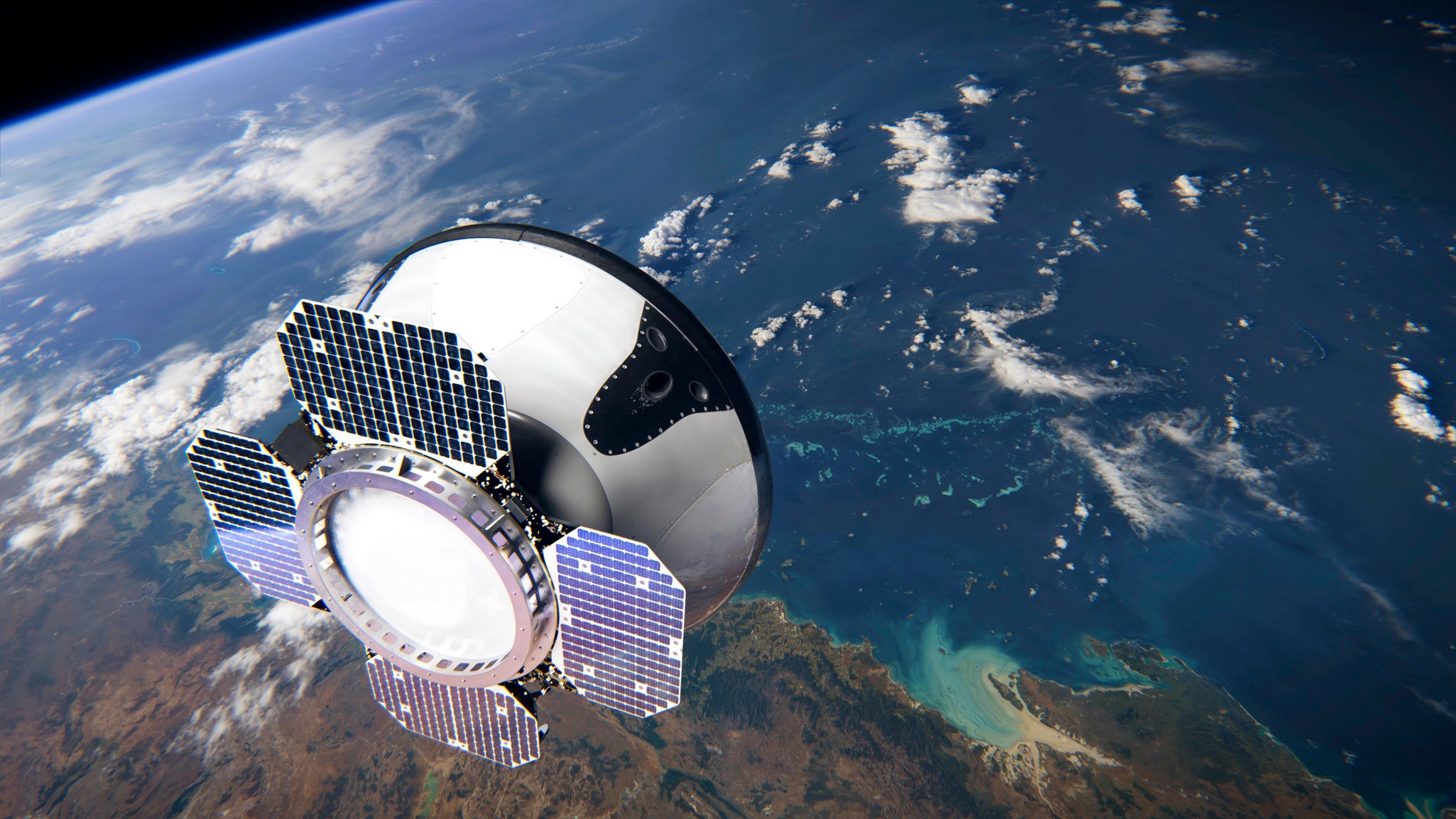

TAMPA, Fla. — Reditus Space announced $7.1 million in seed funding Dec. 1 to fly its first reusable spacecraft next summer, joining a wave of startups emerging from stealth to support microgravity research and in-space manufacturing as the International Space Station nears retirement.
The seed funding was a “party round in the sense that there were a lot of investors involved,” said Stef Crum, chief executive and co-founder of the Atlanta-based company, in an interview. Among the investors were venture capital firm Antler and Y Combinator, the startup accelerator that the company participated in earlier this year.
The funding will support development of a demonstrator with a 40-kilogram payload capacity that has lined up customers for an eight-week mission in orbit, he said. The spacecraft, slated to launch on a SpaceX rideshare mission, will end its mission with a splashdown off the U.S. coast.
“It’ll be the largest commercial free flyer that will have ever been launched, just by sheer virtue of the amount of mass that makes it back from orbit,” he said in an interview with SpaceNews. He declined to provide specifics on the size of the spacecraft or its ultimate payload capacity.
But “the thing that we hang our hat on, if you will, is that we will have gone from seed to launch in 15 months.” That is being carried out by a company with 13 full-time employees and several interns, he noted.
Reusable challengers
Reditus is the latest in a growing list of reusable-satellite startups to surface this year.
In October, San Francisco-based Catalyx Space announced it had also raised about $7.1 million, supporting plans to build a 20-kilogram reusable demonstrator for launch next fall.
Denver-based Lux Aeterna recently came out of stealth with $4 million in pre-seed funding for a 200-kilogram demonstrator slated to fly in 2027.
While Lux Aeterna aims to demonstrate a fully reusable satellite, the solar panels and heat shield on Reditus’ inaugural ENOS spacecraft are not being designed for recovery.
However, Crum said the venture aims to achieve full reusability as early as 2027.
“The intention is that we don’t need to do any adjustments, any refurbishing, in any capacity — it’ll just be about maintenance,” he said.
Like its rivals, Reditus plans to increase capacity on future models as demand grows. According to Crum, the startup’s edge in the increasingly crowded field will center on its spacecraft architecture and proprietary heat-shield materials.
He declined to name the “multiple customers” on the debut mission, but said most demand is expected from pharmaceutical and biotechnology companies, along with developers of advanced materials such as semiconductor substrates.
In addition to other startups developing reusable spacecraft, Reditus will also compete with companies already testing and flying spacecraft with reentry vehicles for microgravity research and manufacturing applications.
Varda Space Industries, the current leader in the field, launched its fifth reentry spacecraft on the Transporter-15 rideshare mission Nov. 28. Inversion Space flew a reentry demonstrator, Ray, earlier this year, although the spacecraft was not able to reenter as planned. European startup Atmos Space Cargo tested a reentry vehicle prototype earlier this year and recently announced plans to partner with another European firm, Space Cargo Unlimited, for a series of missions starting next year.
Crum said that reusability will help Reditus compete in terms of flying missions at a faster cadence as well as offering a lower price “that is facilitated by reusability.”
Growing interest in reusable orbital platforms is mainly being driven by plans to retire the ISS around 2030, he added, though emerging in-space manufacturing capabilities and a commercial market starting to recognize value beyond data-downlink missions are also playing a part.
An ancillary market is collecting data during reentry for hypersonic testing. Crum said the company has contracts with “some DOD stakeholders” to collect data during reentry, where the spacecraft being sits return to Earth at Mach 28. “Those types of speeds are just interesting on a fundamental basis,” he said.
However, the primary focus of Reditus is on commercial microgravity applications. “We are a dual-use application, where commercial contracts and customers are our primary application,” Crum said. “But because we go through that high hypersonic environment, we’re going to take advantage of it.”
Jeff Foust contributed to this article from Washington.










Related Posts

Stay Informed With the Latest & Most Important News
Previous Post
Next Post


Advertisement
-
 01Two Black Holes Observed Circling Each Other for the First Time
 -
 02From Polymerization-Enabled Folding and Assembly to Chemical Evolution: Key Processes for Emergence of Functional Polymers in the Origin of Life
 -
 03Astronomy 101: From the Sun and Moon to Wormholes and Warp Drive, Key Theories, Discoveries, and Facts about the Universe (The Adams 101 Series)
 -
 04True Anomaly hires former York Space executive as chief operating officer
 -
 05Φsat-2 begins science phase for AI Earth images
 -
 06Hurricane forecasters are losing 3 key satellites ahead of peak storm season − a meteorologist explains why it matters
 -
 07Binary star systems are complex astronomical objects − a new AI approach could pin down their properties quickly