
Now Reading: NASA astrophysics director offers optimistic vision despite budget uncertainty
-
01
NASA astrophysics director offers optimistic vision despite budget uncertainty

NASA astrophysics director offers optimistic vision despite budget uncertainty


GREENBELT, Md. — The head of NASA’s astrophysics division offered an upbeat assessment of upcoming missions, a stark contrast to the bleak outlook in the agency’s budget proposal six months ago.
Speaking at a Maryland Space Business Roundtable luncheon Dec. 10, Shawn Domagal-Goldman, acting director of NASA’s astrophysics division, highlighted missions set to launch or advance in the coming year.
That includes several balloon and smallsat missions flying in the next few weeks, among them the first two Pioneer missions: PUEO, a balloon mission studying high-energy particles over Antarctica, and Pandora, a smallsat examining exoplanet atmospheres. Pioneer is a program for astrophysics missions with a cost cap of $20 million.
“It’s taken us a while to get the first one on the launch pad, but that’s by design, because we were waiting for the right rides to show up,” he said. “Now we’re going to have a series of them.” Pandora and PUEO were among four concepts selected in 2021 in the program’s first round.
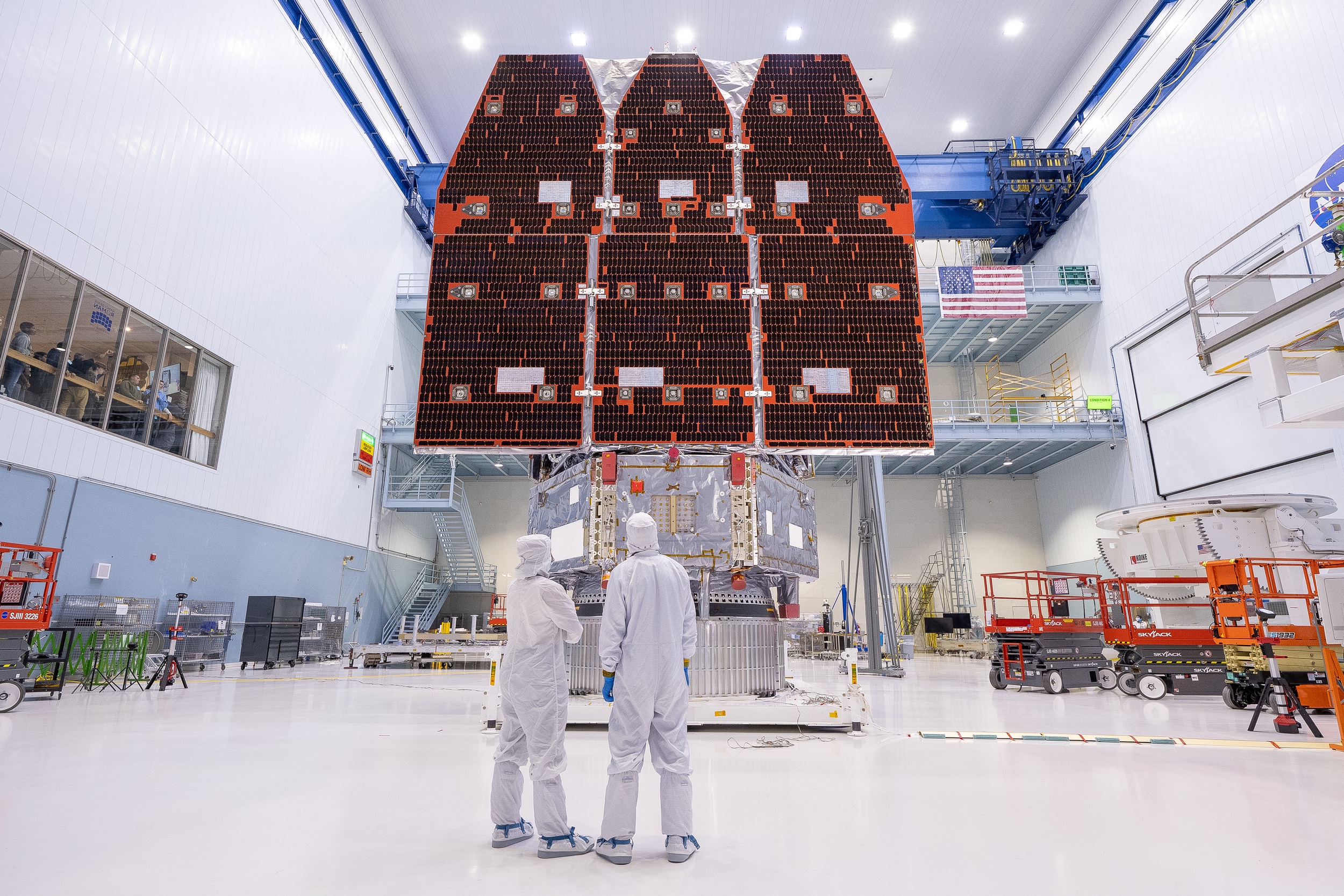
At the other end of the size spectrum is the Nancy Grace Roman Space Telescope. NASA announced Dec. 4 it had completed assembly of the telescope, now entering final testing at the Goddard Space Flight Center before shipment to the Kennedy Space Center next summer. Launch is scheduled as soon as next fall on a Falcon Heavy.
“It’s going to launch in 2026,” he said. “And when it does, it will do things on a routine basis that are right now impossible.”
Domagal-Goldman also expects to move forward next year with a call for proposals for the next astrophysics Small Explorer, or SMEX, mission. NASA released a draft announcement of opportunity in January but delayed the final version for a year in April.
“We are still planning for that one-year delay. We haven’t changed anything,” he said. “We’re still hoping for a final draft to be released in April of next year.”
He suggested that NASA will try to accelerate the mission’s development timeline. Under the January draft, NASA expected to select missions in spring 2027 for launch by spring 2031.
“We are going to try to go a little bit faster, because we want to be aligned with the administration,” he said. “We’re leaning in to the vision we’ve gotten from agency leadership to find ways to go faster.”
NASA is also expected to select next year a concept for its first astrophysics probe-class mission. In October 2024, NASA chose the Advanced X-ray Imaging Satellite and the Probe far-Infrared Mission for Astrophysics for further study, with a goal of selecting one in 2026 under a $1 billion cost cap.
Domagal-Goldman said that work was slowed by the six-week government shutdown but that NASA still intends to select one by the end of the fiscal year. “If we’re able to do that, we’re going to set ourselves up for a very bright future.”
That optimism contrasts sharply with NASA’s fiscal 2026 budget proposal released in May, which would have cut astrophysics funding from about $1.53 billion to $523 million — nearly two-thirds — canceling ongoing and planned missions including the Chandra X-ray Observatory and the planned probe selection. Funding for Roman was also reduced, threatening its schedule.
Appropriations bills pending in the House and Senate largely rejected those proposed cuts. NASA, along with the rest of the federal government, is operating under a continuing resolution until late January.
After the presentation, Domagal-Goldman said he has been instructed to operate under the House funding level during the continuing resolution. That bill provides $1.485 billion for astrophysics, less than the Senate’s $1.605 billion or flat funding under the resolution.
Doing so, he said, is the most conservative approach and allows NASA flexibility to increase funding later, such as for early work on the Habitable Worlds Observatory, if final appropriations are higher than the House level.
Thoughts on servicing
Domagal-Goldman also highlighted an upcoming mission to reboost the orbit of the Neil Gehrels Swift Observatory. The spacecraft, launched in 2004 to study gamma-ray bursts, is in a decaying orbit that could lead to an uncontrolled reentry late next year.
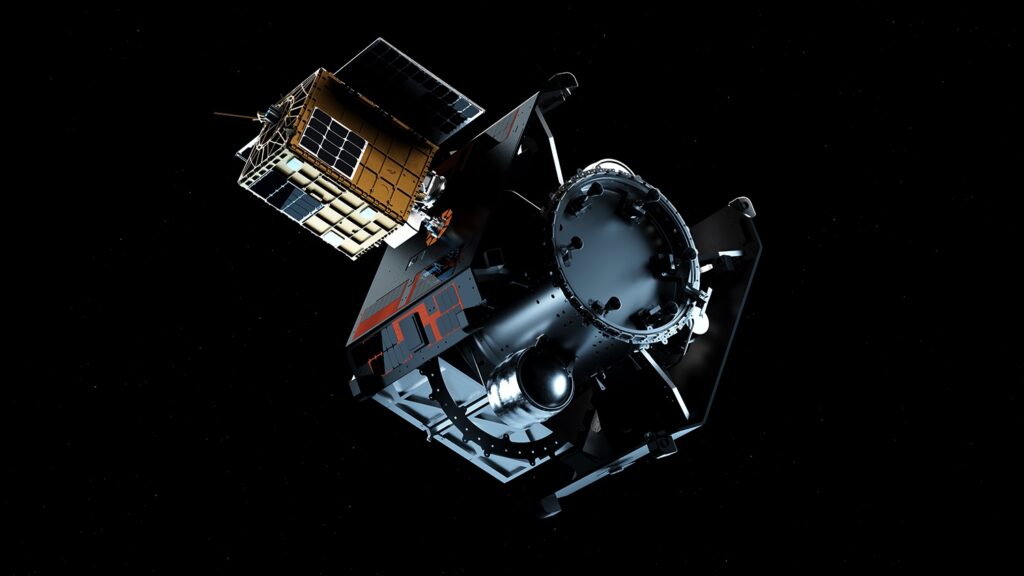
NASA announced in September it selected Katalyst Space Technologies to send a spacecraft to dock with Swift and raise its orbit in mid-2026. Katalyst has since contracted Northrop Grumman to launch the mission on a Pegasus XL.
Domagal-Goldman noted that the risk to people and property from an uncontrolled Swift reentry is low. “However, the astrophysics division director cannot accept the risk that that presents to our fleet to look at amazing things in the universe,” he said, explaining the decision to pursue a reboost.
He said the mission provides a “national strategic capability” beyond astrophysics in two ways: demonstrating the ability to conduct on-orbit servicing publicly and doing so on an accelerated schedule. The mission is set to launch less than a year after contract award.
Servicing could also extend to the Hubble Space Telescope, he said. “We’ve got a new boss coming in. He’s mentioned the possibility of doing that on the Hubble Space Telescope. I think that’s possible.”
Jared Isaacman, expected to be confirmed soon as NASA administrator, previously worked with NASA and SpaceX on a Crew Dragon concept mission to reboost and possibly service Hubble. However, NASA announced in June 2024 that it was declining both that proposal and other private servicing options, concluding the risks outweighed the benefits.
Domagal-Goldman pointed to another challenge for Hubble servicing: the telescope’s operating cost, more than $90 million in 2024. “But if we have an observatory that lasts a long time, and we have another observatory that lasts a long time,” he said, “that starts to get into your free energy in your budget to build new things that you have to go service in the future.”
“I think we can fit it in our portfolio,” he said of Hubble servicing, “so long as we find a way to bring in its year-over-year cost in the outyears. That becomes the challenge.”










Related Posts
Stay Informed With the Latest & Most Important News
Previous Post
Next Post

Advertisement
-
 01Two Black Holes Observed Circling Each Other for the First Time
 -
 02From Polymerization-Enabled Folding and Assembly to Chemical Evolution: Key Processes for Emergence of Functional Polymers in the Origin of Life
 -
 03Astronomy 101: From the Sun and Moon to Wormholes and Warp Drive, Key Theories, Discoveries, and Facts about the Universe (The Adams 101 Series)
 -
 04True Anomaly hires former York Space executive as chief operating officer
 -
 05Φsat-2 begins science phase for AI Earth images
 -
 06Hurricane forecasters are losing 3 key satellites ahead of peak storm season − a meteorologist explains why it matters
 -
 07Binary star systems are complex astronomical objects − a new AI approach could pin down their properties quickly