
Now Reading: Max Space unveils plans for commercial space station
-
01
Max Space unveils plans for commercial space station


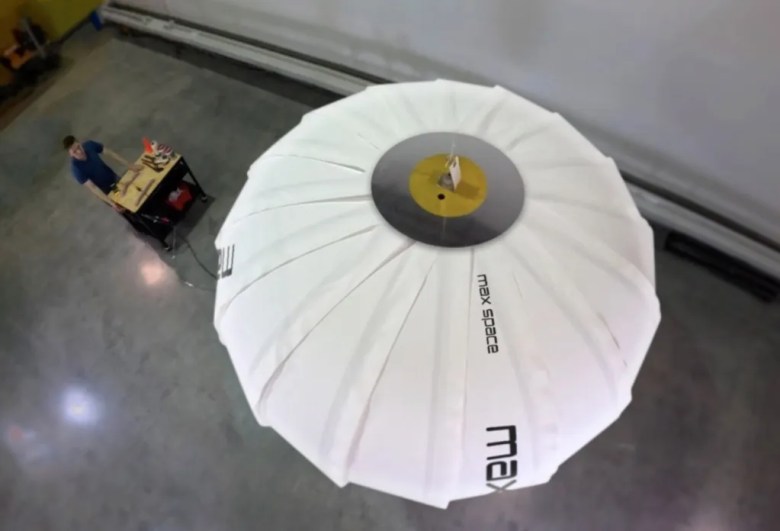
WASHINGTON — Max Space, a startup developing expandable module technologies, plans to build a commercial space station that could launch on a single Falcon 9 rocket.
The company unveiled plans Dec. 17 for Thunderbird Station, a space station featuring a single large module that would expand to a volume of 350 cubic meters, about one-third the volume of the International Space Station, once in orbit. The station is designed to support four people continuously and includes two docking ports for visiting vehicles.
Max Space emerged from stealth in April 2024, unveiling its expandable module technology. The company is taking a different approach from others developing inflatable modules, which Max Space says results in modules with more predictable safety margins and better scalability to larger sizes.
At the time, the company did not plan to develop its own space station, instead offering the module technology to companies planning stations and for other applications, such as in-space propellant depots. NASA’s revised approach to its Commercial Low Earth Orbit Destinations, or CLD, program, announced in August, led the company to advance its own station concept.
“It was pretty clear that was an opportunity for us to put a proposal forward to show how these modules can really be used for human habitation,” said Saleem Miyan, Max Space’s chief executive, in an interview.
NASA’s shift toward awarding multiple funded Space Act Agreements to support development and initial demonstrations of commercial stations created an opportunity to accelerate the company’s long-term plans.
“That CLD proposal gave us an incentive to strategically look at how we would bring forward the roadmap, and so that’s exactly what we’ve done,” Miyan said.
A key element of Thunderbird Station’s design is that it can be launched on a single Falcon 9. Other commercial space station concepts require either multiple launches or a single heavy-lift launch, such as SpaceX’s Starship.
That capability is enabled by what the company calls a “morphic interior structure” that uses soft goods for much of the interior and can be reconfigured by crews to support different activities.
“We effectively have a highly customizable internal environment,” Miyan said, comparing it to moving furniture in a house. “It allows us to create usable volume, personalized space for astronauts, and a large amount of space that can be readily leveraged for large-scale manufacturing in orbit.”
To support the station’s design, Max Space hired former NASA astronaut Nicole Stott as its lead astronaut. “She’s been incredibly helpful to our design and engineering teams in developing the original concepts for what an internal habitat should look like,” Miyan said.
Also joining Max Space is Kartik Sheth, a former associate chief scientist at NASA. Miyan said Sheth will help the company “strategically and tactically align what we’re doing on Thunderbird Station to satisfy not just NASA’s needs, but also America’s needs.”
While changes in NASA’s CLD strategy are driving the accelerated work on Thunderbird Station, the company sees additional potential customers. “What they’ve seen of our design, strategy and solution for a very low-cost launch of a substantial station has generated a lot of interest outside the CLD program,” Miyan said.
Potential demand includes customers seeking to continue research currently performed on the International Space Station, as well as those interested in in-space manufacturing of semiconductors and fiber optics. Those uses have generated more interest than other potential applications, such as tourism.

The next major development milestone is Mission Evolution, a small prototype scheduled to launch in early 2027 on a SpaceX rideshare mission. A key objective of that mission will be testing the module’s micrometeoroid and orbital debris protection system, which Miyan described as a “layer of leaves” that has performed well in ground tests but has not yet flown in space. The mission will also test the module’s environmental control and life support system.
Miyan said the company, which has nearly 50 employees and a facility in Exploration Park near the Kennedy Space Center, is fully funded through the Mission Evolution launch through a group of strategic and institutional investors he did not identify. The company has raised more than $10 million in a pre-seed round.
The expandable module technology could also be adapted for other applications, including lunar and Mars missions. Miyan said the same module design used for Thunderbird Station could be readily adapted for a lunar lander.
“We see so many interesting applications where habitats, whether human-rated or not, are required,” he said. “Those are the areas where I think we’re going to stand out.”










Related Posts

Stay Informed With the Latest & Most Important News
Previous Post
Next Post
Advertisement
-
 01Two Black Holes Observed Circling Each Other for the First Time
 -
 02From Polymerization-Enabled Folding and Assembly to Chemical Evolution: Key Processes for Emergence of Functional Polymers in the Origin of Life
 -
 03Astronomy 101: From the Sun and Moon to Wormholes and Warp Drive, Key Theories, Discoveries, and Facts about the Universe (The Adams 101 Series)
 -
 04True Anomaly hires former York Space executive as chief operating officer
 -
 05Φsat-2 begins science phase for AI Earth images
 -
 06Hurricane forecasters are losing 3 key satellites ahead of peak storm season − a meteorologist explains why it matters
 -
 07Binary star systems are complex astronomical objects − a new AI approach could pin down their properties quickly