
Now Reading: Rare annular solar eclipse captivates skywatchers with stunning ring of fire effect
-
01
Rare annular solar eclipse captivates skywatchers with stunning ring of fire effect

Rare annular solar eclipse captivates skywatchers with stunning ring of fire effect


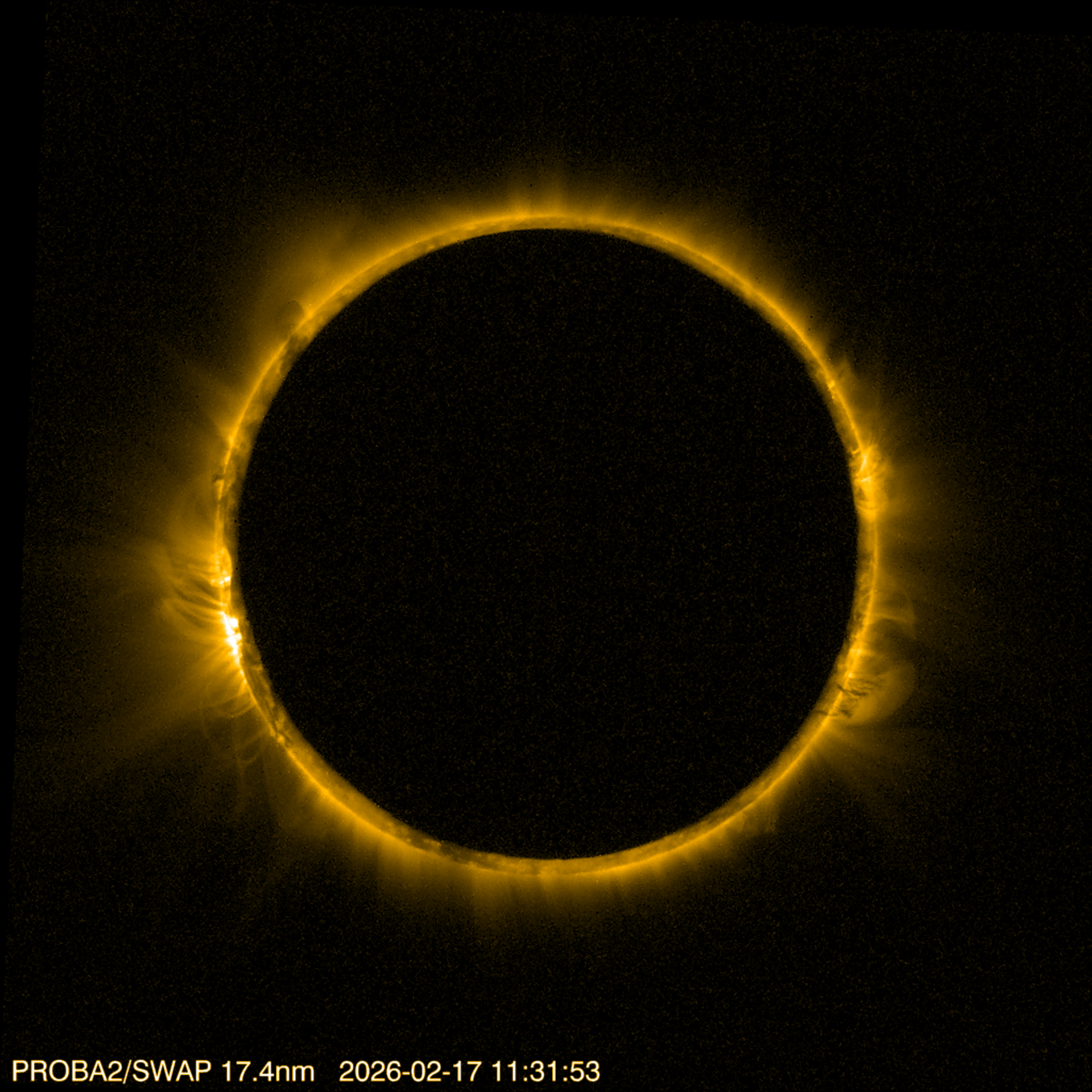
On February 17, 2026, the Moon traversed the path between the Earth and the Sun, resulting in an annular solar eclipse characterized by a prominent ‘ring of fire.’ This phenomenon occurred as the Moon was positioned farther away in its elliptical orbit, preventing it from fully obscuring the Sun. The event was notably documented by the European Space Agency’s Proba-2 satellite, which observed the eclipse multiple times from its orbit, capturing the striking ring effect at 11:31 Universal Time using its SWAP extreme ultraviolet imager operating at a wavelength of 17.4 nanometers.
From Earth’s vantage point, the rare spectacle was primarily visible from Antarctica, while a partial solar eclipse could be seen from regions including the southern parts of Chile and Argentina, as well as areas in southern Africa. Looking ahead, the European Space Agency anticipates a series of eclipses over the next two years that will be observable from more populous regions. These include a total solar eclipse on August 12, 2026, with visibility across Greenland, Iceland, and Spain; another total solar eclipse on August 2, 2027, expected to be seen from the southern part of Spain, northern Africa, and the Middle East; and an annular eclipse on January 26, 2028, which will be visible from South America as well as parts of Portugal and Spain.
As always, observers are reminded of the importance of safe viewing practices and should never stare directly at the Sun, even during a partial eclipse, without appropriate protective eyewear, such as specialized solar eclipse glasses, to avoid potential eye damage.










Related Posts

Stay Informed With the Latest & Most Important News
Previous Post
Next Post



Advertisement
-
 01Two Black Holes Observed Circling Each Other for the First Time
 -
 02From Polymerization-Enabled Folding and Assembly to Chemical Evolution: Key Processes for Emergence of Functional Polymers in the Origin of Life
 -
 03Astronomy 101: From the Sun and Moon to Wormholes and Warp Drive, Key Theories, Discoveries, and Facts about the Universe (The Adams 101 Series)
 -
 04True Anomaly hires former York Space executive as chief operating officer
 -
 05Φsat-2 begins science phase for AI Earth images
 -
 06Hurricane forecasters are losing 3 key satellites ahead of peak storm season − a meteorologist explains why it matters
 -
 07Binary star systems are complex astronomical objects − a new AI approach could pin down their properties quickly