
Now Reading: Space Force officially terminates AeroVironment contract for satellite control antennas
-
01
Space Force officially terminates AeroVironment contract for satellite control antennas

Space Force officially terminates AeroVironment contract for satellite control antennas

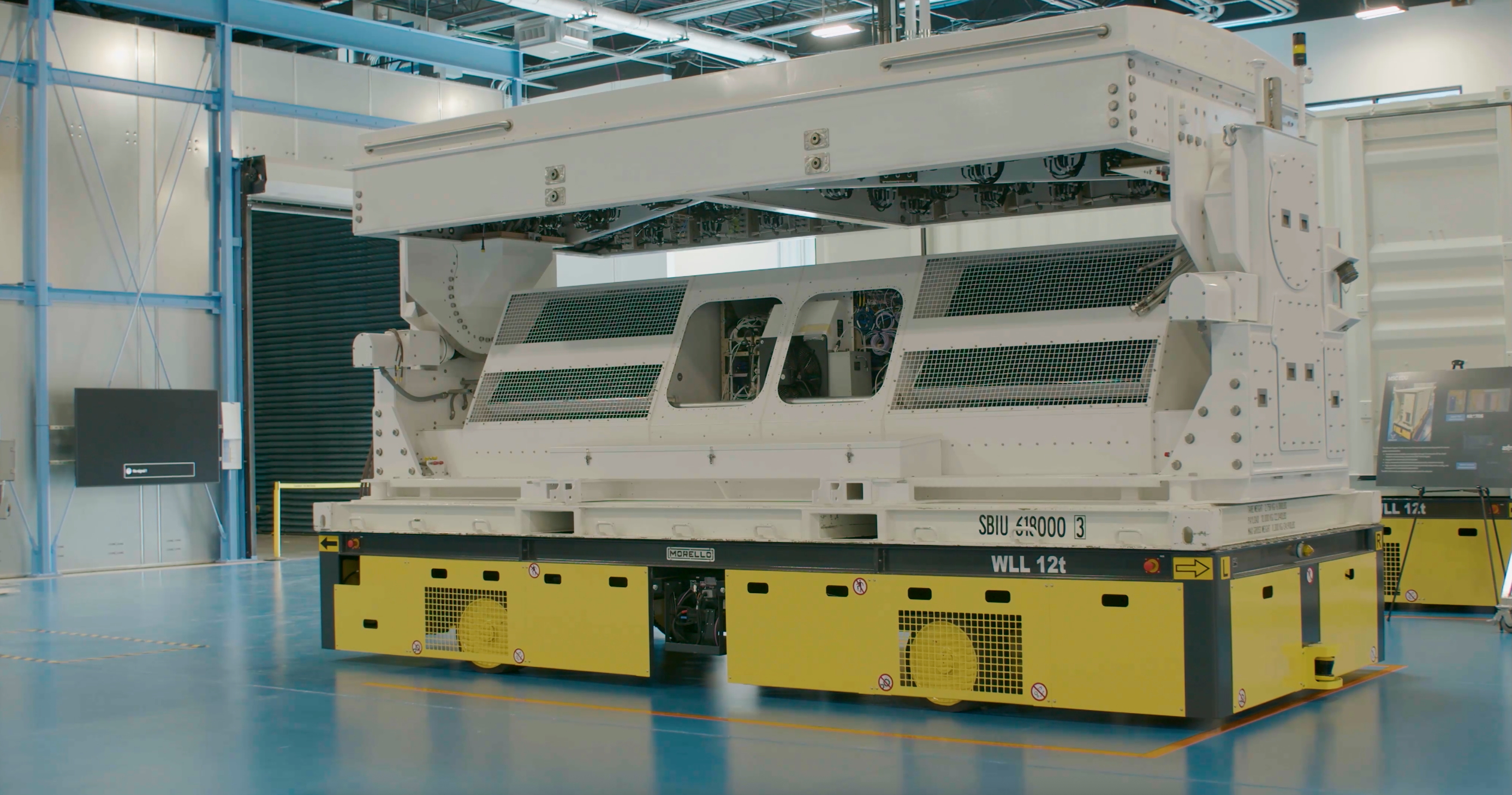

WASHINGTON — The U.S. Space Force has formally terminated an estimated $1.7 billion contract with defense technology firm AeroVironment to build a new generation of antennas used to command and control military satellites.
Company executives confirmed the decision during a March 10 earnings call, saying the government ended the agreement after unsuccessful renegotiations.
The contract covered the Satellite Communications Augmentation Resource program, known as SCAR, an effort to field mobile phased-array antennas to supplement the military’s aging Satellite Control Network. That network relies largely on fixed ground stations equipped with mechanically steered parabolic dishes to communicate with satellites in geosynchronous orbit.
The Space Force’s Rapid Capabilities Office in 2022 selected defense contractor BlueHalo to build an estimated 12 ground terminals called BADGER, short for Broad Area Deployable Ground Terminal Enabling Resilient communications. BlueHalo was acquired by AeroVironment in 2025.
The termination marks a turning point for the program as the Space Force rethinks how it wants to buy satellite control infrastructure.
Procurement reset
Space Force officials said the government decided to shift its acquisition strategy away from the existing single-vendor arrangement and toward an open competition built around commercially developed systems rather than a customized design.
“We could not come to a mutually acceptable agreement with our customer to modify the existing contract and resume work,” AeroVironment Chief Executive Wahid Nawabi said.
“Therefore, the U.S. Space Force has concluded to terminate our existing contract for convenience, pay us for our allowable incurred cost with a fee and enable AV to recompete for the program with their revised requirements and our proposed solution,” he said.
Under a termination for convenience, the government reimburses the contractor for allowable costs incurred and a profit fee.
The company said it still plans to pursue whatever new procurement the Space Force launches and intends to adapt the BADGER design into a commercially offered product.
Nawabi said he met with officials from the Space Rapid Capabilities Office earlier this week in Albuquerque, N.M., but the two sides were unable to reach terms.
“Unfortunately, we could not come to a mutually acceptable solution that allows us to have a win-win outcome moving forward by renegotiating and resuming the work,” he said.
Financial impact
The canceled contract prompted AeroVironment to lower its fiscal 2026 revenue outlook to about $1.9 billion, down from prior expectations of $1.975 billion.
The company ended the quarter with roughly $3 billion in unfunded backlog, including about $1.5 billion tied to the SCAR program.
Executives sought to minimize the long-term impact, pointing to strong demand for other products within the company’s Space and Directed Energy business.
“There are several other products and technologies within our Space & Directed Energy business that are in high demand,” Nawabi said, citing the company’s Laser Optical Counter-UAS System for Tactical Use, a mobile high-energy laser designed to detect, track and destroy small drones.
Analysts at William Blair said the contract termination overshadowed otherwise strong results.
“The SCAR termination overshadowed a stellar quarter from the core AeroVironment business, which grew 38% in the quarter,” the firm said in a research note, attributing the growth to demand for drones and related systems.
Betting on a commercial product
Despite the setback, AeroVironment executives said they intend to continue developing the BADGER technology and position it as a commercial offering that could be sold to multiple customers.
“The Space Force has directly told me that they’re actually going to invest more money in this area because we need it as a country,” Nawabi said.
He argued the company retains a technical advantage. “We believe we have at least a 3 to 3.5-year head start on all competitors,” he said.
Chief Financial Officer Kevin McDonnell said the company has already received inquiries from other potential customers.
A commercialized BADGER product, however, is unlikely to generate revenue before fiscal year 2028.
“One of the challenges is to get our customers to agree to a set of requirements that we lock down,” Nawabi said. Once requirements are finalized, the company expects about a year to convert the design into a producible system.
Roughly 80% of the BADGER antenna architecture already developed will carry over to the commercial version, he said. The remaining work will focus on simplifying manufacturing and reducing cost.
“What we’re trying to do is to reduce the parts count, simplify the design, shrink it to a smaller size, reduce complexity, make it more of a viable commercial product,” Nawabi said.
He framed the shift as a strategic opportunity despite the near-term financial hit.
“Obviously, we’re not happy that we’re taking a hit in the short term,” Nawabi said. “But it is a very good option for us long term.”










Related Posts


Stay Informed With the Latest & Most Important News
Previous Post
Next Post



Advertisement
-
 01Two Black Holes Observed Circling Each Other for the First Time
 -
 02From Polymerization-Enabled Folding and Assembly to Chemical Evolution: Key Processes for Emergence of Functional Polymers in the Origin of Life
 -
 03Astronomy 101: From the Sun and Moon to Wormholes and Warp Drive, Key Theories, Discoveries, and Facts about the Universe (The Adams 101 Series)
 -
 04True Anomaly hires former York Space executive as chief operating officer
 -
 05Φsat-2 begins science phase for AI Earth images
 -
 06Hurricane forecasters are losing 3 key satellites ahead of peak storm season − a meteorologist explains why it matters
 -
 07Binary star systems are complex astronomical objects − a new AI approach could pin down their properties quickly