
Now Reading: Hydrocarbon Complexity And Photochemical Shielding Of Prebiotic Feedstock Molecules In Exoplanet Atmospheres
-
01
Hydrocarbon Complexity And Photochemical Shielding Of Prebiotic Feedstock Molecules In Exoplanet Atmospheres

Hydrocarbon Complexity And Photochemical Shielding Of Prebiotic Feedstock Molecules In Exoplanet Atmospheres

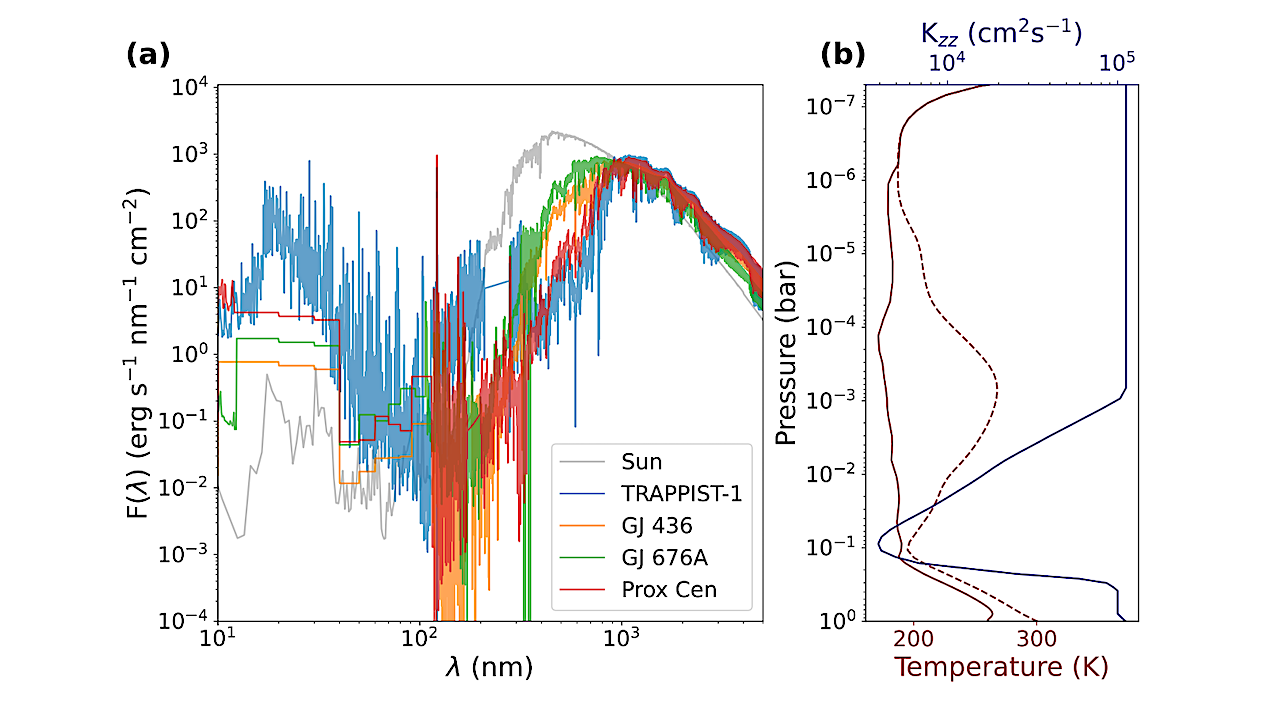

Background stellar and planetary environments: (a) the spectral radiant flux density as received by Proxima Centauri b and planets around different M-type stars receiving the same irradiance, compared to the Solar flux at 1 AU. Panel (b) shows vertical profiles of the temperature from Braam et al. (2022) (solid line) compared to Earth’s temperature profile (dashed line) and eddy diffusion (𝐾𝑧𝑧), following Tsai et al. (2021) and Massie & Hunten (1981). — astro-ph.EP
The potential of prebiotic chemistry to propagate on an exoplanet fundamentally depends on whether the atmospheric conditions can facilitate the production of prebiotic feedstock molecules.
Photochemical simulations of exoplanet atmospheres can be used to explore this potential atmospheric synthesis, but require a comprehensive chemical network. We present the implementation of the CRAHCN-O network, constructed to simulate the formation of feedstock molecules such as HCN, H2CO, and simple hydrocarbons, into the VULCAN photochemical kinetics code.
We investigate the production of feedstock molecules driven by M-star radiation and compare these to predictions by the N-C-H-O network in VULCAN, for N2-dominated atmospheres with C/O ratios between 0.5-1.5. Predicted abundances are similar for C/O=0.5. Once CH4 is included (i.e., for C/O>0.5), the abundance profiles diverge in the photochemical regions.
By analysing the attenuation of UV radiation, we find that hydrocarbon photochemical shielding causes the diverging profiles. CRAHCN-O accumulates C2H6, while N-C-H-O accumulates C4H3 and C3H4. Importantly, C2H6 is photochemically active whereas C4H3 and C3H4 are assumed inactive.
With mixing ratios up to a few percent in CRAHCN-O, C2H6 shields CH4 and CO2 from photodissociation and weakens the destruction of HCN and H2CO. Maximum HCN mixing ratios reach 1000 ppm with CRAHCN-O compared to only 3 ppm with N-C-H-O. Other feedstock molecules like HC3N and C2H2 form more efficiently in N-C-H-O. The shielding mechanism and its impact on feedstock molecules persist for radiation from distinct M-star types.
These results demonstrate the crucial role of chemical kinetics in understanding prebiotic processes in exoplanet atmospheres, including important considerations for the construction and applicability of chemical networks.
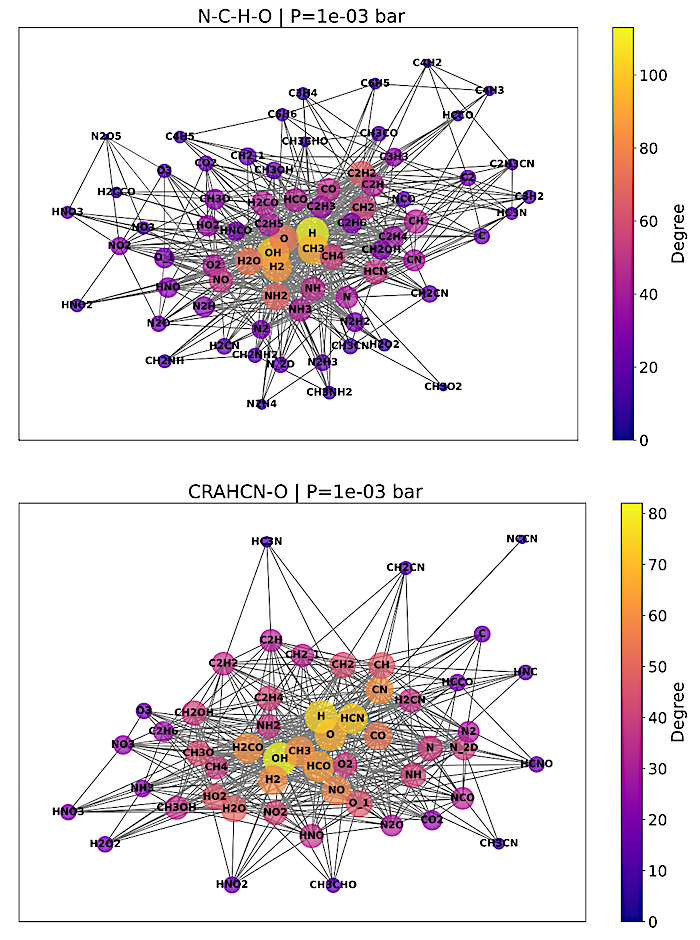
Graph networks comparing the chemical networks used in this study: N-C-H-O (top) and CRAHCN-O (bottom), for a reference pressure of 1 × 10⁻³ bar. Chemical species are represented as nodes, whereas reactions between species are shown as edges with their length corresponding to the inverse reaction rate. The clustering and position of species give a relative measure of their connectivity. The colour of the species relates to their degree, or the number of reaction connections to other species. The size of nodes represents the eigenvector centrality, which measures the importance of a species by taking into account the number of reactions it is involved with, the rates of these reactions, and the connections to reactive species. CRAHCN-O has an additional slow pathway from C2H4 to C2H3 , which was omitted from the plot for readability. — astro-ph.EP
Marrick Braam, Ellery Gopaoco, Shang-Min Tsai, Gergely Friss, Paul I. Palmer, Paul B. Rimmer, Skyla B. White
Comments: 36 pages, 20 figures, accepted for publication in Icarus Special issue entitled ‘Carbon in Planetary Environments: Sources and Evolution’
Subjects: Earth and Planetary Astrophysics (astro-ph.EP)
Cite as: arXiv:2603.08172 [astro-ph.EP] (or arXiv:2603.08172v1 [astro-ph.EP] for this version)
https://doi.org/10.48550/arXiv.2603.08172
Focus to learn more
Related DOI:
https://doi.org/10.1016/j.icarus.2026.117032
Focus to learn more
Submission history
From: Marrick Braam
[v1] Mon, 9 Mar 2026 09:52:42 UTC (1,289 KB)
https://arxiv.org/abs/2603.08172
Astrobiology, Astrochemistry,










Related Posts


Stay Informed With the Latest & Most Important News
Previous Post
Next Post


Advertisement
-
 01Two Black Holes Observed Circling Each Other for the First Time
 -
 02From Polymerization-Enabled Folding and Assembly to Chemical Evolution: Key Processes for Emergence of Functional Polymers in the Origin of Life
 -
 03Astronomy 101: From the Sun and Moon to Wormholes and Warp Drive, Key Theories, Discoveries, and Facts about the Universe (The Adams 101 Series)
 -
 04True Anomaly hires former York Space executive as chief operating officer
 -
 05Φsat-2 begins science phase for AI Earth images
 -
 06Hurricane forecasters are losing 3 key satellites ahead of peak storm season − a meteorologist explains why it matters
 -
 07Binary star systems are complex astronomical objects − a new AI approach could pin down their properties quickly