
Now Reading: Hera Spacecraft on Course for Historic Mission to Asteroid System Didymos
-
01
Hera Spacecraft on Course for Historic Mission to Asteroid System Didymos


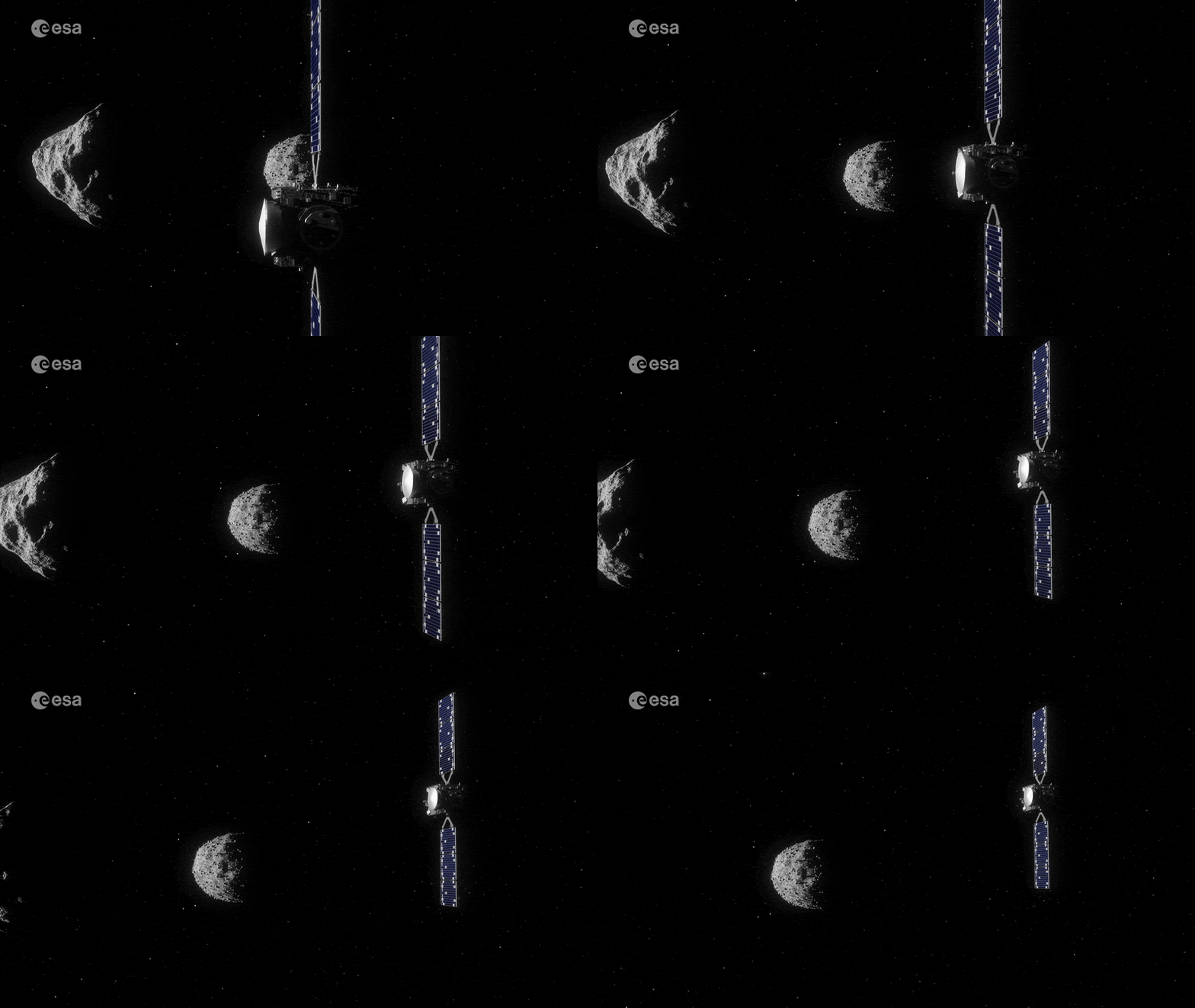
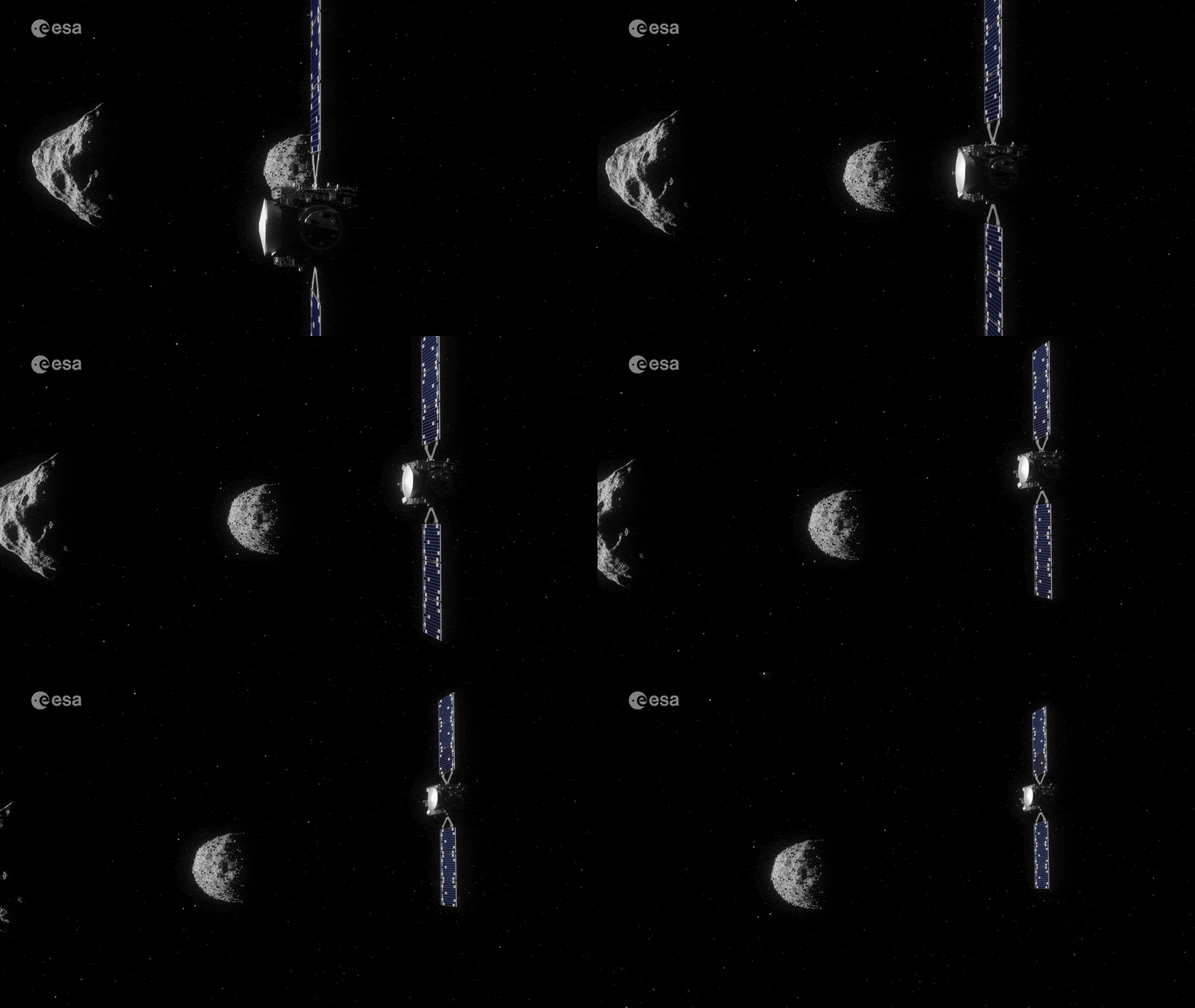
The European Space Agency (ESA) has announced that its Hera spacecraft has successfully executed a critical deep-space maneuver, putting it on a trajectory toward the Didymos binary asteroid system. This mission, which is poised to take place later this year, will help advance our understanding of asteroid deflection techniques following NASA’s recent DART mission, which impacted Didymos’ smaller moon, Dimorphos.
Hera’s journey marks a historic endeavor, as it aims to study asteroids that have had their orbits intentionally altered by human intervention. The spacecraft recently accomplished the second of two significant maneuvers designed to adjust its course. This particular maneuver expended 123 kilograms of hydrazine fuel and resulted in a velocity adjustment of 367 meters per second. To put this into perspective, that’s akin to accelerating from rest to supersonic speeds.
Francesco Castellini, a member of ESA’s Flight Dynamics team, highlighted the mission’s complexity, explaining that the deep-space maneuver was divided into three engine burns, alongside a minor correction, over a period of about four weeks. Castellini noted that this was the most fuel-intensive maneuver of the mission, employed to test key systems that will be essential when the spacecraft approaches Didymos later this year.
The successful alignment of Hera’s orbital path with that of the Didymos system was confirmed through tracking data from ESA’s Estrack network, with telemetry indicating that all spacecraft subsystems functioned as intended. With these initial operations complete, the Hera team is now focused on preparations for its upcoming arrival at the asteroid system.
To facilitate these operations, the team has designed extensive software updates aimed at enhancing the spacecraft’s capabilities for close-quarters exploration. These updates include new functions for Hera’s laser altimeter, which will continuously monitor its distance from the asteroids, as well as updates for the monitoring camera that will oversee the deployment of Hera’s two accompanying CubeSats.
Anna Schiavo from the Hera Flight Control Team emphasized the challenge of uploading software across such vast distances, noting that it resembles a video call with a significant lag and greatly reduced transmission speeds. The process to send the software is just the initial phase of the overall upgrade, expected to take around three hours.
Looking ahead, Hera is set to commence a series of precisely scheduled burns in October that will shift it from its interplanetary cruise phase to asteroid rendezvous. Unlike larger celestial bodies, Didymos and Dimorphos are relatively small and dim, necessitating an active search by Hera to locate and maintain focus on the asteroids during its approach. This phase is anticipated to last three weeks and will rigorously test the spacecraft’s guidance, navigation, and control systems. As the mission progresses, ESA aims to turn the concept of asteroid deflection from a theoretical exercise into a tangible reality.










Related Posts


Stay Informed With the Latest & Most Important News
Previous Post
Next Post

Advertisement
-
 01Two Black Holes Observed Circling Each Other for the First Time
 -
 02From Polymerization-Enabled Folding and Assembly to Chemical Evolution: Key Processes for Emergence of Functional Polymers in the Origin of Life
 -
 03Astronomy 101: From the Sun and Moon to Wormholes and Warp Drive, Key Theories, Discoveries, and Facts about the Universe (The Adams 101 Series)
 -
 04True Anomaly hires former York Space executive as chief operating officer
 -
 05Φsat-2 begins science phase for AI Earth images
 -
 06Hurricane forecasters are losing 3 key satellites ahead of peak storm season − a meteorologist explains why it matters
 -
 07Binary star systems are complex astronomical objects − a new AI approach could pin down their properties quickly