
Now Reading: Wind Accretion Onto Planets Orbiting An Evolving Solar-like Star And Their Detectability
-
01
Wind Accretion Onto Planets Orbiting An Evolving Solar-like Star And Their Detectability

Wind Accretion Onto Planets Orbiting An Evolving Solar-like Star And Their Detectability

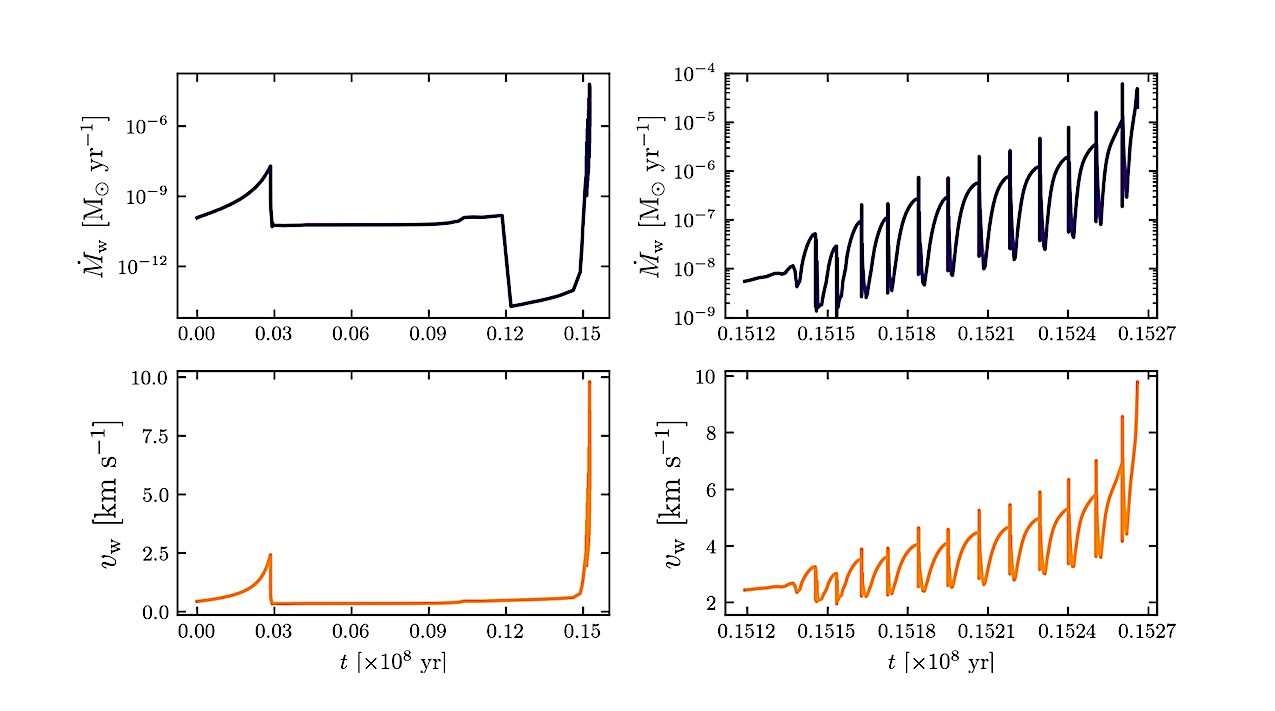
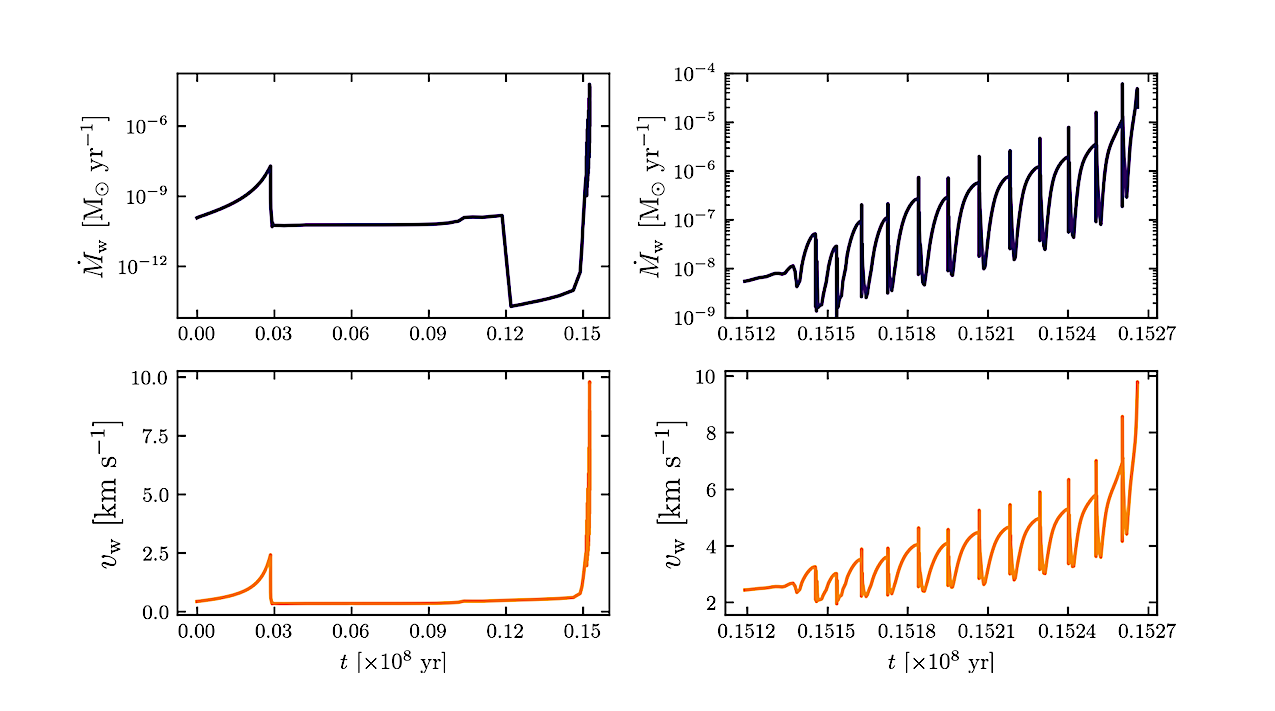
Evolution of the stellar mass-loss rate (𝑀̇ w) and wind velocity (𝑣w) obtained from our 2 M⊙ stellar model. The left panels show the complete evolution of 𝑀̇w and 𝑣w through the RGB to the TPAGB phases, while the right panels focus specifically on the TPAGB evolutionary phase. — astro-ph.EP
As stars evolve, they undergo significant changes in their physical properties, which can have a profound impact on the planets orbiting them.
In particular, the mass lost through stellar wind may be partially accreted by orbiting planets. We present the results of 18 simulations of one-planet systems with planetary masses of 0.5, 1, 2.5, 5, 10, and 13~MJ, each at initial orbital distances of 5, 10, and 20~AU, orbiting a 2~M⊙ star through its red giant branch and thermally pulsating asymptotic giant branch phases.
Our results show that planets with smaller orbits and higher masses accrete more stellar wind material than their wider-orbit and lower-mass counterparts, although the total mass accreted across all simulations remains small compared to their initial planetary mass.
Even for the most massive planet, 13 MJ at 5 AU, the total mass accreted was ∼0.56% of the planet’s initial mass; nevertheless, we find that the accretion luminosities of the simulated planets, with the exception of one planet, exceed their expected equilibrium luminosities, suggesting that such emission could be potentially detected.
This result is key for the detection of planets around AGB stars, which have no confirmed detections as of yet. We also estimated the accretion and luminosities of two detected two-planet systems over a few orbits, obtaining results consistent with the one-planet simulated systems.
Additional tests without wind accretion and with stellar wind drag force showed that, while both have a negligible effect on the orbital evolution, wind accretion remains relevant for the planetary luminosity.
P. Padilla-López, R. F. Maldonado, J. A. Toalá, E. Tejeda, J. B. Rodríquez-González
Comments: 14 pages, 13 figures, accepted in RMxAA for publication
Subjects: Earth and Planetary Astrophysics (astro-ph.EP); Solar and Stellar Astrophysics (astro-ph.SR)
Cite as: arXiv:2603.18525 [astro-ph.EP] (or arXiv:2603.18525v1 [astro-ph.EP] for this version)
https://doi.org/10.48550/arXiv.2603.18525
Focus to learn more
Submission history
From: Paulina Padilla López
[v1] Thu, 19 Mar 2026 06:14:40 UTC (5,636 KB)
https://arxiv.org/abs/2603.18525
Astrobiology, exoplanet,










Related Posts
Stay Informed With the Latest & Most Important News
Previous Post
Next Post

Advertisement
-
 01Two Black Holes Observed Circling Each Other for the First Time
 -
 02From Polymerization-Enabled Folding and Assembly to Chemical Evolution: Key Processes for Emergence of Functional Polymers in the Origin of Life
 -
 03Astronomy 101: From the Sun and Moon to Wormholes and Warp Drive, Key Theories, Discoveries, and Facts about the Universe (The Adams 101 Series)
 -
 04True Anomaly hires former York Space executive as chief operating officer
 -
 05Φsat-2 begins science phase for AI Earth images
 -
 06Hurricane forecasters are losing 3 key satellites ahead of peak storm season − a meteorologist explains why it matters
 -
 07Binary star systems are complex astronomical objects − a new AI approach could pin down their properties quickly