
Now Reading: Smile fuelled for launch
-
01
Smile fuelled for launch


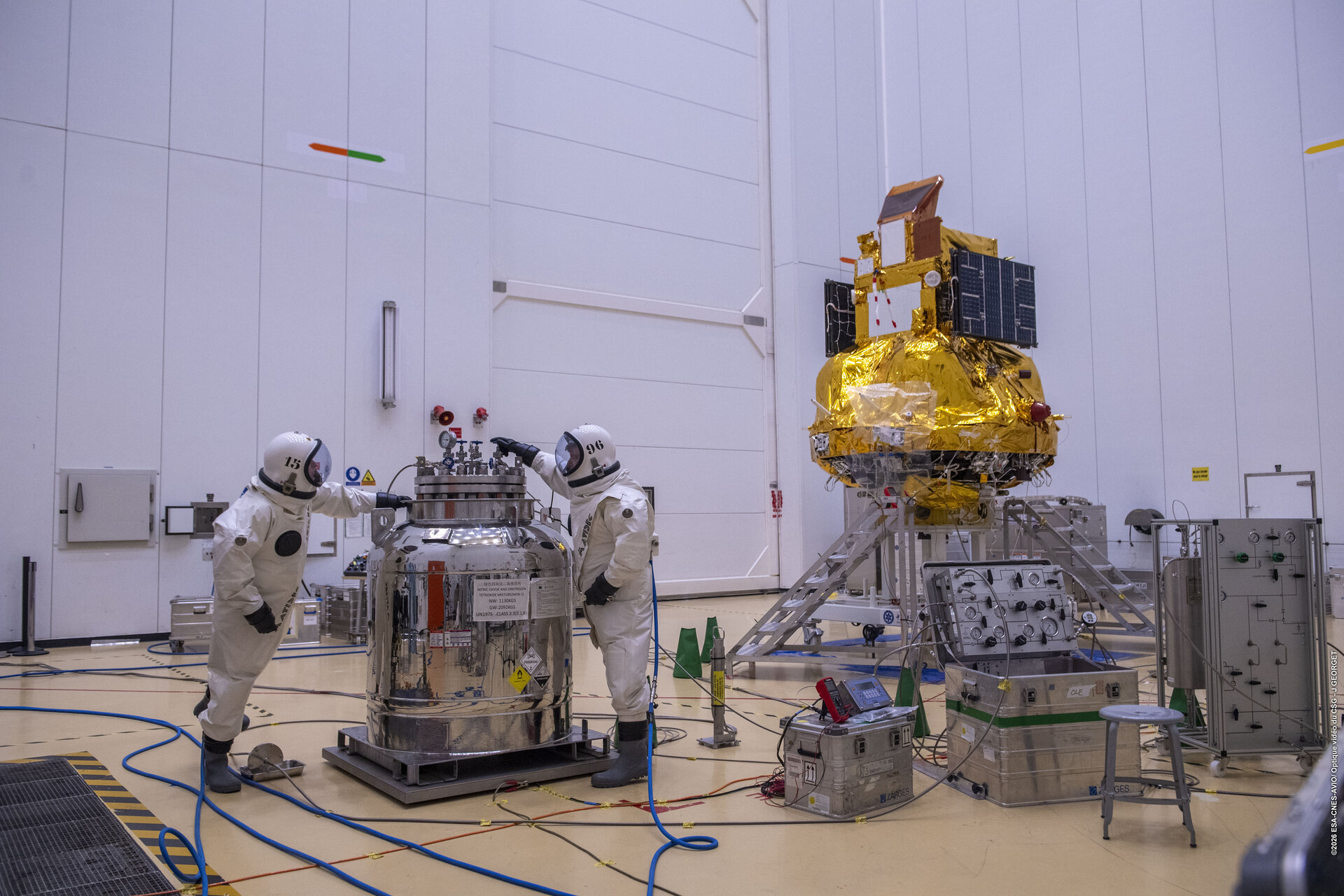

On 20 March, specialists filled the European-Chinese Smile mission with fuel ahead of its launch on a Vega-C rocket on 9 April.
Smile has four fuel tanks, making the bulbous shape underneath the solar panels. Each tank carries 380 litres of hydrazine fuel and oxidiser, which will feed an engine that can deliver 490 Newtons of thrust. The total weight of the spacecraft is 2300 kg, 1580 kg of which is fuel.
Smile will use 90% of this fuel during its first month in space. After the Vega-C rocket drops it off in a circular orbit 700 km above Earth’s surface, Smile will fire its engines 11 times in 25 days.
These engine burns will gradually elongate Smile’s orbit. Ultimately it will reach 121 000 km above the North Pole to collect information on how Earth’s magnetic field is reacting to the stream of charged particles from the Sun, before coming down to 5000 km above the South Pole to deliver this valuable data to a waiting ground station. Each orbit will take around two days.
Once Smile has reached this final orbit, it will have enough fuel remaining to maintain the orbit for a couple more years. During this time, it will collect enough data to complete its ambitious scientific goals.
Fuelling any satellite is a particularly delicate operation requiring careful setup of the equipment and connections, fuelling, and then pressurisation.
The astronaut-like suits worn by the two people seen in this image are called Self-Contained Atmospheric Protective Ensemble, or ‘SCAPE’ suits. Though hydrazine is common in spacecraft thanks to its stability, high performance and reliability, it is extremely explosive and toxic. Only a few specialists remained in the dedicated hall for fuelling and they must wear SCAPE suits at all times to avoid possible damage to their brains, blood, lungs or skin.
For the latest updates on Smile’s preparations for launch, visit our dedicated webpage.
Smile (the Solar wind Magnetosphere Ionosphere Link Explorer) is a joint mission between the European Space Agency and the Chinese Academy of Sciences. Using four instruments, it will study how Earth responds to the solar wind from the Sun. This will improve our understanding of solar storms, geomagnetic storms and the science of space weather.
[Image description: Inside a large, clean laboratory with white walls, two people wearing full white protective suits are working on a spacecraft. The spacecraft is mounted on a metal support frame and wrapped in shiny gold thermal foil, with dark rectangular solar panels on its sides. Cables, tools, and test equipment are spread across the floor around them. The scene suggests careful technical work on a satellite in a controlled clean-room environment.]










Related Posts


Stay Informed With the Latest & Most Important News
Previous Post
Next Post
Previous Post

Next Post




Advertisement
-
 01Two Black Holes Observed Circling Each Other for the First Time
 -
 02From Polymerization-Enabled Folding and Assembly to Chemical Evolution: Key Processes for Emergence of Functional Polymers in the Origin of Life
 -
 03Astronomy 101: From the Sun and Moon to Wormholes and Warp Drive, Key Theories, Discoveries, and Facts about the Universe (The Adams 101 Series)
 -
 04True Anomaly hires former York Space executive as chief operating officer
 -
 05Φsat-2 begins science phase for AI Earth images
 -
 06Hurricane forecasters are losing 3 key satellites ahead of peak storm season − a meteorologist explains why it matters
 -
 07Binary star systems are complex astronomical objects − a new AI approach could pin down their properties quickly