
Now Reading: Geopolitical shifts bring opportunities and headaches for satellite execs
-
01
Geopolitical shifts bring opportunities and headaches for satellite execs


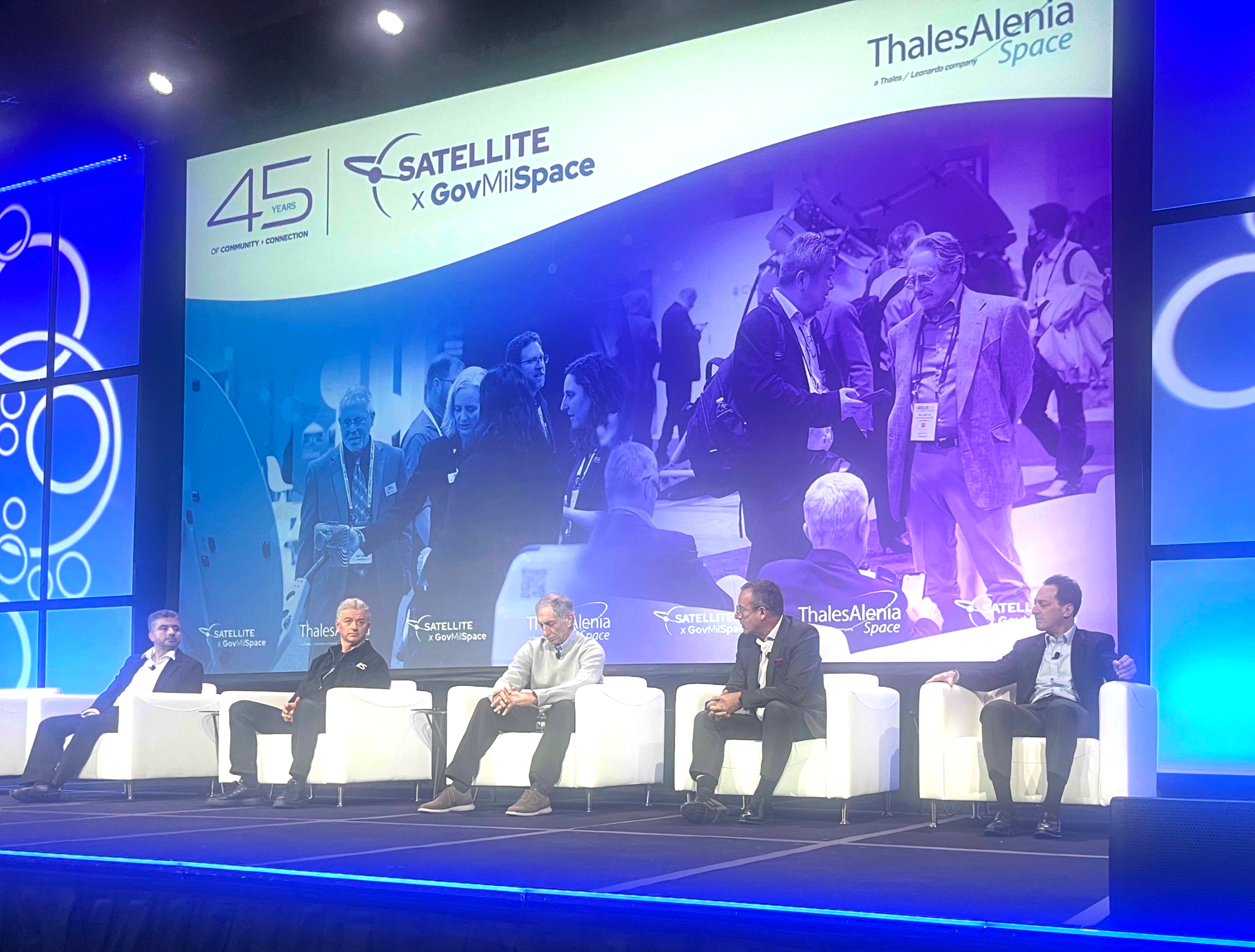

TAMPA, Fla. — A shifting geopolitical landscape is driving huge business opportunities for satcoms but also bringing new supply chain and regulatory challenges, industry executives said March 24 at the Satellite Conference in Washington, D.C.
“I’m very worried about the bifurcation of the U.S. from Western Europe,” said Adel Al-Saleh, CEO of SES, a Luxembourg-based multi-orbit operator with significant operations across both sides of the Atlantic.
The space industry is inherently global, he continued, “so for us to be able to navigate regulatory environments that are different significantly between U.S., Europe, Asia, Africa, Latin America is a big challenge.”
As countries increasingly prioritize national security and sovereignty, satellite operators are being forced to rethink a historical push toward globalized supply chains in favor of less efficient, more regionally aligned models.
“We are building supply chains that actually give us presence in North America and give us a different supply chain for European capabilities,” Al-Saleh added.
Earlier in the day, SES announced it had ordered an initial 28 satellite buses from California-based startup K2 Space for its next-generation medium Earth orbit network, using payloads developed in-house in Luxembourg.
Meanwhile, the pace of innovation is accelerating among legacy players as they adapt to competition from Starlink, SpaceX’s low Earth orbit (LEO) broadband network, and other newcomers.
“We can’t have a cycle anymore of five-year, seven-year development cycles,” Al-Saleh said, and “whatever you design has to be flexible in a way that you’re able to upgrade it as you go forward.”
Geopolitical tailwinds
That pressure to adapt is matched by a surge in demand tied directly to geopolitical tensions as space becomes an increasingly strategic domain.
“The geopolitical developments that we’re seeing out there are creating, far and away, some of the biggest commercial opportunities for Teleset — and I would say for the rest of us,” said Dan Goldberg, CEO of the Canadian operator.
Goldberg pointed to increased defense spending by NATO countries and to Russia’s war in Ukraine, where Starlink has shown how consequential LEO communications have become in modern conflicts.
Telesat recently announced plans to devote a quarter of its proposed Lightspeed LEO broadband constellation to military Ka-band capacity to address growing demand from allied defense customers.
Dual-use dangers
However, the growing role of satellites in national security is also exposing commercial operators to new risks.
Mark Dankberg, CEO of U.S.-based Viasat, said the lines between military and commercial systems are increasingly blurred as both operate in the same contested environment.
A cyberattack disrupted Viasat’s KA-SAT network at the outset of Russia’s invasion of Ukraine in 2022. Earlier this month, a missile strike damaged part of an SES teleport facility in Israel.
Despite these risks, Dankberg echoed the sentiment that the rapid pace of change is expanding avenues for growth in the industry.
“You can look at it and say, hey, there’s more change than there’s ever been,” he said, while “it also means there’s more opportunity than there’s ever been.”
New approaches to gaining scale
The growing need for sovereignty is also complicating traditional consolidation strategies in the industry as countries seek greater control over critical communications infrastructure.
“Sovereignty is really about control, certainty, trust,” Dankberg said, and “consolidation is sort of the opposite of that. It’s outsourcing. It’s depending on third parties.”
Against this backdrop, he said partnerships and shared infrastructure may offer the best path forward for operators looking to gain scale.
Viasat last year formed an infrastructure-sharing joint venture with Emirati satellite operator Space42 to pursue the emerging market for direct-to-device (D2D) services, offering regional players a way to retain sovereignty while pooling resources to compete more effectively at scale.
But while SES chose to partner with K2 for its rapid, more flexible approach to constellation development, Al-Saleh said consolidation remains an important tool for companies seeking to compete with Starlink and other well-funded players.
“I think there will be many different forms of consolidation,” he said, pointing to both mergers and deeper industry collaboration.










Related Posts

Stay Informed With the Latest & Most Important News
Previous Post
Next Post




Advertisement
-
 01Two Black Holes Observed Circling Each Other for the First Time
 -
 02From Polymerization-Enabled Folding and Assembly to Chemical Evolution: Key Processes for Emergence of Functional Polymers in the Origin of Life
 -
 03Astronomy 101: From the Sun and Moon to Wormholes and Warp Drive, Key Theories, Discoveries, and Facts about the Universe (The Adams 101 Series)
 -
 04True Anomaly hires former York Space executive as chief operating officer
 -
 05Φsat-2 begins science phase for AI Earth images
 -
 06Hurricane forecasters are losing 3 key satellites ahead of peak storm season − a meteorologist explains why it matters
 -
 07Binary star systems are complex astronomical objects − a new AI approach could pin down their properties quickly