
Now Reading: Breakthrough Discovery Solves 50-Year Mystery of High-Energy Emissions from Gamma-Cas Star
-
01
Breakthrough Discovery Solves 50-Year Mystery of High-Energy Emissions from Gamma-Cas Star

Breakthrough Discovery Solves 50-Year Mystery of High-Energy Emissions from Gamma-Cas Star

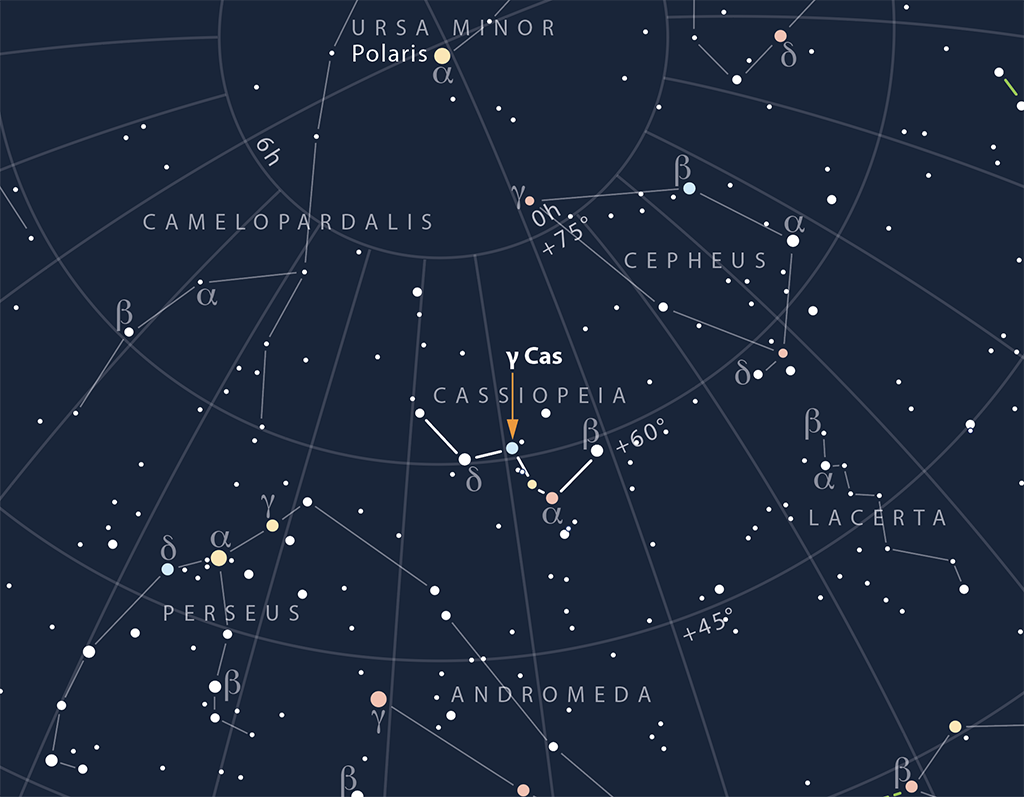
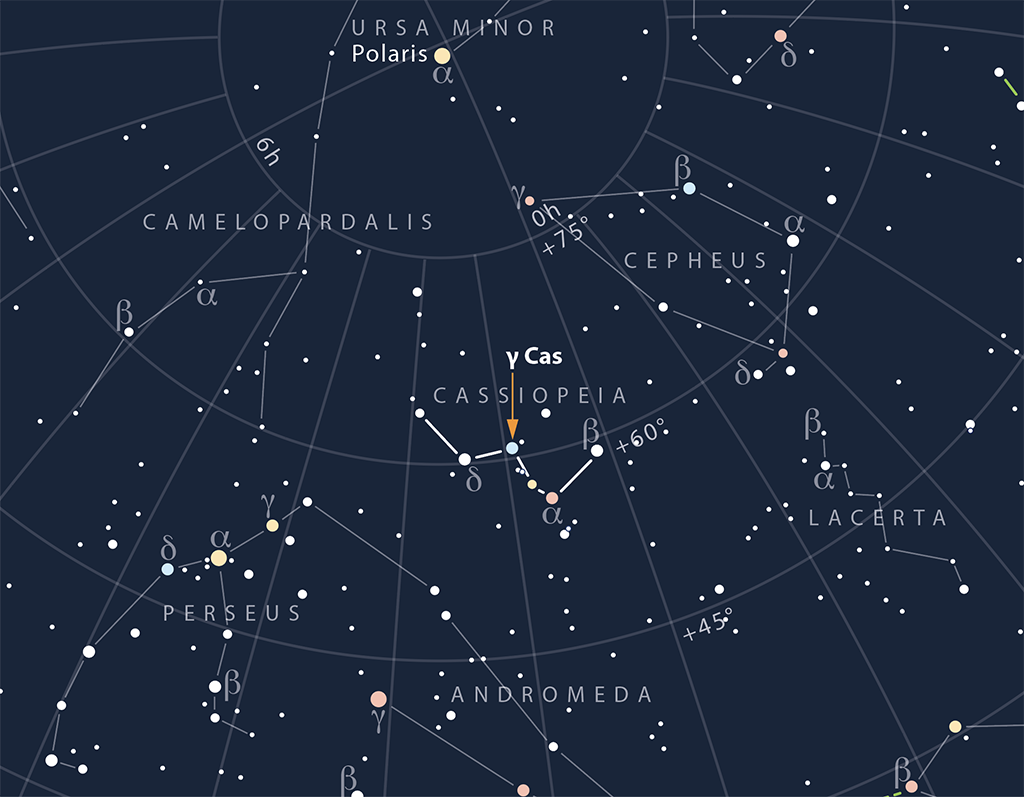
The enigmatic high-energy X-ray emissions from gamma-Cas, the notable star at the center of the Cassiopeia constellation, have been traced back to matter cascading onto a concealed white dwarf companion, effectively settling a longstanding astronomical enigma that spanned five decades. Observations of gamma-Cas, which has intrigued scientists since its unusual X-ray emissions were first detected in the 1970s, have long been the subject of debate. Researchers proposed two primary hypotheses: one suggested that the emissions were a result of magnetic interactions between gamma-Cas and surrounding gas, while the other posited that X-rays were produced due to material from this gas disc falling onto an unseen partner star.
Now, advanced findings from the X-Ray Imaging and Spectroscopy Mission (XRISM), a project developed by the Japan Aerospace Exploration Agency (JAXA) in partnership with the European Space Agency (ESA) and NASA, have provided clarity. Through the use of XRISM’s state-of-the-art Resolve spectrometer, astronomers achieved unprecedented clarity in observing the dynamics of hot gas emitting X-rays. The results indicated that the gas follows the gravitational pull of gamma-Cas’s hidden companion, confirming that a white dwarf star is the source of the X-ray emissions, rather than magnetic interactions within gamma-Cas itself.
Yaël Nazé from the University of Liège in Belgium, who spearheaded the research, expressed satisfaction in finally solving the mystery that has captivated astronomers for years. She noted that the new findings not only address questions surrounding gamma-Cas but also enhance the understanding of a rare class of stars exhibiting similar behavior. Approximately two dozen such gamma-Cas-like stars have been cataloged through the efforts of various X-ray space telescopes, including ESA’s XMM-Newton and NASA’s Chandra.
Nazé acknowledged the critical role of earlier research conducted with XMM-Newton in paving the way for XRISM’s discoveries. “The previous work really cleared the way for XRISM, enabling us to eliminate a high number of theories and validate the correct hypothesis,” she remarked. With the mysteries of gamma-Cas elucidated, researchers can refine models related to binary star interactions, especially among high-mass stars, which have proven to be more complex than initially anticipated.
This breakthrough in understanding the dynamics of gamma-Cas underscores a shift in the scientific community’s perception of stellar evolution, particularly binary systems. The results, which were published recently in the journal Astronomy & Astrophysics, usher in a new chapter in the study of these fascinating celestial phenomena.










Related Posts


Stay Informed With the Latest & Most Important News
Previous Post
Next Post




Advertisement
-
 01Two Black Holes Observed Circling Each Other for the First Time
 -
 02From Polymerization-Enabled Folding and Assembly to Chemical Evolution: Key Processes for Emergence of Functional Polymers in the Origin of Life
 -
 03Astronomy 101: From the Sun and Moon to Wormholes and Warp Drive, Key Theories, Discoveries, and Facts about the Universe (The Adams 101 Series)
 -
 04True Anomaly hires former York Space executive as chief operating officer
 -
 05Φsat-2 begins science phase for AI Earth images
 -
 06Hurricane forecasters are losing 3 key satellites ahead of peak storm season − a meteorologist explains why it matters
 -
 07Binary star systems are complex astronomical objects − a new AI approach could pin down their properties quickly