
Now Reading: X-ray And γ-ray Beam Interstellar Communication And Implications For SETI
-
01
X-ray And γ-ray Beam Interstellar Communication And Implications For SETI


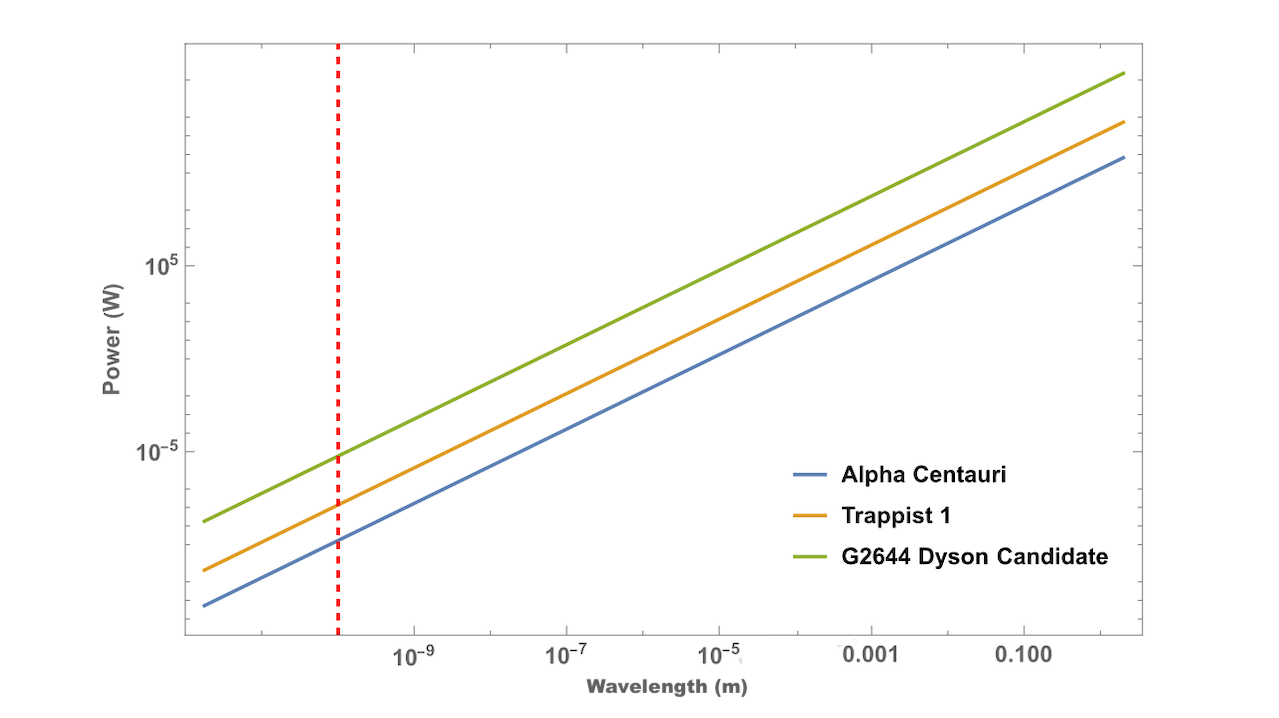
Transmitted power vs wavelength to various star systems of potential interest. The red dashed line shows the current wavelength limit of reflective optics. — Nature
The possibility of detecting artificial signals transmitted by alien civilizations via collimated X-ray or gamma-ray beams is investigated.
The prospect of using such beams for human communication within the solar system and beyond is also discussed. Detector responses were simulated for input signals and analyzed using relative entropy.
For simplicity, all signals were assumed to use on-off keying (OOK) modulation. “Real” signals were generated by taking digital files and sequentially feeding their raw binary data to the detector simulator, the resulting normalized information content of the detector signals was plotted and compared to random noise signals.
Since jpeg files contain compressed information, these served as a proxy for artificial alien signals. This showed that there is a clear difference in measured information content between natural and artificial signals, even with relatively poor time resolution in the detector causing the signals to be smeared (dead-time/rise-time intervals many times longer than the duration between signal pulses).
It was found that so long as the signal lasts for at least several rise-time/dead-time intervals, the distinction between random and artificial signals is obvious. A space-telescope with high time resolution for searching for such signals is briefly described and its basic requirements are outlined.
X-ray and γ-ray beam interstellar communication and implications for SETI, Nature
Astrobiology, Astronomy, SETI,











Related Posts
Stay Informed With the Latest & Most Important News

Advertisement
-
 01Two Black Holes Observed Circling Each Other for the First Time
 -
 02From Polymerization-Enabled Folding and Assembly to Chemical Evolution: Key Processes for Emergence of Functional Polymers in the Origin of Life
 -
 03Astronomy 101: From the Sun and Moon to Wormholes and Warp Drive, Key Theories, Discoveries, and Facts about the Universe (The Adams 101 Series)
 -
 04True Anomaly hires former York Space executive as chief operating officer
 -
 05Φsat-2 begins science phase for AI Earth images
 -
 06Hurricane forecasters are losing 3 key satellites ahead of peak storm season − a meteorologist explains why it matters
 -
 07Binary star systems are complex astronomical objects − a new AI approach could pin down their properties quickly