
Now Reading: Did decaying dark matter help create the universe’s first supermassive black holes?
-
01
Did decaying dark matter help create the universe’s first supermassive black holes?


New research suggests that supermassive black holes that existed before the cosmos was 1 billion years old may have formed with a helping hand from dark matter, the universe’s most mysterious stuff.
Ever since the James Webb Space Telescope (JWST) first began reporting data back to Earth in the summer of 2022, it has been delivering a curious problem into the laps of scientists, finding supermassive black holes as early as 500 million years after the Big Bang. That is, however, an issue because the merger and feeding processes that allow black holes to reach masses of millions of billions of times that of the sun should take at least 1 billion years to reach fruition.
One suggested mechanism for the early growth of black holes is the direct collapse of vast clouds of gas and dust to immediately form a seed black hole without the time it takes for a massive star to be born, live its life, and then die.
However, that process would still require stars shining on these clouds of matter, providing them with energy — but that’s rare. Too rare to explain the abundance of early supermassive black holes seen by JWST. That is, unless there is another energy source to help this process along.
“Our study suggests that decaying dark matter could profoundly reshape the evolution of the first stars and galaxies, with widespread effects across the universe,” team leader Yash Aggarwal of the University of California, Riverside, said in a statement. “With the JWST now revealing more supermassive black holes in the early universe, this mechanism may help bridge the gap between theory and observation.”
Does dark matter decay?
Dark matter is the mysterious substance that makes up 85% of the matter in the cosmos. It remains so curious because it doesn’t interact with light (more accurately, electromagnetic radiation). Not only does this make it effectively invisible, but it also tells scientists that dark matter can’t be made up of electrons, neutrons and protons, the particles that compose the atoms that make up stars, planets, moons, our bodies and everything we see around us.
This has spurred the search for particles beyond the Standard Model of particle physics. These hypothetical particles have a range of masses and possible properties. This includes some that pass through each other like ghosts, some that interact with each other, exchanging energy, and others that decay into smaller particles, releasing a tiny bit of energy in the process.
Aggarwal and UCR colleague Flip Tanedo think that it would only take energy equivalent to a billion trillionth of the energy of a single AA battery to “supercharge” primordial gas clouds, with the decay of dark matter capable of providing this.
“The first galaxies are essentially balls of pristine hydrogen gas whose chemistry is incredibly sensitive to atomic-scale energy injection,” said Tanedo. “These are the properties that we want for a dark matter detector — the signature of these ‘detectors’ might be the supermassive black holes that we see today.”
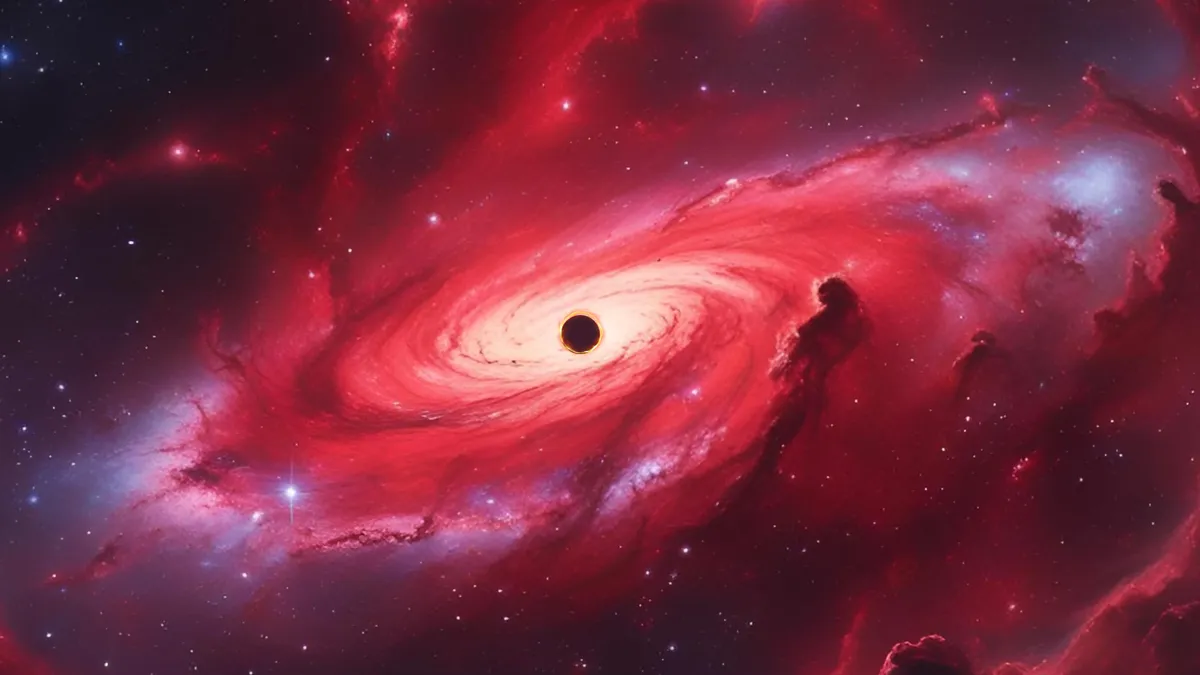
The team’s work also allowed them to pin down a hypothetical mass range of between 24 and 27 electronvolts for dark matter particles capable of sparking the creation of direct collapse black holes that could give supermassive black hole growth a head start. The team’s conclusion stems from a series of very happy coincidences that help them gather the right mix of particle physicists, cosmologists and astrophysicists to formulate a theory of cosmic coincidence.
“We showed that the right dark matter environment can help make the ‘coincidence’ of direct collapse black holes much more likely,” Tanedo said. “In the same way, the support for interdisciplinary work helped make the ‘coincidence’ leading to this work possible.”
The team’s research was published on Tuesday (April 14) in the Journal of Cosmology and Astroparticle Physics.










Related Posts
Stay Informed With the Latest & Most Important News
Previous Post
Next Post
Previous Post
Next Post



Advertisement
-
 01Two Black Holes Observed Circling Each Other for the First Time
 -
 02From Polymerization-Enabled Folding and Assembly to Chemical Evolution: Key Processes for Emergence of Functional Polymers in the Origin of Life
 -
 03Astronomy 101: From the Sun and Moon to Wormholes and Warp Drive, Key Theories, Discoveries, and Facts about the Universe (The Adams 101 Series)
 -
 04True Anomaly hires former York Space executive as chief operating officer
 -
 05Φsat-2 begins science phase for AI Earth images
 -
 06Hurricane forecasters are losing 3 key satellites ahead of peak storm season − a meteorologist explains why it matters
 -
 07Binary star systems are complex astronomical objects − a new AI approach could pin down their properties quickly