
Now Reading: NASA’s Artemis 2 commander and astrophotographer team up to capture breathtaking, never-before-seen shots of the moon’s far side
-
01
NASA’s Artemis 2 commander and astrophotographer team up to capture breathtaking, never-before-seen shots of the moon’s far side

NASA’s Artemis 2 commander and astrophotographer team up to capture breathtaking, never-before-seen shots of the moon’s far side

Just weeks before the first Artemis 2 launch window, astrophotographer Andrew McCarthy had a last-minute idea: What if he could get the Artemis 2 astronauts to shoot the moon the same way he shoots the moon?
So McCarthy slid into the DMs (direct messages) of Artemis 2 commander and NASA astronaut Reid Wiseman. He knew getting a response at such a late date was a long shot, but he couldn’t pass up the chance for a once-in-a-lifetime collaboration. And the long shot came through.
NASA’s Artemis 2 mission launched on April 1, flying four astronauts on a 10-day journey around the far side of the moon that captivated people across the world. The astronauts snapped breathtaking photos of the moon, which showed beautifully haunting views of the lunar far side that Artemis 2 crew member Christina Koch of NASA described as “the most ominous thing I’ve ever loved.”
On Earth, McCarthy combines hundreds to thousands of photos of the moon to bring out details you can’t see in a single image. The results are colorful landscapes that look more like paintings than the gray orb we’re used to seeing hang in the night sky, but the diversity he presents in his images come down to lunar spectroscopy rather than artistic interpretation.
“It’s very true life in a sense that everything you’re seeing is real features on the surface that your eyes just simply don’t have the color sensitivity to make out on their own,” McCarthy said. He explained that his approach to astrophotography is all about showing you the things your eyes can’t see.
“I don’t want to show you something the way your eyes see it. I want to show you something as if you had superhuman vision … I want to show you the moon as if you had cyborg eyes, because your cyborg eyes can actually pick out the color differences,” McCarthy said. “The camera becomes cyborg eyes for our vision.”
“The color is naturally there, just much more subtle to your eyes,” he added. Some color differences on the moon are possible to see with your eyes, using binoculars or a telescope, and there are ways to trick your eyes into noticing more of the contrast than you realize.
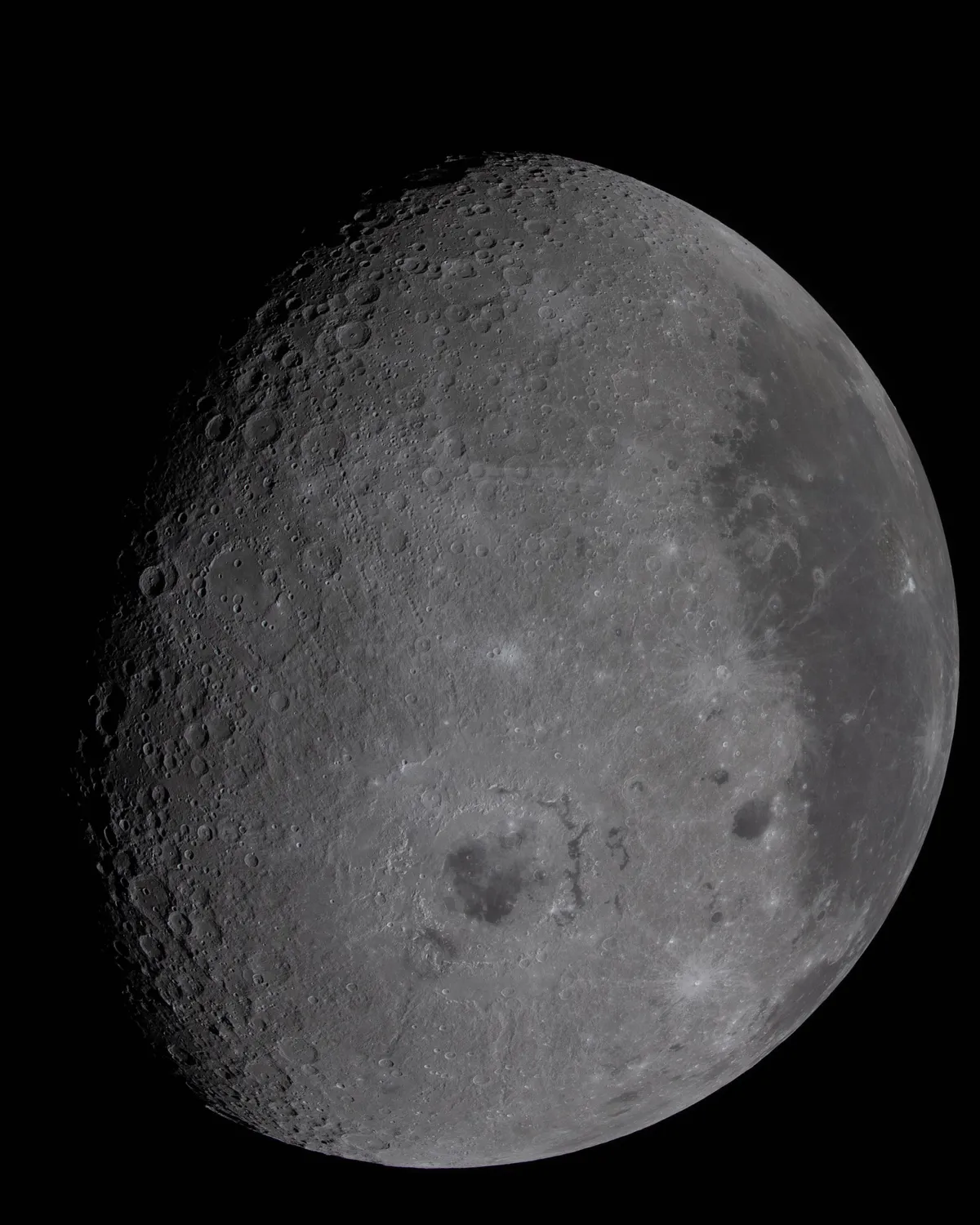
“If you take a normal photo of the moon with a DSLR and just completely desaturate it, you can tell the difference,” McCarthy explained. “When you return it to regular saturation, it suddenly seems a little more colorful.”
For his collaboration with Wiseman, McCarthy wanted to see if he could get the same colorful results with a camera from the lunar far side.
“Usually you can’t get very high-fidelity color data from the far side of the moon,” McCarthy said. “We’ve got LRO [NASA’s Lunar Reconnaissance Orbiter], which has some color data, but … it’s too low fidelity to do the kind of saturation pumps that show the really granular geological differences in the regolith.”
McCarthy outlined a plan with Wiseman and NASA’s lunar photography team, which was responsible for teaching the Artemis 2 crew how to use the cameras they brought aboard the Orion capsule during their mission. “They worked it in where he would shoot bursts in different exposures and different times, depending on where they were during the flyby,” McCarthy explained.
Stacking is the key to McCarthy’s lunar imagery, enabling him to turn the subtle variations of color in an image of the moon into the rich browns and blues seen in his edits. The technique isn’t a new one in the astrophotography world, but no one had ever tried it before using photos from the far side of the moon.
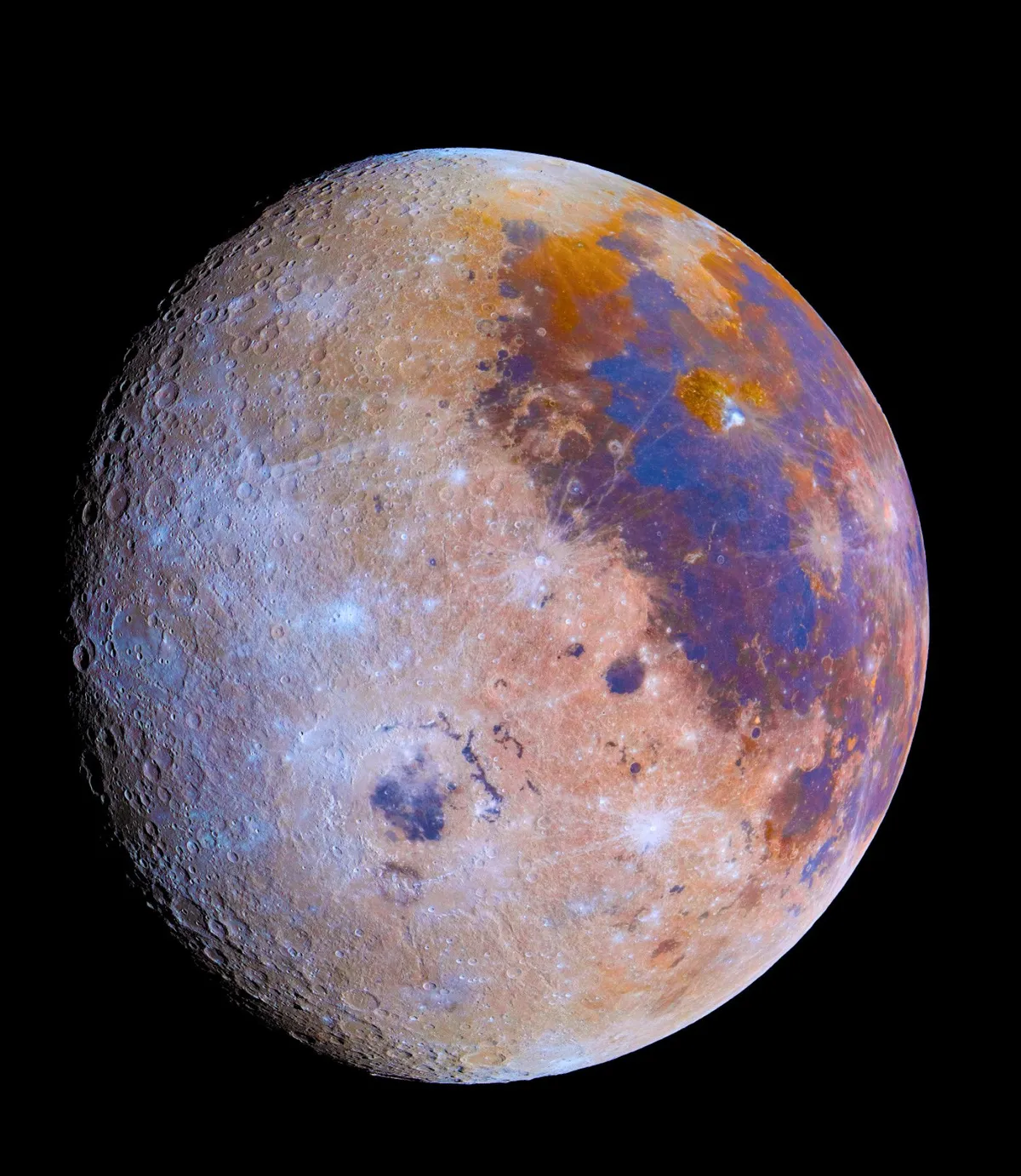
The colors themselves indicate the diverse distribution of different minerals across the moon’s surface and reveal key information about chemical composition of the soil and rocks. Titanium-rich basalts, for example, take on a bluish hue, while iron-rich or older, weathered material can appear in shades of brown and red.
“You can do it with a single photo, but it’s really, really low resolution from a noise standpoint,” McCarthy said. “What’s different about those different photos is the noise, because noise, by definition, is random. So, when I’m stacking those photos together, I’m able to average out that noise, and then that noise vanishes … That’s why you hear astrophotographers talk about the signal-to-noise ratio, because when you stack, the signal stays the same, but the noise diminishes.”
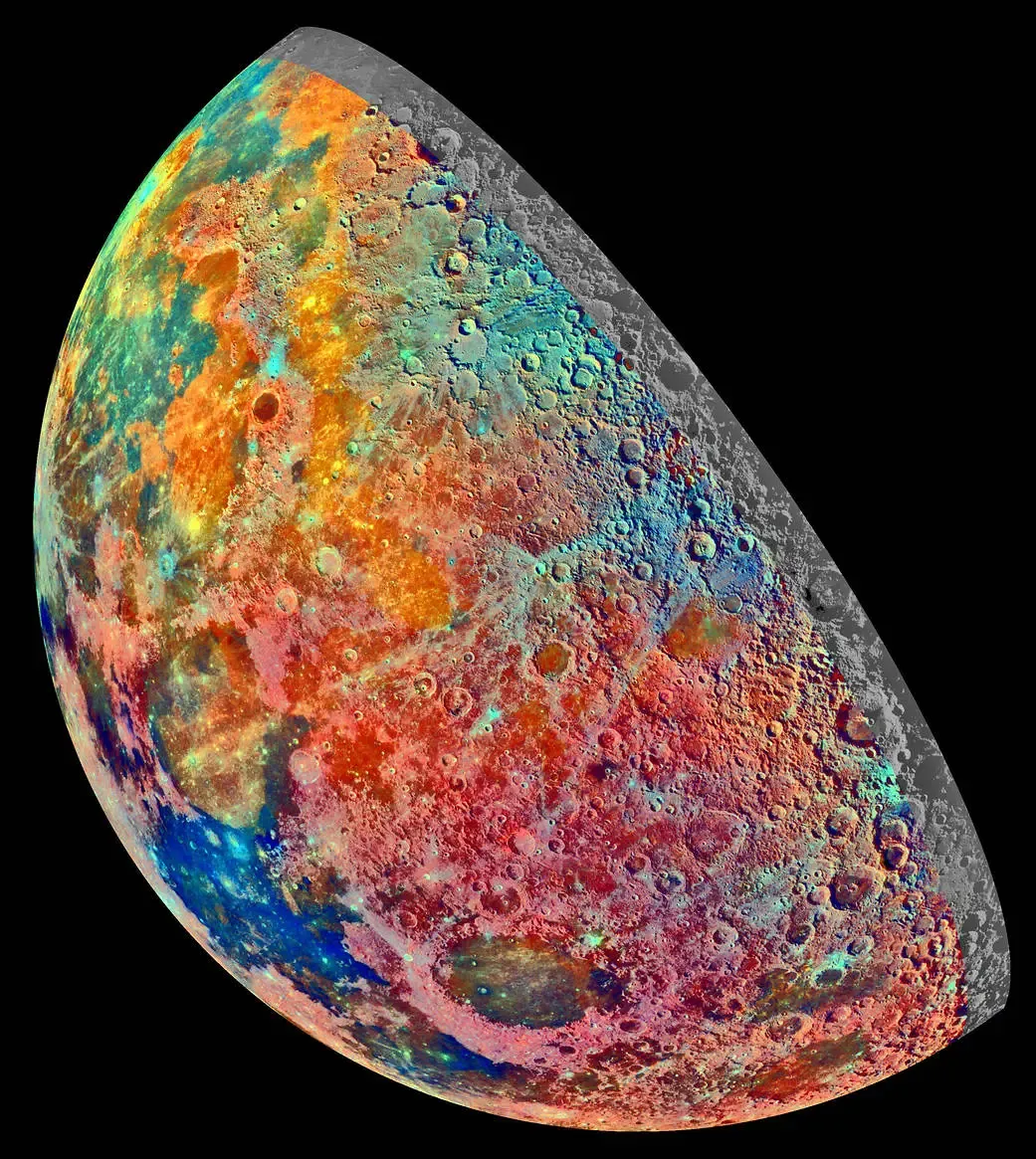
NASA has published its own “mineral moon” photos in the past, like the one shot using the Jupiter-bound Galileo spacecraft as it swung by Earth for a gravity assist in 1992, but McCarthy said the quality of images from space probes can’t match the dynamics of a human with a good camera.
“With the really, really high-fidelity image stacks from the stuff that Reid got, I’m able to bring out that saturation,” McCarthy said.
McCarthy also noticed a huge difference in the quality of Wiseman’s individual photos compared to those McCarthy takes on the ground, pointing to the lack of a lunar atmosphere as a contributing factor.
“On Earth, you’re dealing with atmosphere in the way, and atmosphere actually adds a color cast to the moon,” he said. “I’m often shooting 150 to 200 photos just to barely be able to get out the color …. It’s way more than that if I’m doing it with a mosaic — sometimes thousands of photos.”
Comparatively, McCarthy found he needed to stack far fewer of the images Wiseman took from the lunar far side. “I was able to cut down the number of exposures used,” he said. “Maybe [Wiseman] shot 50 exposures. I only ended up using 10 to 15.”
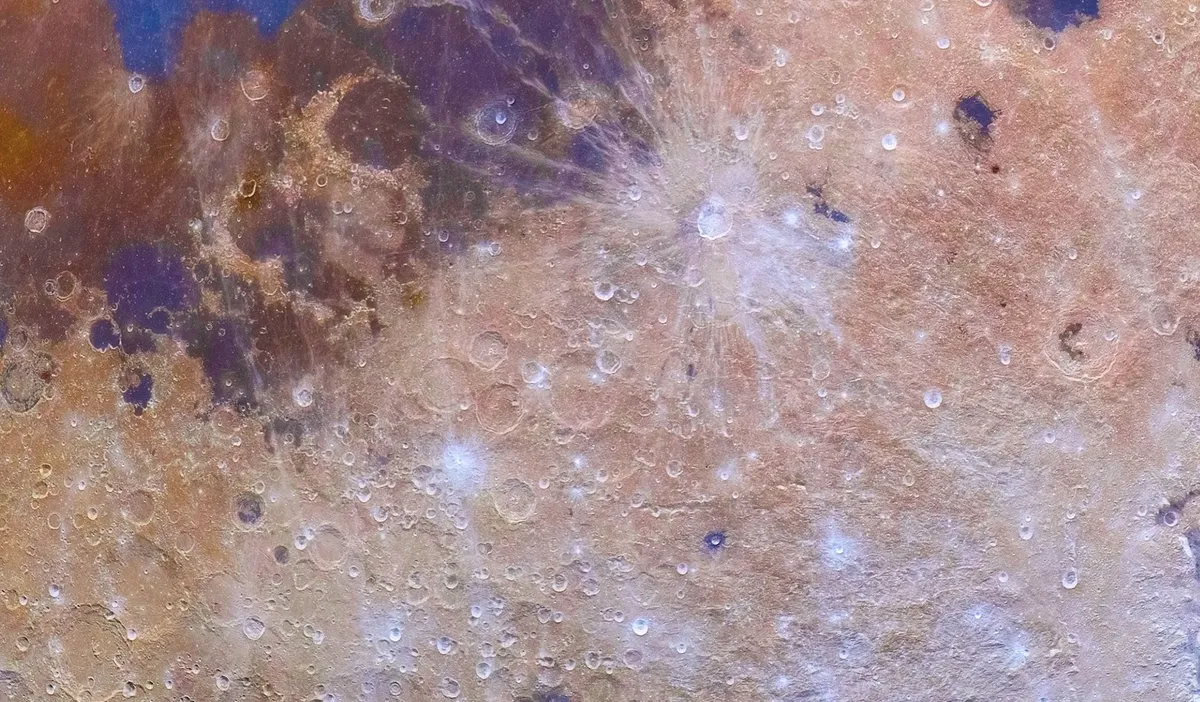
“It’s been quite fun working this data, not only because of the features I’ve never seen before, but also, the data is just so clean,” McCarthy said. “It is phenomenally clean. It’s the best data I’ve ever worked.”
Since Artemis 2’s April 10 splashdown, NASA has released more than 12,000 images taken by the astronauts during their flight around the moon. McCarthy says he’s only scratched the surface of how he wants to use the wealth of material, and he expects to release more edits in the future.
“I’m just going to keep working the data. There are some close-up shots I haven’t worked or published yet. Nothing too crazy. I’m going to go into the highlands a little deeper,” McCarthy said.










Related Posts

Stay Informed With the Latest & Most Important News
Previous Post
Next Post
Advertisement
-
 01Two Black Holes Observed Circling Each Other for the First Time
 -
 02From Polymerization-Enabled Folding and Assembly to Chemical Evolution: Key Processes for Emergence of Functional Polymers in the Origin of Life
 -
 03Astronomy 101: From the Sun and Moon to Wormholes and Warp Drive, Key Theories, Discoveries, and Facts about the Universe (The Adams 101 Series)
 -
 04True Anomaly hires former York Space executive as chief operating officer
 -
 05Φsat-2 begins science phase for AI Earth images
 -
 06Hurricane forecasters are losing 3 key satellites ahead of peak storm season − a meteorologist explains why it matters
 -
 07Binary star systems are complex astronomical objects − a new AI approach could pin down their properties quickly