
Now Reading: Planetary Formation Tracks On The Hertzsprung-Russell Diagram: Visualising The Processes Of Giant Planet Growth
-
01
Planetary Formation Tracks On The Hertzsprung-Russell Diagram: Visualising The Processes Of Giant Planet Growth

Planetary Formation Tracks On The Hertzsprung-Russell Diagram: Visualising The Processes Of Giant Planet Growth

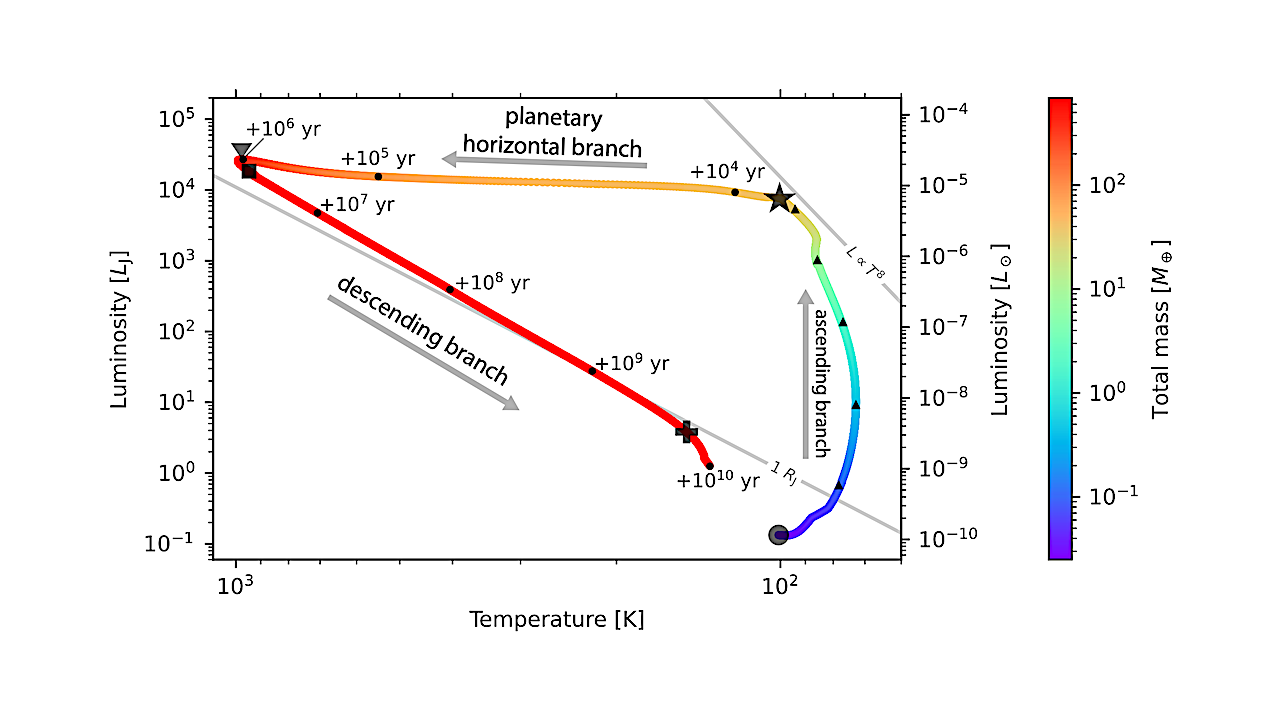
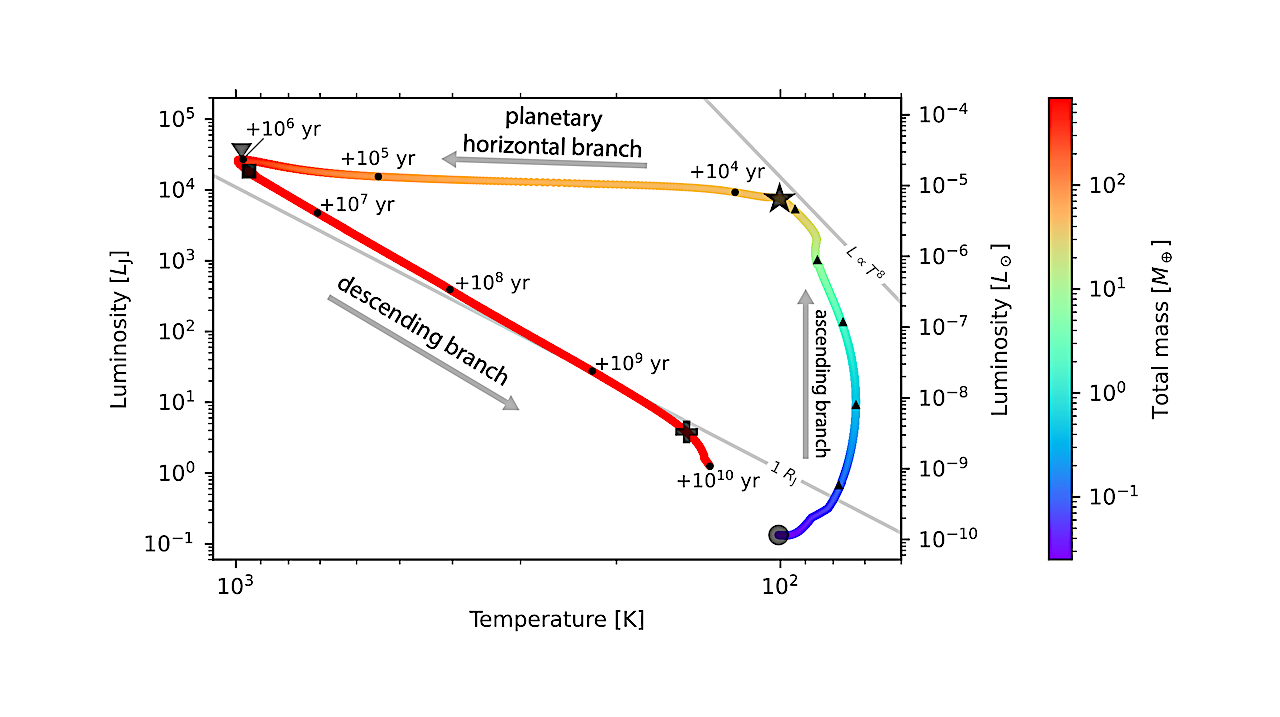
HR diagram track of the default case (final mass of 2.2 MJ ; see Table 1), showing its surface temperature (Eqs. 12, 19 or 21, depending on the phase) and total luminosity (Eq. 6). Highlighted key moments show the start point (•), detachment (⋆), the point of maximum luminosity (▼), disk dispersal (■), and the age of Jupiter (+). Table 2 lists the corresponding values for time, mass and radius. In the ascending branch small black triangles (▲) show linearly spaced time indicators every Myr. The black dots (•) represent post-detachment intervals equally spaced in log(time). Grey reference lines show two trends: the predicted slope derived in Sect. A, evaluated with the median late-attached-phase surface density of Σpla = 1.7 g cm−2 (labelled with L ∝ T 8 ), and a constant-radius track for Rp = 1 RJ , which approximates a cooling planet in the evolutionary phase before stellar irradiation becomes relevant (last downturn). — astro-ph.EP
The Hertzsprung-Russell diagram (HRD) is central to stellar astrophysics but has rarely been used to interpret planet formation.
We extend the HRD concept to forming planets and study how solid and gas accretion, cooling/contraction, and migration shape luminosity-temperature tracks in different formation scenarios.
We compute planetary interior structures throughout formation and evolution with the Bern model and, for the first time, couple it to radiation-hydrodynamical simulations to obtain a time-dependent accretion-shock heating efficiency, helping to address the cold-/hot-start ambiguity.
Planetary HRDs exhibit three branches corresponding to successive phases:
(i) an ascending branch during solid-dominated growth, strongly set by the size of accreted bodies (and thus the solid accretion rate) and by migration; for in-situ planetesimal accretion we find analytically L∝T8.
(ii) A near-horizontal branch beginning at detachment when gas accretion becomes disk-limited and contraction accelerates; hot accretion, higher masses, and pebble accretion bend tracks upward. Increasing electron degeneracy after detachment lowers interior temperatures and stabilises radii.
(iii) A descending branch where accretion ends and planets join constant-mass cooling tracks with weak radius evolution and L∼T4. Our tracks agree well with synthetic populations and are broadly consistent with directly imaged planets.
Populating the short-lived early branches observationally will be difficult, and embedded accreting planets require models including accretion-shock emission and circumplanetary-disk reprocessing.
Benedikt Gottstein, Gabriel-Dominique Marleau, Christoph Mordasini
Comments: 21 pages, 11 figures, accepted for publication in A&A
Subjects: Earth and Planetary Astrophysics (astro-ph.EP)
Cite as: arXiv:2605.18950 [astro-ph.EP] (or arXiv:2605.18950v1 [astro-ph.EP] for this version)
https://doi.org/10.48550/arXiv.2605.18950
Focus to learn more
Submission history
From: Benedikt Gottstein
[v1] Mon, 18 May 2026 18:00:02 UTC (10,214 KB)
https://arxiv.org/abs/2605.18950
Astrobiology,










Related Posts

Stay Informed With the Latest & Most Important News
Previous Post
Next Post


Advertisement
-
 01Two Black Holes Observed Circling Each Other for the First Time
 -
 02From Polymerization-Enabled Folding and Assembly to Chemical Evolution: Key Processes for Emergence of Functional Polymers in the Origin of Life
 -
 03Astronomy 101: From the Sun and Moon to Wormholes and Warp Drive, Key Theories, Discoveries, and Facts about the Universe (The Adams 101 Series)
 -
 04True Anomaly hires former York Space executive as chief operating officer
 -
 05Φsat-2 begins science phase for AI Earth images
 -
 06Hurricane forecasters are losing 3 key satellites ahead of peak storm season − a meteorologist explains why it matters
 -
 07Binary star systems are complex astronomical objects − a new AI approach could pin down their properties quickly