
Now Reading: DARPA readies robotic deep-space repair satellite for 2026 launch
-
01
DARPA readies robotic deep-space repair satellite for 2026 launch


DARPA is at last ready to test fueling up satellites in faraway Earth orbits, to keep those machines working a little bit longer.
DARPA’s (Defense Advanced Research Projects Agency) long-delayed Robotic Servicing of Geosynchronous Satellite (RSGS) demonstrator is slated to launch as soon as this summer, the U.S. military’s research and development group stated in a statement on Wednesday (May 20). And as the name suggests, robots will form an integral part of the spacecraft’s work.
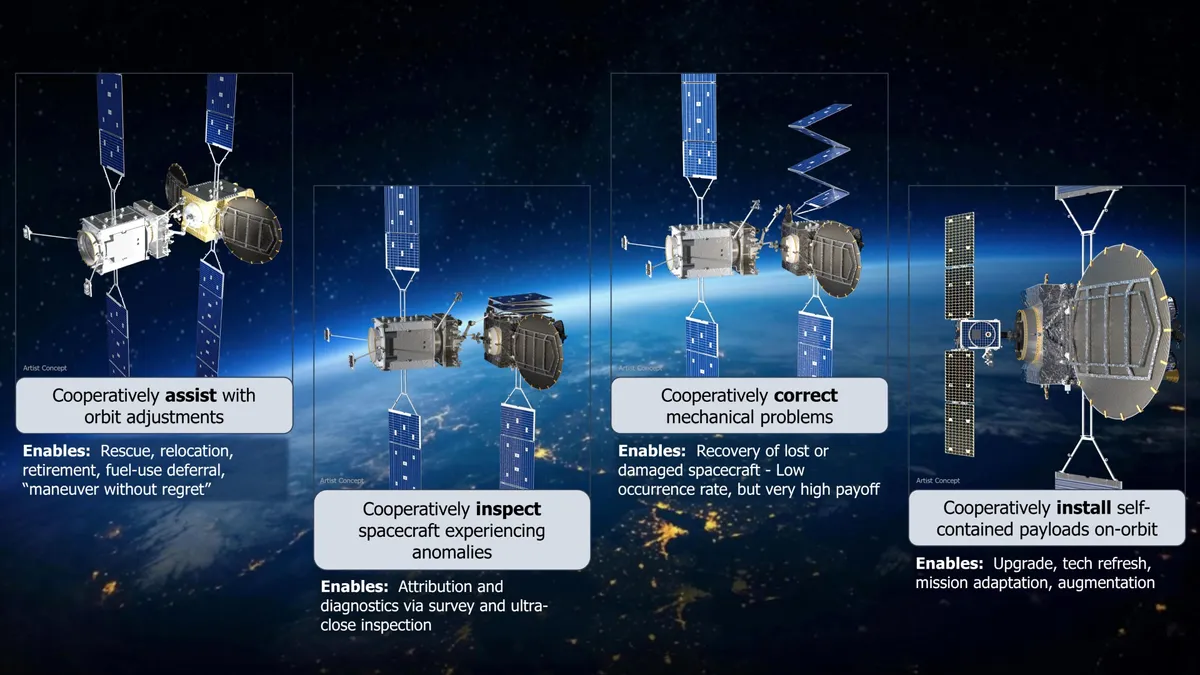
The heart of the mission will be a “highly dexterous robotic servicing suite”, DARPA stated, that should be able to jump in on several critical tasks to help satellites needing a boost: “on-orbit upgrades, inspections, anomaly resolution, and satellite relocation.”
What’s more, DARPA aims to up the ambition by tackling this work far away from our planet. The program aims to service satellites in geosynchronous orbit (GEO), which is roughly 22,236 miles (35,786 kilometers) above the Earth.
These satellites, orbiting at about 90 times higher than the International Space Station (at 250 miles or 400 km), are positioned in a sweet spot allowing the speed of their orbit to match the rotation of the Earth. The satellites’ positioning allows them to get a consistent view of one patch of planet, which is helpful for providing reliable telecommunications—or for performing long-term climate or defense monitoring.
But at such a distant perch from Earth, satellites in GEO typically have few options when they run out of fuel besides simply being maneuvered out of the way, for a new satellite to take their place. With space junk rising (along with collision risk between satellites), that’s where DARPA and its partners on the mission aim to make a difference.
RSGS was originally announced in 2017, but has had delays for various reasons, according to Breaking Defense. The original contractor, then known as Maxar Technologies, left the project in 2019, then the pandemic interrupted the industry’s supply chain distribution.
Newer prime contractor SpaceLogistics (a Northrop Grumman subsidiary) also had challenges integrating the DARPA payload on their spacecraft, the report said. But DARPA emphasized RSGS is at last ready to fly. Assuming an on-time launch, RSGS will begin work in 2027 after a 10-month journey to geosynchronous orbit using electric propulsion.
Other participants in RSGS include NASA and the U.S. Naval Research Laboratory. Working together with its partners, DARPA wants to ensure their robotic servicer is able “to adapt to a variety of on-orbit missions and conditions” with safety and efficiency in mind, according to DARPA materials.
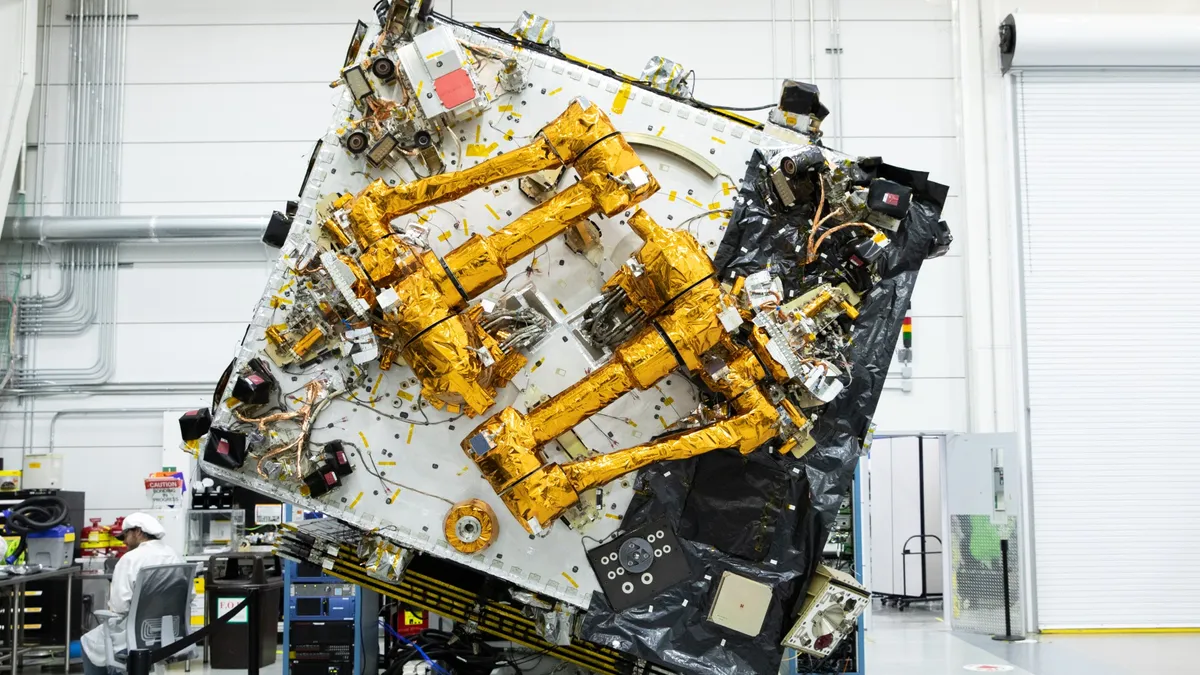
The eventual goal is for DARPA to support a servicing spacecraft that could work for years in orbit, potentially helping out spacecraft dozens of times. What’s more, the agency emphasized, the maintenance will go beyond refueling the spacecraft.
“Even fully functional satellites often have their operational lives cut short simply because they carry obsolete payloads — a frustrating situation for owners of assets worth hundreds of millions of dollars. With no support once in orbit, GEO satellites are equipped with redundant systems and maximum fuel capacity, which increases their complexity, weight, and expense,” DARPA stated.
The overall approach, therefore, includes installing new payloads on the spacecraft along with doing preventative maintenance: orbit adjustments, fixing up mechanical problems, and doing inspections to address any other anomalies that may come up.
A typical geostationary satellite lasts about 15 years, according to IEEE. That is a very long time compared to say, a SpaceX Starlink in low Earth orbit or LEO (which might last five years.) But the rapid refresh rate of Starlink and other LEO satellites also ensures the tech will not get old, and that the satellites can be replaced frequently and at low cost. That’s not the case in GEO.
DARPA and its partners will need to prove that they can service a geostationary satellite, which costs hundreds of millions of dollars to launch, at an affordable and rapid pace. They also are competing in a quickly growing field of other companies looking at space servicing, ranging from Astroscale to Thales Alenia Space. But the agency not only frames their approach as possible, says that the RSGS program will create a new approach to satellite operations altogether.
“By transitioning from a paradigm of disposable space assets to one of sustainable, upgradable, and resilient satellites, RSGS aims to fundamentally alter space operations for both the public and private sectors,” officials wrote of the mission in a separate statement. “With launch on the horizon, the RSGS program is poised to pave the way for a more resilient and sustainable infrastructure in space.”










Related Posts

Stay Informed With the Latest & Most Important News
Previous Post
Next Post



Advertisement
-
 01Two Black Holes Observed Circling Each Other for the First Time
 -
 02From Polymerization-Enabled Folding and Assembly to Chemical Evolution: Key Processes for Emergence of Functional Polymers in the Origin of Life
 -
 03Astronomy 101: From the Sun and Moon to Wormholes and Warp Drive, Key Theories, Discoveries, and Facts about the Universe (The Adams 101 Series)
 -
 04True Anomaly hires former York Space executive as chief operating officer
 -
 05Φsat-2 begins science phase for AI Earth images
 -
 06Hurricane forecasters are losing 3 key satellites ahead of peak storm season − a meteorologist explains why it matters
 -
 07Binary star systems are complex astronomical objects − a new AI approach could pin down their properties quickly