
Now Reading: New research challenges black hole formation theories by revealing massive black hole at early galaxy Abell2744-QSO1
-
01
New research challenges black hole formation theories by revealing massive black hole at early galaxy Abell2744-QSO1

New research challenges black hole formation theories by revealing massive black hole at early galaxy Abell2744-QSO1

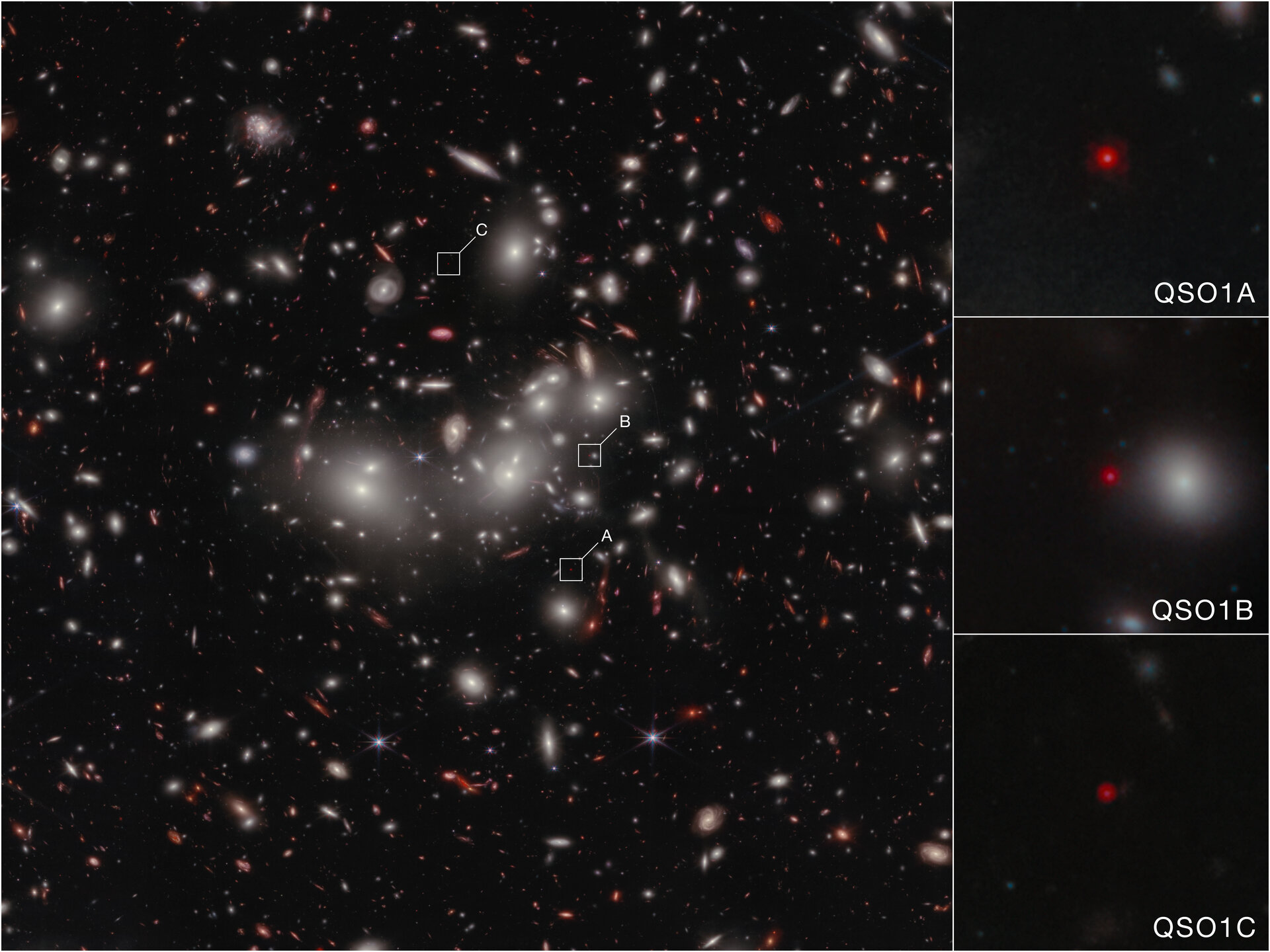

Researchers using the advanced capabilities of the NASA/ESA/CSA James Webb Space Telescope have successfully mapped the dynamics and chemical composition of gas surrounding a black hole located at the center of the distant galaxy Abell2744-QSO1, which is over 13 billion light-years from Earth. Their findings suggest that this supermassive black hole, weighing in at approximately 50 million solar masses, may have formed shortly after the Big Bang, challenging previous assumptions about the relationship between black holes and the galaxies they reside in.
The long-standing scientific debate regarding whether galaxies or black holes emerge first has been reignited. Traditionally, it was believed that black holes develop from collapsing massive stars within established galaxies. However, the rapid growth of supermassive black holes detected in the early Universe has raised questions about how such colossal entities could evolve from relatively small beginnings. The new research indicates that some black holes may have been massive from their inception, forming without first going through a stellar collapse and lacking a significantly larger host galaxy to provide them with material.
Roberto Maiolino from Cambridge University, a co-author of studies released in both Nature and the Monthly Notices of the Royal Astronomical Society, called the discovery a significant shift in scientific understanding, stating it necessitates a re-examination of traditional theories regarding black hole formation and growth.
The research focuses on Abell2744-QSO1, a prototypical object that existed just 700 million years post-Big Bang. Although this galaxy measures only 1,300 light-years in diameter, its gravitational lensing by the galaxy cluster Abell 2744 facilitates easier observations. Initial analyses suggested that QSO1 might be primarily composed of glowing hydrogen and helium gas surrounding a supermassive black hole, estimated to be 40 million solar masses. Yet, until now, the precise mass of this black hole remained uncertain.
The research team used the Near Infrared Spectrograph (NIRSpec) on the Webb Telescope to analyze the gas dynamics surrounding the black hole. By mapping the rotational velocities of the hydrogen gas, they found evidence of Keplerian motion, indicating that the mass is concentrated in the black hole itself and not dispersed among a large number of stars. This method allowed for a direct measurement of the black hole’s mass, revealing it to be approximately 50 million solar masses—an amount that constitutes two-thirds of QSO1’s total mass, a stark contrast to typical nearby galaxies where supermassive black holes account for a much smaller fraction.
The elemental composition of the gas surrounding QSO1 further corroborates these findings. The gas is almost entirely hydrogen and helium, displaying a metallicity of less than 0.5% of that found in the Sun, suggesting that QSO1 is among the most pristine galactic environments ever observed. Cosimo Marconcini from the University of Florence, also a co-author, described this as a groundbreaking measurement of black hole mass within the first billion years after the Big Bang, consistent with previous indirect assessments.
The disproportionate mass of QSO1’s black hole relative to its galaxy implies that it could not have gradually formed from smaller black holes through merging processes. Instead, Ignas Juodžbalis, a graduate student at Cambridge University and lead author of one of the studies, speculated that this black hole may indeed represent a primordial or direct collapse black hole, which had been theorized but not yet substantiated.
Researchers believe that QSO1’s black hole could either have originated as a ‘heavy seed’ formed within moments of the Big Bang or later from a collapsing massive gas cloud, but in either case, it likely began its existence as a massive entity. The team anticipates that similar early cosmic structures were not rare and plans to study other such galaxies to explore if supermassive black holes truly predate their host galaxies.










Related Posts

Stay Informed With the Latest & Most Important News
Previous Post
Next Post

Advertisement
-
 01Two Black Holes Observed Circling Each Other for the First Time
 -
 02From Polymerization-Enabled Folding and Assembly to Chemical Evolution: Key Processes for Emergence of Functional Polymers in the Origin of Life
 -
 03Astronomy 101: From the Sun and Moon to Wormholes and Warp Drive, Key Theories, Discoveries, and Facts about the Universe (The Adams 101 Series)
 -
 04True Anomaly hires former York Space executive as chief operating officer
 -
 05Φsat-2 begins science phase for AI Earth images
 -
 06Hurricane forecasters are losing 3 key satellites ahead of peak storm season − a meteorologist explains why it matters
 -
 07Binary star systems are complex astronomical objects − a new AI approach could pin down their properties quickly