
Now Reading: 100 years after Robert Goddard’s 1st liquid-fueled rocket launch, NASA is using the technology to send astronauts back to the moon
-
01
100 years after Robert Goddard’s 1st liquid-fueled rocket launch, NASA is using the technology to send astronauts back to the moon

100 years after Robert Goddard’s 1st liquid-fueled rocket launch, NASA is using the technology to send astronauts back to the moon

100 years ago, a liquid-fueled rocket flew into the sky for the very first time. The unlikely contraption was designed by Clark University physics professor Robbert Goddard, and launched from a cabbage field in Auburn, Massachusetts on March 16, 1926.
Goddard’s design climbed a short 40 feet into the air that day, but launched the world into an era of modern rocketry that would lead to the first moon landing less than 50 years later. After his initial success, Goddard continued developing increasingly sophisticated systems and breakthroughs that paved the way for the technological foundation upon which nearly every major rocket, from early missiles and military vehicles to orbital launch vehicles, has been based. And, within only a few decades, would carry humanity’s first satellites and eventually astronauts into space.
Article continues below
Today, Goddard is regarded as the father of modern rocketry, and is the namesake for NASA’s Goddard Space Flight Center in Greenbelt, Maryland. Much of the technologies introduced in his designs are still central to the function of today’s launch vehicles, including turbopumps, gimbaling engines and gyroscopic guidance.
Those technologies evolved to support NASA’s missions during the space race of the 1960s, carrying astronauts to orbit as part of the agency’s Mercury, Gemini and Apollo missions, and, as the decades continued, the space shuttle.
Now, Goddard’s fundamentals are being put back to work as a part of NASA’s Artemis program to return humanity to the moon.
Standing only 10 feet (3 meters) tall, Goddard’s rocket burned liquid oxygen and gasoline — a revolutionary idea at a time when rockets relied almost entirely on solid propellants. Solid rocket boosters, like the kind designed to help lift NASA’s Space Launch System (SLS) for Artemis through Earth’s atmosphere, are still in use today. Solid boosters, though, come with some disadvantages. Once they’re lit, they’re lit. There’s no extinguishing solid propellants after ignition. They will burn completely through at a consistent thrust until spent.
Liquid propellants, on the other hand, allow engineers to throttle that raw power into a precisely controlled thrust, and offer far more power than their solid predecessors. The concept is simple: liquid fuel and oxidizer are pumped into a chamber where they are ignited to create an explosion of superheated gas that’s channeled and expelled from an engine nozzle at tremendous speed, propelling a rocket upward, or in whichever direction it happens to be pointing.
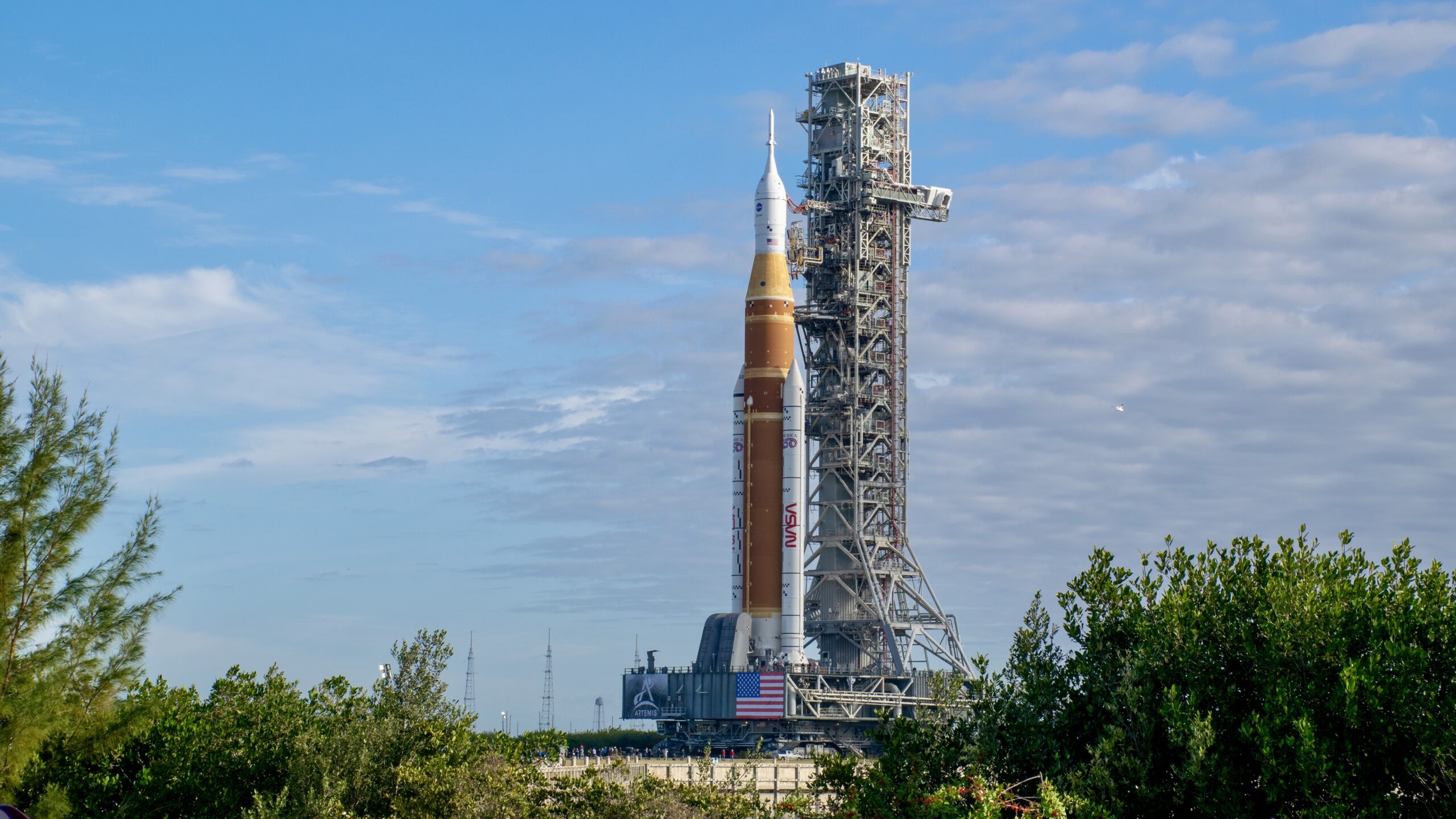
Just like its earliest predecessor, SLS relies on the introduction of a spark to a mixture of pressurized liquid fuel and liquid oxygen to power the massive 322-foot tall (98 meters) rocket into orbit. Atop that rocket when it launches no earlier than April 1, an Orion spacecraft will carry NASA astronauts Reid Wiseman, Victor Glover, Christina Koch and Canadian Space Agency astronaut Jeremy Hansen on a 10-day mission around the moon and back to Earth.

Their mission, Artemis 2, is the first crewed flight of NASA’s new lunar program, which aims to eventually establish a permanent human presence on the surface of the moon. While the astronauts of Artemis 2 won’t be landing on the moon themselves, their mission is an important stepping stone toward NASA’s ultimate goal.
Ultimately, Artemis 2 is meant as a crewed shakedown flight for Orion. Similar to the progression of the spaceflight missions of the 1960s, NASA has shaped each flight of the Artemis program to build on its predecessor.
After a successful demonstration of Orion’s life support systems around the moon on Artemis 2, Artemis 3 will launch to Earth orbit to practice rendezvous and docking maneuvers with the program’s lunar landers. NASA is planning to launch Artemis 3 at some point during 2027, with Artemis 4 reserved as the program’s first crewed lunar landing scheduled for 2028.
Artemis 2 is expected to launch much sooner. That mission is potentially just weeks away from liftoff. The Artemis 2 SLS is currently scheduled to roll out from the Vehicle Assembly Building at NASA’s Kennedy Space Center in Florida, to the pad at Launch Complex-39B on March 19. Once there, NASA hopes to prepare the rocket and ground systems for a launch window that lasts from April 1-6.
What began as a small experimental flight in that Massachusetts field ultimately sparked a century of exploration that continues to carry us into the stars today. In the hundred years since Goddard’s first launch, rockets have grown from experimental machines to the backbone of space exploration, and enabled humanity’s reach of exploration to extend to every planet in our solar system and beyond. And, as NASA prepares to return humanity to the moon with Artemis, the legacy of that first liquid-fueled rocket remains visible in every mission.










Related Posts

Stay Informed With the Latest & Most Important News
Previous Post
Next Post

Advertisement
-
 01Two Black Holes Observed Circling Each Other for the First Time
 -
 02From Polymerization-Enabled Folding and Assembly to Chemical Evolution: Key Processes for Emergence of Functional Polymers in the Origin of Life
 -
 03Astronomy 101: From the Sun and Moon to Wormholes and Warp Drive, Key Theories, Discoveries, and Facts about the Universe (The Adams 101 Series)
 -
 04True Anomaly hires former York Space executive as chief operating officer
 -
 05Φsat-2 begins science phase for AI Earth images
 -
 06Hurricane forecasters are losing 3 key satellites ahead of peak storm season − a meteorologist explains why it matters
 -
 07Binary star systems are complex astronomical objects − a new AI approach could pin down their properties quickly