
Now Reading: 1400 quirky objects found in Hubble’s archive
-
01
1400 quirky objects found in Hubble’s archive



27/01/2026
184 views
3 likes
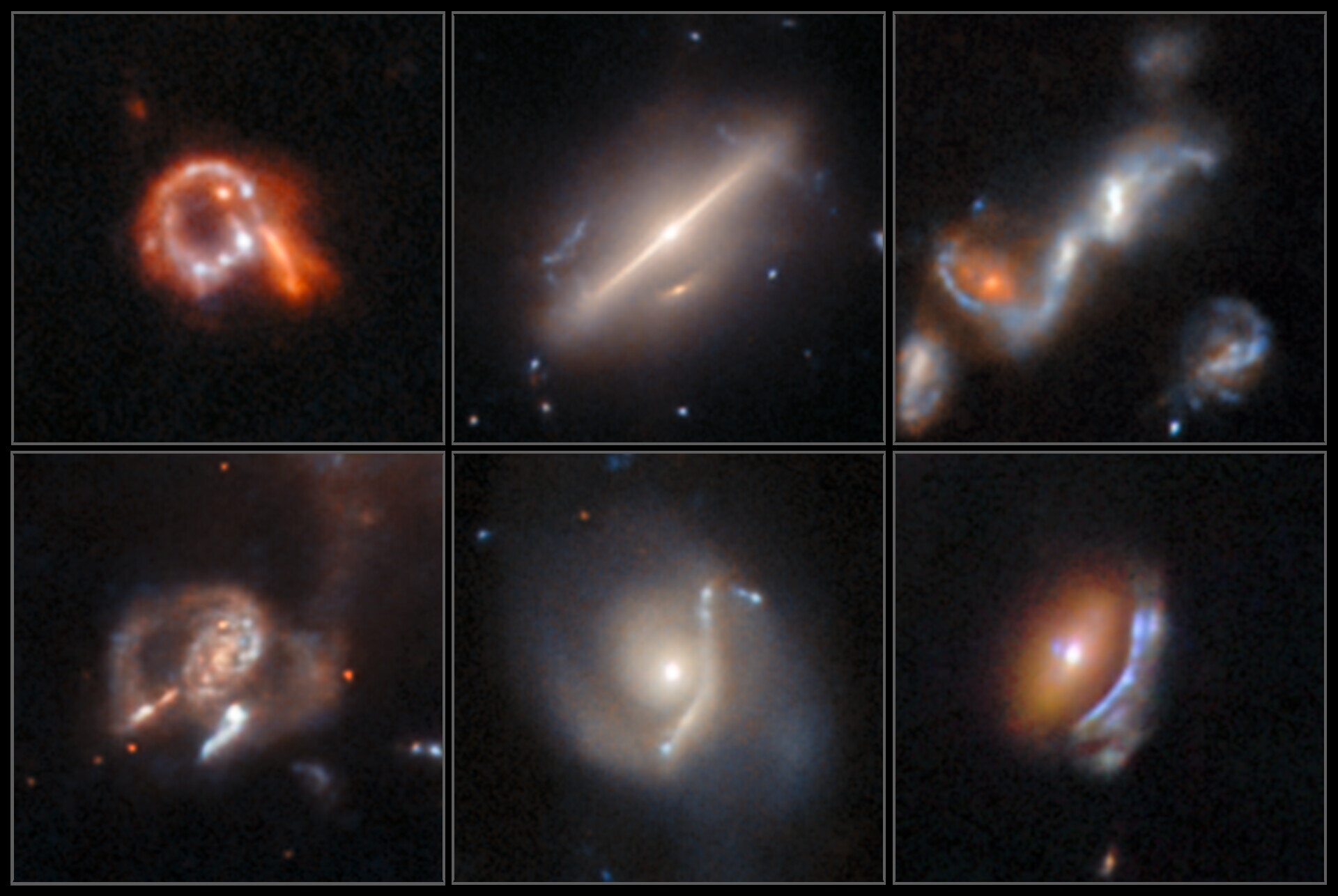
A team of astronomers have used a new AI-assisted method to search for rare astronomical objects in the Hubble Legacy Archive. The team sifted through nearly 100 million image cutouts in just two and a half days, uncovering nearly 1400 anomalous objects, more than 800 of which had never been documented before.
Rare and anomalous objects like colliding galaxies, gravitational lenses and ring galaxies are of immense scientific interest, but they’re difficult to find in the growing masses of data from telescopes like the NASA/ESA Hubble Space Telescope. Increasingly, astronomers must ask how they can find a cosmic needle in a haystack the size of the Universe.
Recently, researchers David O’Ryan and Pablo Gómez of the European Space Agency developed an AI tool that allows them to inspect millions of astronomical images in a fraction of the time it would take a human. The team trained their tool and demonstrated its capabilities using the Hubble Legacy Archive, which contains tens of thousands of datasets spanning Hubble’s long lifetime.
“Archival observations from the Hubble Space Telescope now stretch back 35 years, providing a treasure trove of data in which astrophysical anomalies might be found,” says David, lead author of the research paper published today in the journal Astronomy & Astrophysics.
Astrophysical anomalies are usually discovered when scientists manually search for objects that are outside the norm – or find them by chance. While trained scientists excel at spotting cosmic anomalies, there’s simply too much Hubble data for experts to sort through at the necessary level of fine detail by hand.
Citizen science projects, which enlist non-scientists to collaborate on tasks such as classifying galaxies, provide another way to chip away at the mountains of data available. While citizen science groups greatly expand the amount of data that can be inspected, they’re still no match for extensive archives like Hubble’s, or for datasets from telescopes that survey the sky like ESA’s Euclid space telescope.
Now, this new work by David and Pablo takes the search to a whole new level. The team developed what’s called a neural network, an AI tool that uses computers to process data and search for patterns in a way that is inspired by the human brain. Their neural network, which they named AnomalyMatch, is trained to search for and recognise rare objects like jellyfish galaxies and gravitational arcs.
The team used AnomalyMatch to search through nearly 100 million image cutouts from the Hubble Legacy Archive, marking the first time the archive has been systematically searched for astrophysical anomalies. In just two and a half days, AnomalyMatch completed its search of the archive and returned a list of likely anomalies.
As the process of tracking down rare objects still requires an expert eye, David and Pablo personally inspected the sources rated by their algorithm as most likely to be anomalous. Of these, more than 1300 were true anomalies, more than 800 of which had never been documented in the scientific literature.
Most of the anomalies were galaxies in the process of merging or interacting, taking on unusual shapes or trailing long tails of stars and gas. Many others were gravitational lenses, in which the gravity of a foreground galaxy bends spacetime and warps the light from a distant background galaxy into a circle or arc. The team also discovered examples of several other rare objects such as galaxies with huge clumps of stars, jellyfish galaxies with gaseous ‘tentacles’, and planet-forming disks seen edge-on, giving them a hamburger-like or butterfly-like appearance. Perhaps most intriguing of all, there were several dozen objects that defied classification altogether.
“This is a fantastic use of AI to maximise the scientific output of the Hubble archive,” says study co-author Pablo. “Finding so many anomalous objects in Hubble data, where you might expect many to have already been found, is a great result. It also shows how useful this tool will be for other large datasets.”
Hubble has generated just one of many large data archives in astronomy, and more are on the horizon. New facilities that will return an enormous amount of data include Euclid, which began its survey of billions of galaxies across a third of the night sky in 2023, the NSF–DOE Vera C. Rubin Observatory, which will soon begin its 10-year Legacy Survey of Space and Time and collect more than 50 petabytes of images, and NASA’s Nancy Grace Roman Space Telescope, to which ESA contributes as a Mission of Opportunity, that is scheduled to launch no later than May 2027. AI tools like AnomalyMatch can help astronomers handle the deluge of incoming data and discover new examples of rare and unusual objects – and maybe even things never seen before in the Universe.










Related Posts



Stay Informed With the Latest & Most Important News
Previous Post
Next Post




Advertisement
-
 01Two Black Holes Observed Circling Each Other for the First Time
 -
 02From Polymerization-Enabled Folding and Assembly to Chemical Evolution: Key Processes for Emergence of Functional Polymers in the Origin of Life
 -
 03Astronomy 101: From the Sun and Moon to Wormholes and Warp Drive, Key Theories, Discoveries, and Facts about the Universe (The Adams 101 Series)
 -
 04True Anomaly hires former York Space executive as chief operating officer
 -
 05Φsat-2 begins science phase for AI Earth images
 -
 06Hurricane forecasters are losing 3 key satellites ahead of peak storm season − a meteorologist explains why it matters
 -
 07Binary star systems are complex astronomical objects − a new AI approach could pin down their properties quickly