
Now Reading: 3 puzzles of our universe could be solved with this new dark matter theory
-
01
3 puzzles of our universe could be solved with this new dark matter theory


A new type of self-interacting dark matter could provide solutions to three very different cosmic puzzles, new research suggests.
The first mystery that could be solved involves an ultradense clump of matter detected in the system JVAS B1938+666, which is gravitationally lensed, or visibly distorted, thanks to a quirk of general relativity. The second has to do with a visible “scar” in a stream of stars called GD-1. It basically looks like a dense, invisible object ripped through the stream. And finally, there is the confusing formation of an unusual star cluster named Fornax 6 in the Fornax satellite galaxy of the Milky Way, which could have occurred if a dense patch of dark matter acted as a gravitational trap capturing passing stars.
The new research argues that if dark matter interacts with itself, that could explain away all three of these unique situations.” What’s striking is that the same mechanism works in three completely different settings — across the distant universe, within our galaxy, and in a neighboring satellite galaxy,” Hai-Bo Yu of the University of California, Riverside and the Center for Experimental Cosmology and Instrumentation, said in a statement. “All show densities that are difficult to reconcile with standard model dark matter but arise naturally in self-interacting dark matter.”
But what does it really mean for dark matter to “interact” with itself, and why would that be a deviation from the “standard” picture of this mysterious substance?
Anti-social dark matter can’t explain these mysteries
First, let’s go through a quick recap of what dark matter really is.
Dark matter accounts for around 85% of the matter in the universe, meaning it “outweighs” the ordinary matter that comprises stars, planets, moons, and our bodies by a ratio of around five to one. Scientists know dark matter can’t be made up of protons, electrons and neutrons that compose the atoms that make up everything we see around us, because those particles interact with light (more accurately, electromagnetic radiation) — and whatever composes dark matter doesn’t.
This also means dark matter is effectively invisible to us, only detectable via its interaction with gravity and the knock-on effect this has on everyday matter and light. Separately, the best theory of cosmic evolution we have so far is the standard model of cosmology, also known as the lambda cold dark matter (LCDM) model. In the LCDM model, dark matter is “cold,” meaning its particles move slowly and don’t collide when they meet, instead passing through each other without interacting like anti-social cosmic ghosts.
Thus, unlike cold dark matter, self-interacting dark matter particles can collide with each other, exchanging energy and momentum. These interactions can result in so-called “gravothermal collapse,” creating dense, compact cores of dark matter.
“The difference is like a crowd of people who ignore each other versus one where everyone is constantly bumping into one another,” Yu said. “In self-interacting dark matter, these interactions can dramatically reshape the internal structure of dark matter halos. Dark matter that interacts with itself can become dense enough to explain these observations.”
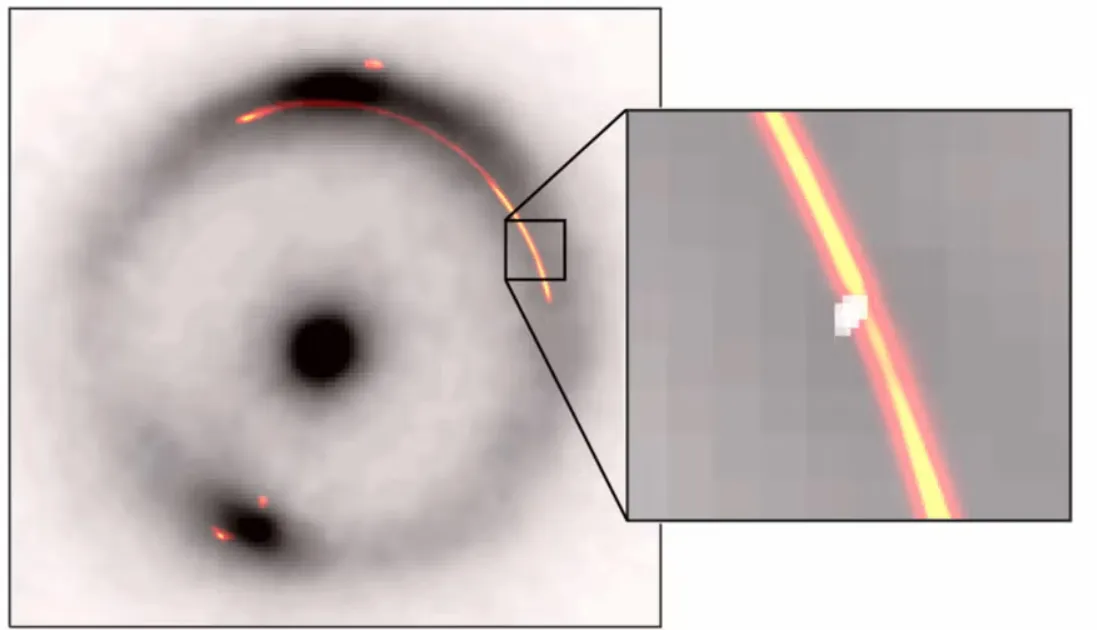
“The difference is like a crowd of people who ignore each other versus one where everyone is constantly bumping into one another,” Yu said. “In self-interacting dark matter, these interactions can dramatically reshape the internal structure of dark matter halos.”
In short, this recipe of self-interacting dark matter allows for dense dark matter cores with morphology that could explain the strange aspects of the astronomical bodies such as the ultradense clump of matter observed in JVAS B1938+666 and the “scar” of GD-1 — but non-interacting dark matter can’t. “Dark matter that interacts with itself can become dense enough to explain these observations,” Yu added.
The team’s research was published on April 9 in the journal Physical Review Letters.










Related Posts

Stay Informed With the Latest & Most Important News
Previous Post
Next Post



Advertisement
-
 01Two Black Holes Observed Circling Each Other for the First Time
 -
 02From Polymerization-Enabled Folding and Assembly to Chemical Evolution: Key Processes for Emergence of Functional Polymers in the Origin of Life
 -
 03Astronomy 101: From the Sun and Moon to Wormholes and Warp Drive, Key Theories, Discoveries, and Facts about the Universe (The Adams 101 Series)
 -
 04True Anomaly hires former York Space executive as chief operating officer
 -
 05Φsat-2 begins science phase for AI Earth images
 -
 06Hurricane forecasters are losing 3 key satellites ahead of peak storm season − a meteorologist explains why it matters
 -
 07Binary star systems are complex astronomical objects − a new AI approach could pin down their properties quickly