
Now Reading: China launches classified Shijian-28 spacecraft, reusable Zhuque-3 rocket faces delay
-
01
China launches classified Shijian-28 spacecraft, reusable Zhuque-3 rocket faces delay

China launches classified Shijian-28 spacecraft, reusable Zhuque-3 rocket faces delay


HELSINKI — China launched the latest in a series of experimental, often opaque satellites Sunday, while the debut flight of the commercial Zhuque-3 faces a delay.
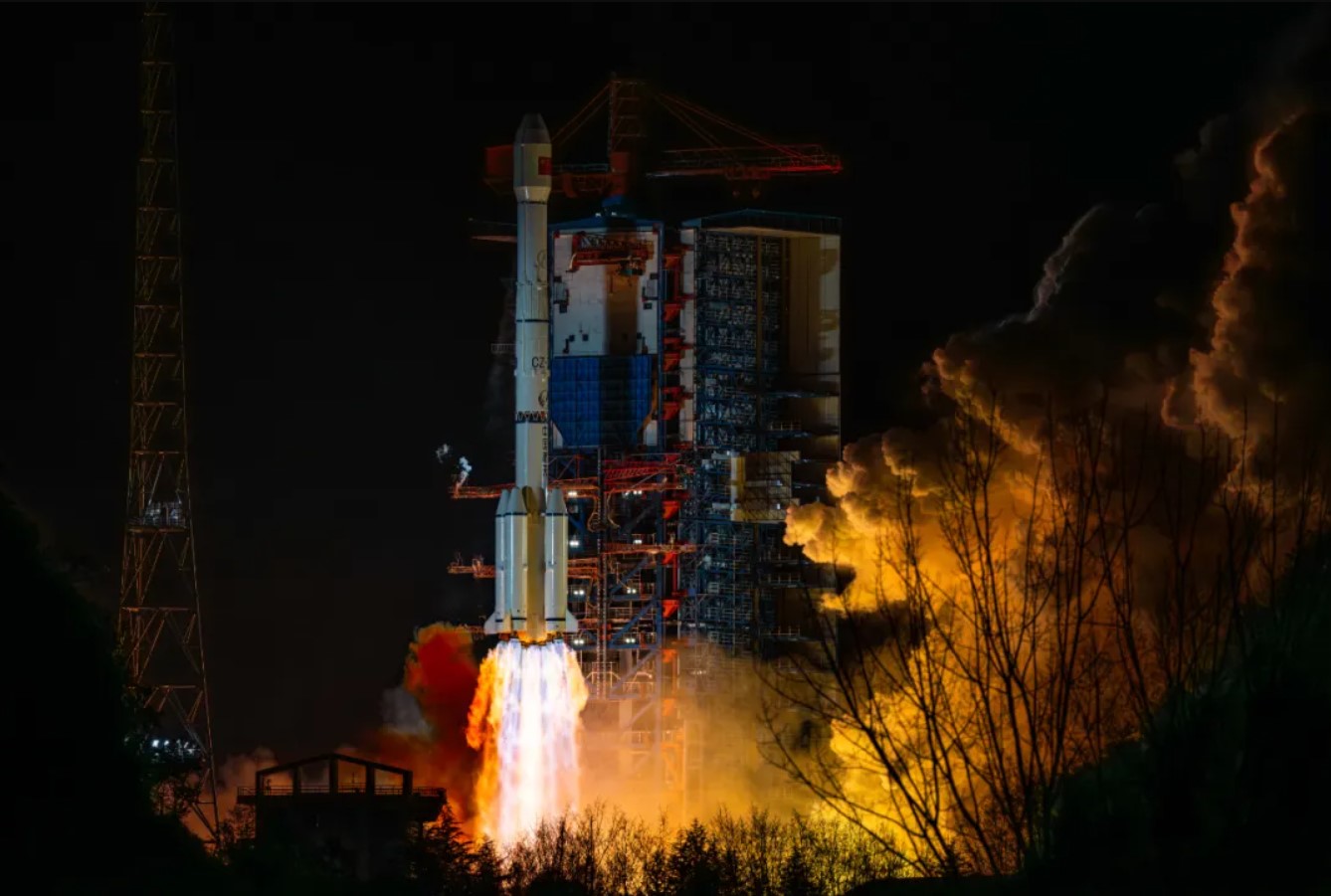
A Long March 7A rocket lifted off at 7:20 a.m. Eastern (1220 UTC) Nov. 30 from Wenchang Satellite Launch Center on the southern island of Hainan. The China Aerospace Science and Technology Corporation (CASC) declared around an hour after liftoff that the payload, revealed to be Shijian-28, has successfully entered its predetermined orbit.
CASC stated that the satellite was developed by the space and defense giant’s China Academy of Space Technology (CAST), but, unusually, provided no further information. Shijian satellite launches are often accompanied only by a terse description of the purposes of the spacecraft, such as being intended for scientific experiments, space environment monitoring or technology tests. Neither CASC nor state media provided any description of the satellite.
The Shijian program comprises a diverse series of satellites, typically used to conduct experiments, test new technologies and verify operational practices on orbit. Orbital data for Shijian-28, unavailable at time of reporting, may later provide some insights into its purposes.
Two separate satellites, Shijian-21 and Shijian-25, recently separated in geosynchronous orbit after spending months apparently docked in order to conduct on-orbit refueling tests.
Growing launch cadence
The Long March 7A, typically used for launches to geosynchronous orbit, has now flown five times in 2025, having had a failed debut flight in 2020 and flying at most twice a year since 2021. Its previous outing, in early November, sent the Yaogan-46 remote sensing satellite into a medium Earth orbit.
sCASC notes that a new mobile launch platform was used for the first time for the Long March 7A launch of Shijian-28, and that the launch campaign for the rocket has been reduced from an initial 35 days down to 19 days.
The increased cadence of the kerosene-liquid oxygen propellant Long March 7A comes as China also appears to begin demonstrating a decline in the proportional use of its older, hypergolic Long March 2, 3 and 4 series rockets in what is an already record-breaking launch year for the country. However, China is still using the Long March 3B, its workhorse for launches to geosynchronous orbit, at a high cadence, with a record-equaling 11 launches so far in 2025. This suggests growing Chinese interest and activity in geostationary orbit overall.
The launch of Shijian-28 was China’s 76th orbital launch attempt of 2025, following the country’s first emergency response launch for Tiangong, seeing the Shenzhou-22 spacecraft head for the space station Nov. 25.
Zhuque-3 test flight postponed
The Shijian-28 mission was, going into the weekend, expected to follow after what was to be a first Chinese orbital launch and booster recovery attempt. The launch attempt was, however, first scrubbed, then later postponed indefinitely for undisclosed reasons.
Commercial firm Landspace appeared set for a test launch of its stainless steel, reusable medium-lift Zhuque-3 launcher from the Dongfeng Commercial Space Innovation Test Zone within the national Jiuquan Satellite Launch Center late Nov. 28 Eastern. Apparent high winds saw a new, two-hour launch window set for the same time late Nov. 30 Eastern to early Dec.1.
Chinese media reports stated early Nov. 29, however, that the ground team had stood down, with no indication of when a new attempt would be made. Airspace closure notices which indicated the imminent test flight were removed and no new notices associated with the launch profile have yet been issued.
Landspace’s Zhuque-3 is a two-stage, stainless steel rocket with a diameter of 4.5 meters and a mass at liftoff of about 570 metric tons. The rocket stands approximately 66 meters tall on the pad, with its first stage powered by nine Tianque-12A methane-liquid oxygen engines. Landspace has constructed a landing site for the first stage, located roughly 390 kilometers to the southeast of Jiuquan, in Minqin county, Gansu province.
CASC is meanwhile preparing its new reusable Long March 12A at Jiuquan, which could instead make the country’s first orbital launch and landing attempt at some time in December.
The operational Zhuque-3 is to have a payload capacity to low Earth orbit (LEO) of 21,000 kilograms when expendable, or up to 18,300 kg when the first stage is recovered downrange, making it comparable to the Falcon 9 in terms of payload capacity. Early flights are expected to have a lower payload capacity.
The delayed flight comes amid newly issued policies affecting the commercial space sector. The China National Space Administration (CNSA) also announced Nov. 29 that it had recently established a new department dedicated to overseeing the country’s rapidly growing commercial space sector. The move followed days after a CNSA announcement of an action plan aimed at integrating the commercial space sector into the country’s overall national space development plan.











Related Posts

Stay Informed With the Latest & Most Important News
Previous Post
Next Post



Advertisement
-
 01Two Black Holes Observed Circling Each Other for the First Time
 -
 02From Polymerization-Enabled Folding and Assembly to Chemical Evolution: Key Processes for Emergence of Functional Polymers in the Origin of Life
 -
 03Astronomy 101: From the Sun and Moon to Wormholes and Warp Drive, Key Theories, Discoveries, and Facts about the Universe (The Adams 101 Series)
 -
 04True Anomaly hires former York Space executive as chief operating officer
 -
 05Φsat-2 begins science phase for AI Earth images
 -
 06Hurricane forecasters are losing 3 key satellites ahead of peak storm season − a meteorologist explains why it matters
 -
 07Binary star systems are complex astronomical objects − a new AI approach could pin down their properties quickly