
Now Reading: The future is now: understanding the once far-off technologies becoming reality
-
01
The future is now: understanding the once far-off technologies becoming reality



The technologies pushing the boundaries of the space economy sound as if they came from a science fiction novel: reusable rockets, satellite assembly lines, lunar landers and octocopters.
On Nov. 3, SpaceNews and the Johns Hopkins University Bloomberg Center kicked off a series about space with an event titled “The Future is Now.” Panelists explained capabilities that once felt far-fetched as recently as a decade ago but are now possible and even under contract to government space agencies.
Below are excerpts from the evening in which speakers described how they see the future technologies expanding the space economy.

Wes Puckett
VP of Government Strategy, Apex
Fundamentally, what we want to do is apply automotive-like manufacturing techniques to space hardware. If you look at the automotive industry, you can see they have massive efficiency with their assembly, and also their supply chain. They also designed their products to be manufactured. And so we want to apply all of that across the board to the satellite bus and enable the hard part, which is oftentimes the mission payload. If you take the automotive analogy a little bit further, let’s say you were going to start a plumbing company that requires work in the field, the first thing you would go do is buy vans or trucks to enable you to take your tools and get out there and do the work. We view Apex buses as the exact same thing. We want to be the very accessible tool that people use to get out into space and do their mission. To do that, we’ve really maximized transparency. You can go to our website and see our pricing for all of our satellite buses. You can download CAD to start designing your mission. We have user guides that allow you to design your payload around our bus, and we’ve also done a lot of product research to be sure that we’re really serving 95% to 99% of the missions out there.


Devon Papandrew
VP of Business Development, Stoke Space
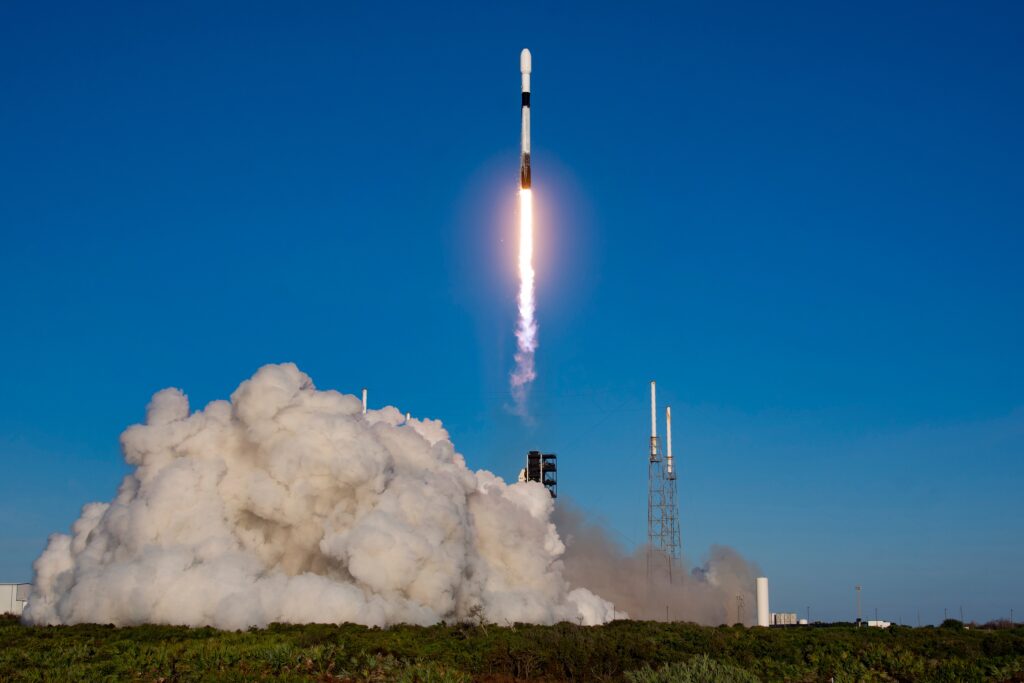
No one is in the launch market and is not competing with SpaceX, right? They’re so dominant that you’re absolutely competing for some of the same customers. I get excited about every Starship launch. I watch every one. It’s great for our industry, for humanity. I want to see more and more fully reusable rockets. We are a medium lift vehicle, so we do go after a slightly different vertical. We see massive unmet demand among what you might call third party, medium to large constellations of satellites, who want to serve a lot of terrestrial markets, communications with Earth observation, signals intelligence, obviously, national security missions as well. Those customers are not well served by the existing launch options. As Starship starts to become commercially available, I anticipate we’ll compete directly for those customers. There’s a lot of excitement justifiably about the new business models that will be unlocked by full and rapid reuse of launch vehicles. It’s important to note that while Starship will reduce costs, it does not necessarily reduce prices. For that, you need two competitors. Competing for customer business, driving prices down to follow cost. So when I look at some really exciting bets on the future that’s unlocked by starship, those are also bets on Stoke.


John Thornton
CEO, Astrobotic
When Astrobotic started back 18 years ago, we would go out and say, “Oh, we’re going to go land on the moon,” and we would literally get laughed at. I remember pitching it at pitch fest, and one of the judges just laughed at me the whole time because he just couldn’t believe the possibility that this could be real. That’s changed. Now we can say this publicly, and you probably don’t think I’m crazy. Maybe you do a little bit. We’re going to succeed as an industry. And NASA believes in that. We’re seeing that interest in demand from the customer side. When Viper came off our lander, we said, “Hey, who wants to go to the moon?” In a really short timeline, we had upwards of 60 players from all over the world knock on our door and say, “Hey, yeah, I want to go.” The demand is increasing, and we’ve only really just begun the trips to the surface of the moon. People are starting to recognize that the moon is the nearest neighbor. It’s the closest thing to Earth.
What else can you do there? Certainly science, certainly exploration. It’s also going to be the very beginning of resource extraction. People are recognizing that the poles of the moon are chock full of water ice. So water you can drink, of course, but you can split it so you’ve got oxygen to breathe. But most importantly, you can split water and condense it and make rocket fuel. So vast quantities of rocket fuel are frozen under the permanently shadowed craters on the surface of the moon. Rocket fuel in space is worth a lot, because you can get back and forth from the moon, you can get out to Mars, you can go beyond; so it starts to really crack open some big possibilities. Okay, getting to the moon is possible, and it’s getting cheaper. Okay, there’s resources there that we can use. Okay, well, what other resources are there in space? Can I learn to live off the land? Can I eventually take those resources from space and bring them back to Earth? That’s the future I believe in. That’s the future that I think the moon unlocks. If we can learn to do that on the moon, we can someday learn to use the resources of space and expand our economic sphere here on Earth and start digging in space and protecting our delicate blue planet. To me, it all starts with the moon.


Bobby Braun
Space Exploration sector head, Johns Hopkins Applied Physics Laboratory (APL)
Well, if you like NASA, you’ll love Dragonfly. It’s the most audacious and the most NASA mission that you could imagine, right? It’s a flying vehicle, so it touches NASA aeronautics. It’s a science mission. It’s laden with high tech science instrumentation. It certainly is an amazing piece of space technology. So it touches the Technology Directorate. And we are definitely exploring a new world, Titan. We at Johns Hopkins are leading that mission on behalf of NASA, but we have partners all around the country. We’re at the point right now where all the designs are finalized, and we’re actually building test hardware. The flight radio was just delivered to the integration and test area. If you were to go out to Lockheed Martin in Denver, you’d see our five meter diameter aeroshell and back shell structures already built, ready to go. The mission is on track to launch in July of 2028 now.
Titan is an ocean world, much like the Earth. We’re going there to learn about the early Earth. We’re a mission of scientific exploration, meaning we’re taking along with us a whole bunch of science instruments that are going to talk about the chemical building blocks of life. So we’re literally going all the way to Titan, the moon of Saturn, out in the outer fringes of our solar system, to learn about how life may have formed here on the Earth, we’re flying a machine that is powered by a nuclear system; by a radio isotope thermal generator that produces electricity. That electricity goes into a battery that we’re taking with us, and that battery either powers our science instrumentation or powers our ability to fly, or powers our telecom system to send data back to Earth.
There are no other spacecraft at Titan today, so we have to communicate directly all the way from Titan to Earth. And so that’s another way of saying our system has to be largely autonomous. Generally speaking, it’ll figure out which instruments to use, given its power levels, and how far to fly, given distance from a safe landing site. And over the course of about three and a third years, it’ll cover a distance from DC to New York, right across Titan’s surface. Think about the broad range of terrain that we’re going to get to explore over that time.

Marshall Smith
CEO, Starlab Space Systems
Starlab has three floors. We were just at the International Astronautical Conference recently, and we had a full size mock up, and everybody would walk around and go, “Holy cow, this is huge.” We have 100% of the payload capability that the ISS has. We have loads of external payload capability as well. The other thing is Starlab is designed differently than the ISS. The ISS was about getting these countries to work together. If you go look at the ISS, you see things. There’s cables and wires everywhere. Stuff just jammed in everywhere. It’s because it wasn’t designed, really, with research in mind. What we’re doing is we’re designing this first Starlab as a research system, a science system. It’s designed around the payload bays. It’s designed around giving proper video and communication capability and control and AI systems to these payloads and research systems. ISS was designed by engineers, for engineers. That’s the way I like to say it. And it looks like it and it feels like it, and actually smells like it. So we’ve partnered with Hilton as well as a company called Journey, which, if you see the sphere out in Las Vegas, they are behind that. This is different than what the government would normally do. We’re partnering with people that have a lot of experience in hospitality and dealing with people and the smells and they’re bringing that expertise to our designs.

Find Space Minds episodes featuring recordings of these conversations, as well as related articles, at spacenews.com/discovery-series.
This article first appeared in the December 2025 issue of SpaceNews Magazine.










Related Posts

Stay Informed With the Latest & Most Important News

Advertisement
-
 01Two Black Holes Observed Circling Each Other for the First Time
 -
 02From Polymerization-Enabled Folding and Assembly to Chemical Evolution: Key Processes for Emergence of Functional Polymers in the Origin of Life
 -
 03Astronomy 101: From the Sun and Moon to Wormholes and Warp Drive, Key Theories, Discoveries, and Facts about the Universe (The Adams 101 Series)
 -
 04True Anomaly hires former York Space executive as chief operating officer
 -
 05Φsat-2 begins science phase for AI Earth images
 -
 06Hurricane forecasters are losing 3 key satellites ahead of peak storm season − a meteorologist explains why it matters
 -
 07Binary star systems are complex astronomical objects − a new AI approach could pin down their properties quickly