
Now Reading: Icy Worlds: Moons And Dwarf Planets
-
01
Icy Worlds: Moons And Dwarf Planets


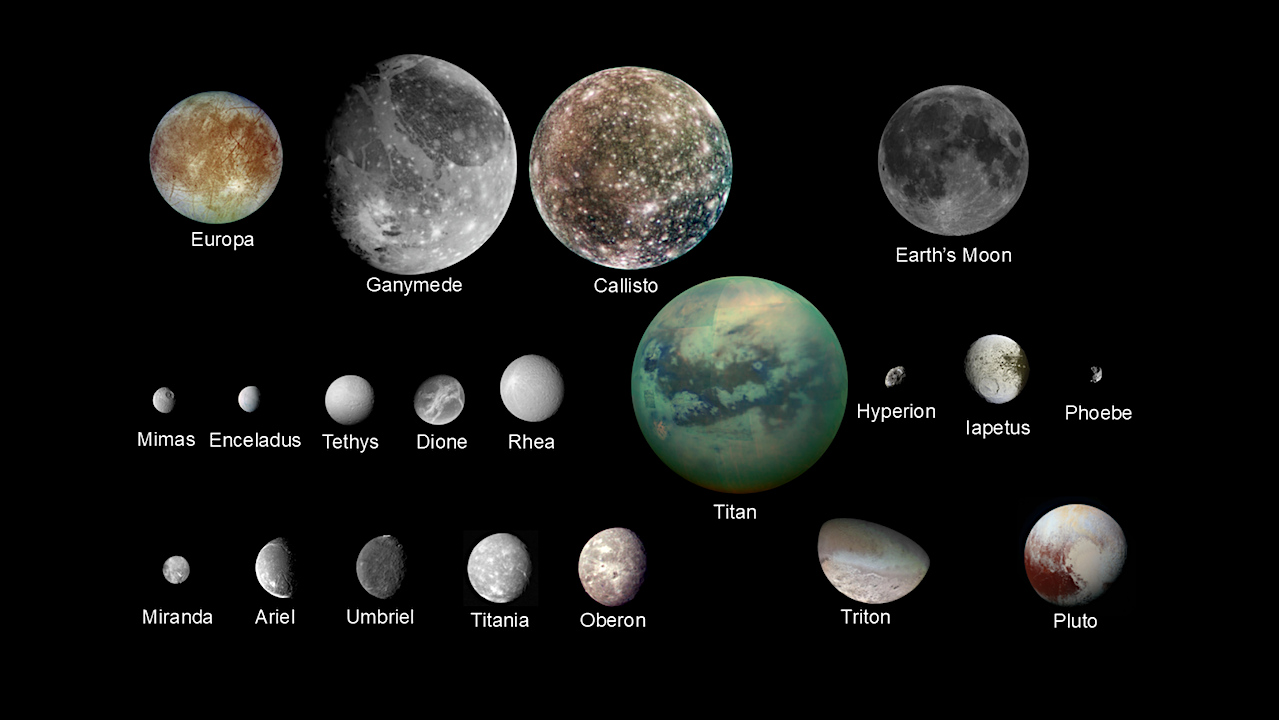
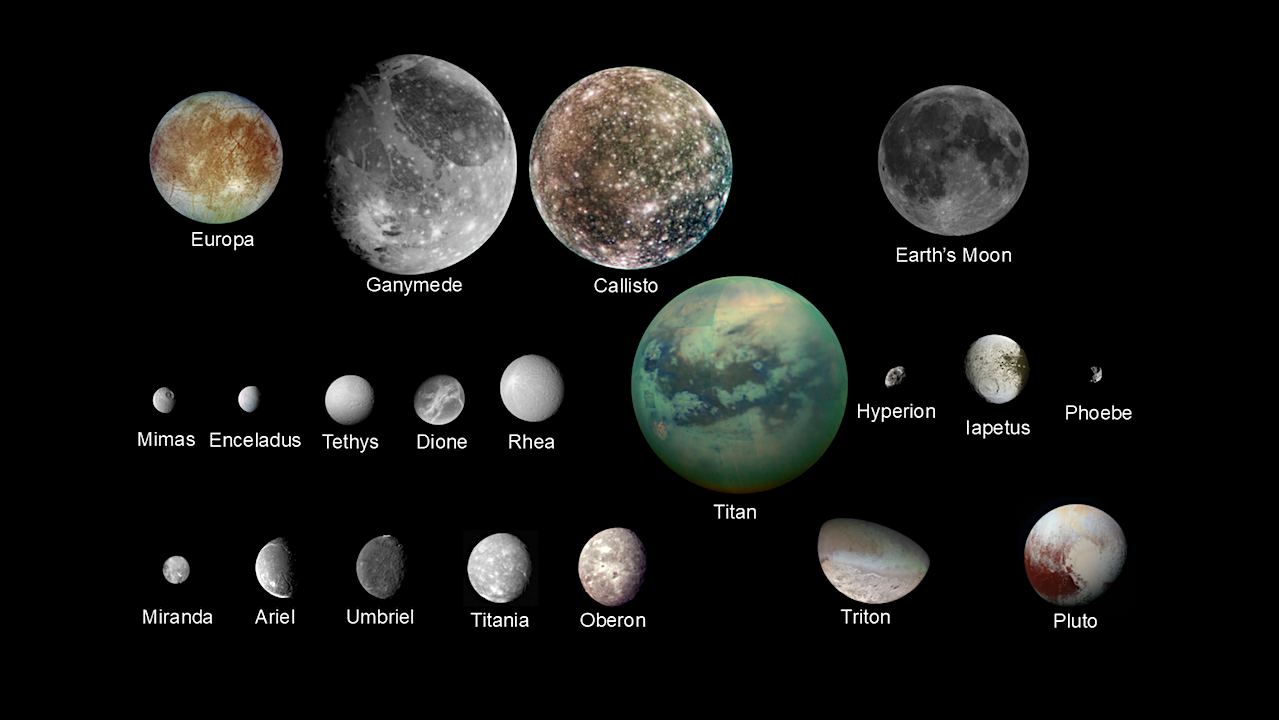
Major icy bodies in the Solar System, with the Earth’s moon to scale. The images are shown at the proper relative size. From NASA’s Planetary Photojournal (https://photojournal.jpl.nasa.gov/), Earth’s Moon (PIA00302), Europa (PIA00502), Ganymede (PIA00716), Callisto (PIA03456), Mimas (PIA06258), Enceladus (PIA06254), Tethys (PIA07738), Dione (PIA08256), Rhea (PIA08256), Titan (PIA08256), Hyperion (PIA07740), Iapetus (PIA08384), Phoebe (PIA06064), Miranda (PIA18185), Ariel (PIA01534), Umbriel (PIA00040), Titania (PIA01979), Oberon (PIA00034), Triton (PIA00317), Pluto (PIA19952). — astro-ph.EP
In the outer solar system beyond Jupiter, water ice is a dominant component of planetary bodies, and most solid objects in this region are classified as icy bodies.
Icy bodies display a remarkable diversity of geological, geophysical, and atmospheric processes, which differ fundamentally from those of the rocky terrestrial planets. Evidence from past and ongoing spacecraft missions has revealed subsurface oceans, cryovolcanic activity, and tenuous but persistent atmospheres, showing that icy bodies are active and evolving worlds.
At the same time, major questions remain unresolved, including the chemical properties of icy materials, the geological histories of their surfaces, and the coupling between internal evolution and orbital dynamics.
Current knowledge of the surfaces, interiors, and atmospheres of the principal icy bodies is built on spacecraft measurements, telescopic observations, laboratory experiments, and theoretical modeling. Recent contributions from Juno, JWST, and stellar occultation studies have added valuable constraints on atmospheric composition, interior structure, and surface activity.
Looking ahead, missions such as JUICE, Europa Clipper, Dragonfly, and the Uranus Orbiter and Probe are expected to deliver substantial progress in the study of icy bodies. Their findings, combined with continued Earth- and space-based observations and laboratory studies, will be critical for assessing the potential habitability of these environments and for placing them within a broader framework of planetary system formation and evolution.
Comments: invited review paper, accepted for publication in Oxford Research Encyclopedia of Planetary Science
Jun Kimura
Subjects: Earth and Planetary Astrophysics (astro-ph.EP)
Cite as: arXiv:2511.18776 [astro-ph.EP] (or arXiv:2511.18776v1 [astro-ph.EP] for this version)
https://doi.org/10.48550/arXiv.2511.18776
Focus to learn more
Related DOI:
https://doi.org/10.1093/acrefore/9780190647926.013.87
Focus to learn more
Submission history
From: Jun Kimura
[v1] Mon, 24 Nov 2025 05:21:05 UTC (4,534 KB)
https://arxiv.org/abs/2511.18776










Related Posts

Stay Informed With the Latest & Most Important News


Advertisement
-
 01Two Black Holes Observed Circling Each Other for the First Time
 -
 02From Polymerization-Enabled Folding and Assembly to Chemical Evolution: Key Processes for Emergence of Functional Polymers in the Origin of Life
 -
 03Astronomy 101: From the Sun and Moon to Wormholes and Warp Drive, Key Theories, Discoveries, and Facts about the Universe (The Adams 101 Series)
 -
 04True Anomaly hires former York Space executive as chief operating officer
 -
 05Φsat-2 begins science phase for AI Earth images
 -
 06Hurricane forecasters are losing 3 key satellites ahead of peak storm season − a meteorologist explains why it matters
 -
 07Binary star systems are complex astronomical objects − a new AI approach could pin down their properties quickly