
Now Reading: A Geothermal Amoeba Sets A New Upper Temperature Limit For Eukaryotes
-
01
A Geothermal Amoeba Sets A New Upper Temperature Limit For Eukaryotes


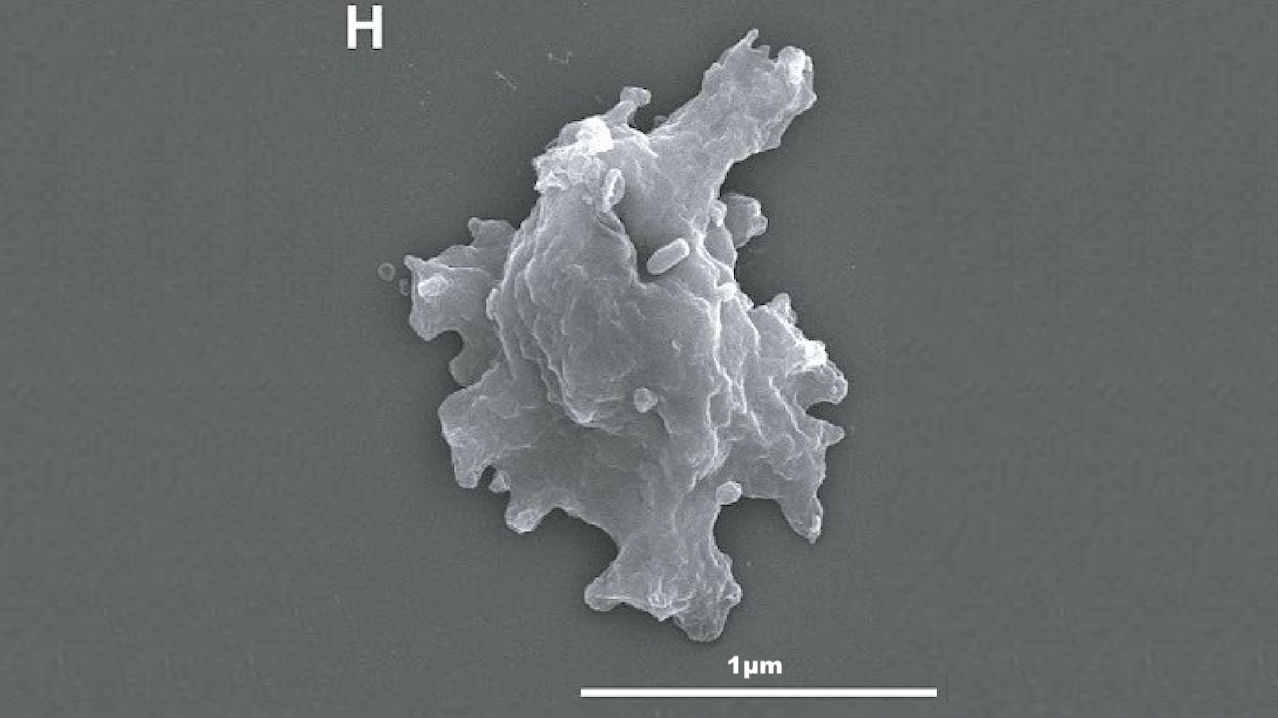

Phylogenetic, morphological, and physiological data support establishment of Incendiamoeba cascadensis, a novel genus and species within Amoebozoa. (H) SEM of V. vermiformis in amoebiform state. Scale bar = 1µm. — biorxiv.org
The study of temperature limits has transformed our knowledge of the boundaries of life but has been largely focused on bacteria and archaea. We isolated a novel geothermal amoeba, Incendiamoeba cascadensis, that divides at 63°C (145.4°F), establishing a new record for the upper temperature limit across all eukaryotes.
We demonstrated cellular proliferation with growth experiments and visualized mitosis via expansion microscopy. Using high-temperature live-cell imaging, we quantified movement up to 64°C.
We assembled the genome of I. cascadensis and using comparative genomics found an enrichment of genes related to proteostasis, genome stability, and sensing the external environment.
Taken together, our findings challenge the current paradigm of temperature constraints on eukaryotic cells and reshape our understanding of where and how eukaryotic life can persist.
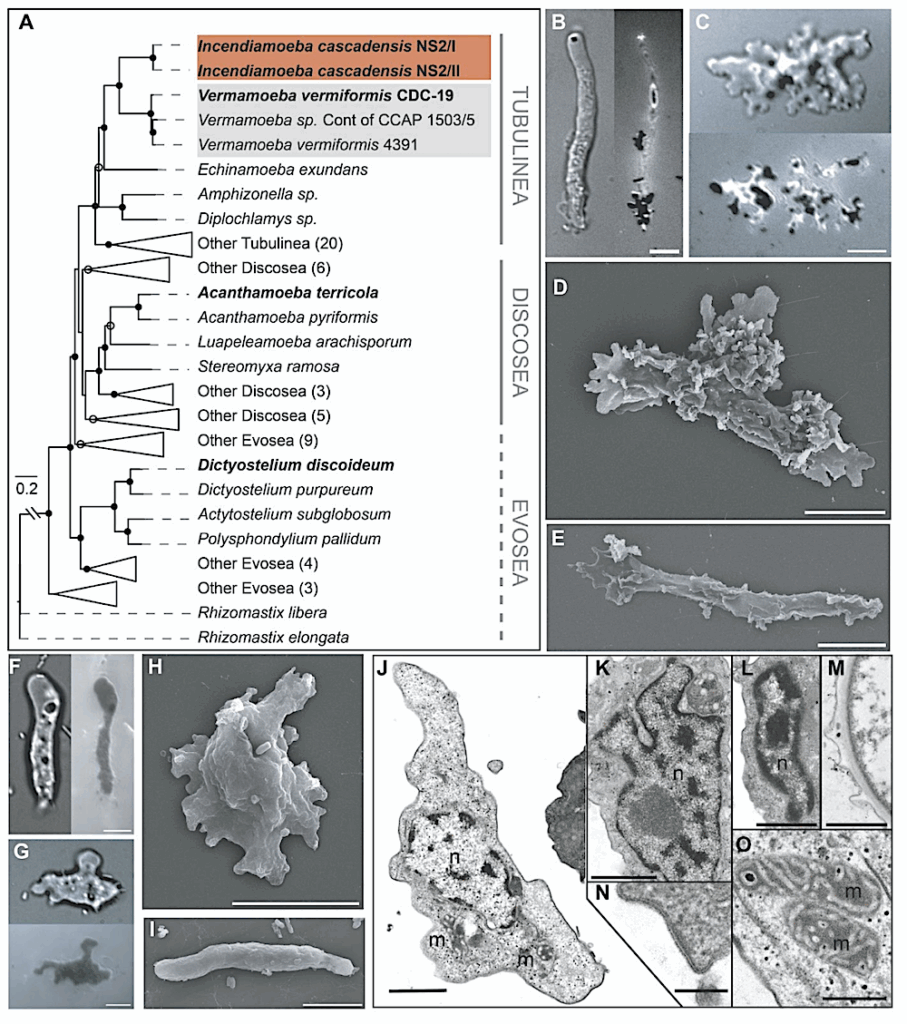
Phylogenetic, morphological, and physiological data support establishment of Incendiamoeba cascadensis, a novel genus and species within Amoebozoa. (A) Concatenated tree of 102 Amoebozoa genes, nodes labeled with filled circles have 100% bootstrap support, open circles have >90% bootstrap support. Novel amoeba sequences are highlighted in dark orange, Vermamoeba vermiformis in grey, and the species used for genome comparison are bolded. (B) DIC and corresponding RICM of representative I. cascadensis in vermiform state and (C) in amoebiform state. (D) SEM of I. cascadensis in amoebiform state and (E) SEM in vermiform state. (F) DIC and corresponding RICM of representative V. vermiformis in vermiform state and (G) in amoebiform state. (H) SEM of V. vermiformis in amoebiform state and (I) SEM in vermiform state. All scale bars A-H are 5µm. (J-O) TEM ultrastructure of I. cascadensis including: (J) Overview of fine structure of trophozoite, nucleus (n), mitochondria (m) (K) Lobate nucleus with dispersed chromatin aggregates. (L) Nucleus with chromatin aggregates beneath the nuclear envelope. (M) Bilayered cyst wall. (N) Cell surface of trophozoite. (O) Mitochondria with non-branching tubular cristae. Scale bars J-M are 1µm, N is 200nm, and O is 500nm. — biorxiv.org
A geothermal amoeba sets a new upper temperature limit for eukaryotes, biorxiv.org (open access)
Astrobiology,











Related Posts
Stay Informed With the Latest & Most Important News
Previous Post
Next Post




Advertisement
-
 01Two Black Holes Observed Circling Each Other for the First Time
 -
 02From Polymerization-Enabled Folding and Assembly to Chemical Evolution: Key Processes for Emergence of Functional Polymers in the Origin of Life
 -
 03Astronomy 101: From the Sun and Moon to Wormholes and Warp Drive, Key Theories, Discoveries, and Facts about the Universe (The Adams 101 Series)
 -
 04True Anomaly hires former York Space executive as chief operating officer
 -
 05Φsat-2 begins science phase for AI Earth images
 -
 06Hurricane forecasters are losing 3 key satellites ahead of peak storm season − a meteorologist explains why it matters
 -
 07Binary star systems are complex astronomical objects − a new AI approach could pin down their properties quickly