
Now Reading: Earthquakes Shake Up Yellowstone’s Subterranean Ecosystems
-
01
Earthquakes Shake Up Yellowstone’s Subterranean Ecosystems


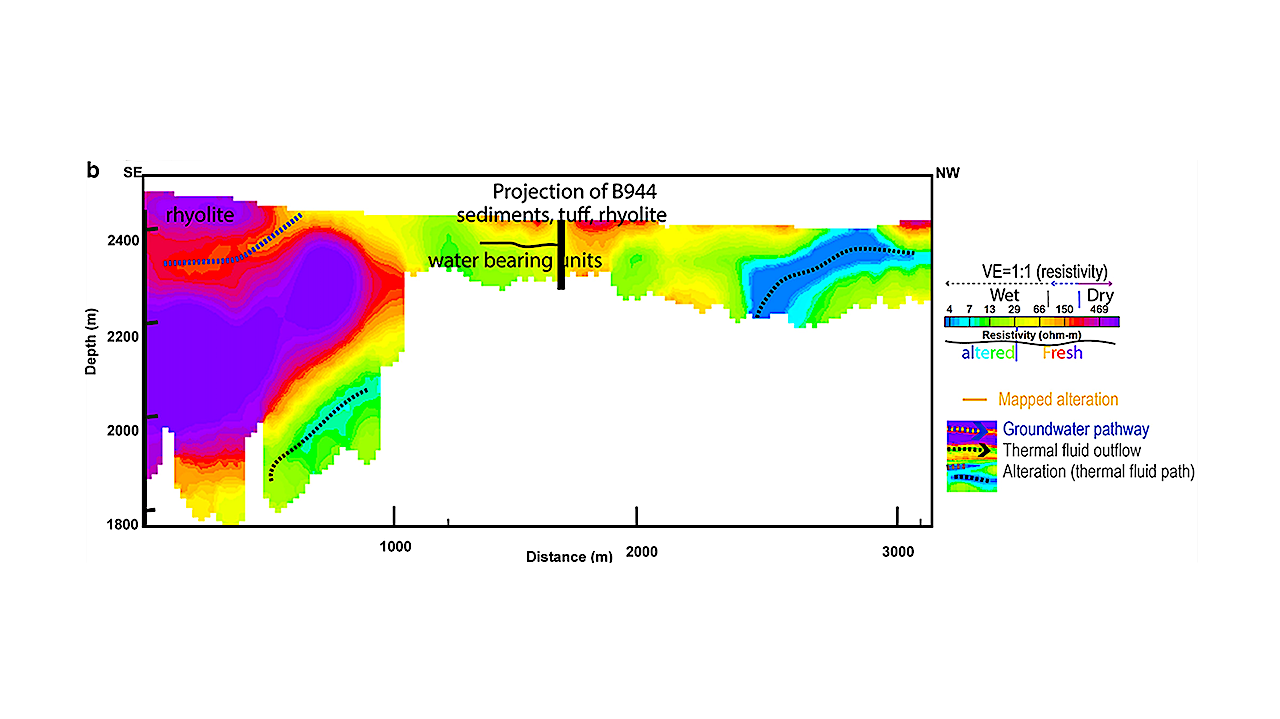
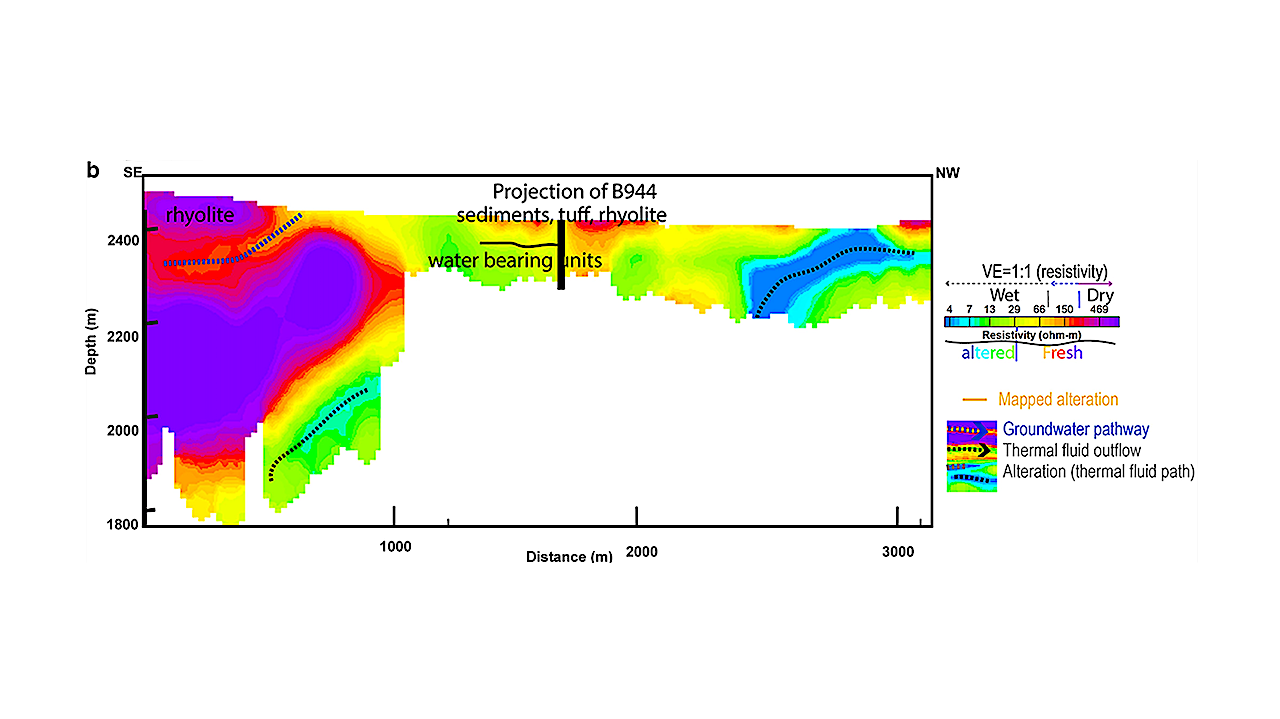
b) Cross-sections from 1D electrical resistivity models from inverted AEM data collected along the selected flight profile. Groundwater and thermal fluids containing appreciable total dissolved solids significantly reduce resistivities of porous volcanic rocks and can be differentiated by their resistivity signatures (40). Mapped alternation and resistivity signatures of groundwater pathways, thermal fluid pathways, and alteration are depicted. — PNAS Nexus
Up to 30% of life, by weight, is underground. Seismic activity may renew the energy supply for subterranean ecosystems.
Eric Boyd and colleagues chronicled the ecological changes in subsurface microbial communities that took place after a swarm of small earthquakes rattled the Yellowstone Plateau Volcanic Field in 2021.
Subsurface microbial communities are powered by chemical energy gleaned from the interactions between rocks and water. Earthquakes can expose new rocks, release trapped fluids, and alter the flow path of water, together kicking off new reactions and changing the chemical “menu” for subsurface microbes.
The authors collected fluid samples from a nearly 100-meter deep borehole on the western shore of Yellowstone Lake five times in 2021 chronicling increased concentrations of hydrogen, sulfide, and dissolved organic carbon after seismic activity. Shifts in the geochemical composition of waters were accompanied by increases in the concentration of planktonic cells.
Further, the microbial populations changed over time, unlike the relatively stable subsurface communities known to inhabit aquifers hosted in continental bedrock. According to the authors, kinetic energy from earthquakes can change the geochemical and microbial compositions of aquifer fluids.
The general mechanics implicated in the Yellowstone borehole could play out in a range of seismically active subterranean ecosystems—and could even be a dynamic that expands microbial habitability on rocky planets such as Mars.
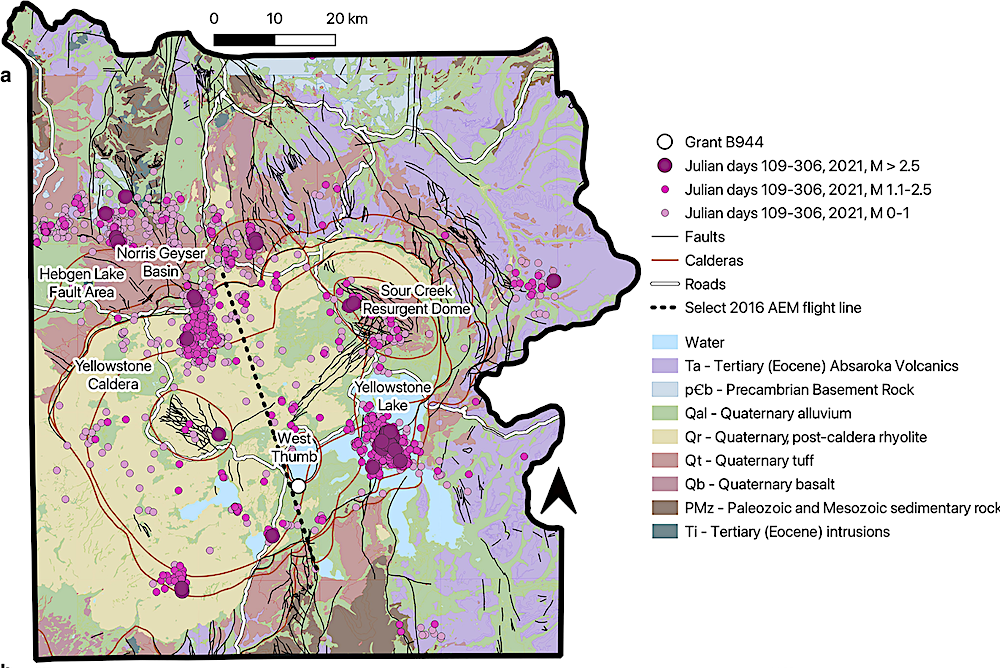
a) Location of the Grant (B944) borehole in Yellowstone National Park (YNP). Magenta dots represent seismic events across Julian days 109–306, 2021, with the size indicative of the magnitude (M) of the event. Quaternary fault lines are shown in black, caldera boundaries are shown in brown, and a single aerial electromagnetic (AEM) flight line that is 1200 m west of B944 is shown with a black dashed line (40). — PNAS Nexus
Seismic shifts in the geochemical and microbial composition of a Yellowstone aquifer, PNAS Nexus (open access)
Astrobiology










Related Posts
Stay Informed With the Latest & Most Important News
Previous Post
Next Post


Advertisement
-
 01Two Black Holes Observed Circling Each Other for the First Time
 -
 02From Polymerization-Enabled Folding and Assembly to Chemical Evolution: Key Processes for Emergence of Functional Polymers in the Origin of Life
 -
 03Astronomy 101: From the Sun and Moon to Wormholes and Warp Drive, Key Theories, Discoveries, and Facts about the Universe (The Adams 101 Series)
 -
 04True Anomaly hires former York Space executive as chief operating officer
 -
 05Φsat-2 begins science phase for AI Earth images
 -
 06Hurricane forecasters are losing 3 key satellites ahead of peak storm season − a meteorologist explains why it matters
 -
 07Binary star systems are complex astronomical objects − a new AI approach could pin down their properties quickly