
Now Reading: Sun unleashes powerful X-class solar flare, knocking out radio signals across Australia
-
01
Sun unleashes powerful X-class solar flare, knocking out radio signals across Australia

Sun unleashes powerful X-class solar flare, knocking out radio signals across Australia

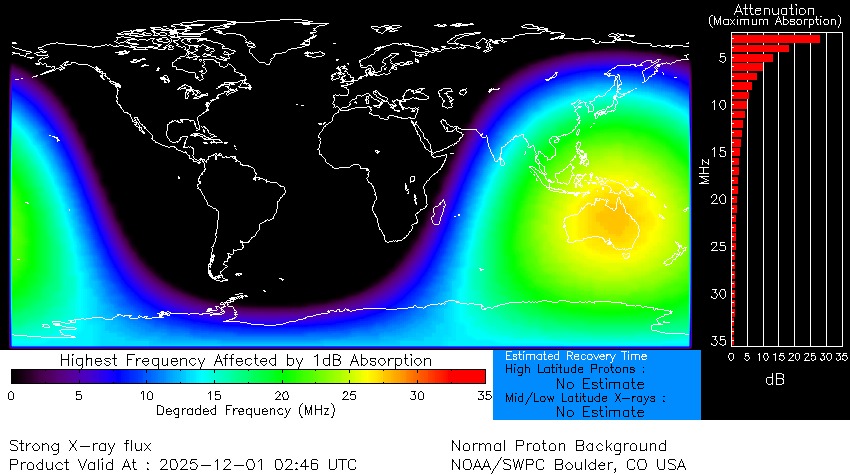
The sun kicked off December with a bang, unleashing a strong X1.9-class solar flare that briefly knocked out radio communications across Australia and parts of southeast Asia.

Coronagraph imagery from SOHO revealed a rapid partial-halo coronal mass ejection (CME), a release of plasma and magnetic field from the sun, blasting off the sun’s northeast limb. Earth modelling confirms that the CME is not Earth-directed.
But the real story might be in the enormous sunspot region following closely behind this flare. AR4294, a sprawling, magnetically complex sunspot cluster, is now turning toward Earth. It is so complex that NOAA has split the region into three numbered groups because of its size and complexity. This is also the same area of the sun responsible for multiple X-class flares last month — and it’s only grown even larger.

NOAA space weather forecasters anticipate a likely continuation of M-class solar flares and a slight chance of more X-flares between Dec. 1-3. While no Earth-directed CMEs have been detected, increased activity from AR4294 could change that in the days ahead, so watch this space!
Meanwhile, geomagnetic conditions are expected to stay mostly quiet until Dec. 3, when a negative-polarity coronal hole stream may bring minor (G1) geomagnetic storming.










Related Posts

Stay Informed With the Latest & Most Important News
Previous Post
Next Post


Advertisement
-
 01Two Black Holes Observed Circling Each Other for the First Time
 -
 02From Polymerization-Enabled Folding and Assembly to Chemical Evolution: Key Processes for Emergence of Functional Polymers in the Origin of Life
 -
 03Astronomy 101: From the Sun and Moon to Wormholes and Warp Drive, Key Theories, Discoveries, and Facts about the Universe (The Adams 101 Series)
 -
 04True Anomaly hires former York Space executive as chief operating officer
 -
 05Φsat-2 begins science phase for AI Earth images
 -
 06Hurricane forecasters are losing 3 key satellites ahead of peak storm season − a meteorologist explains why it matters
 -
 07Binary star systems are complex astronomical objects − a new AI approach could pin down their properties quickly