
Now Reading: The Role Of Polycyclic Aromatic Hydrocarbons In Astrochemical Modeling At Different Evolutionary Stages Of Cold Dense Cloud Cores
-
01
The Role Of Polycyclic Aromatic Hydrocarbons In Astrochemical Modeling At Different Evolutionary Stages Of Cold Dense Cloud Cores

The Role Of Polycyclic Aromatic Hydrocarbons In Astrochemical Modeling At Different Evolutionary Stages Of Cold Dense Cloud Cores

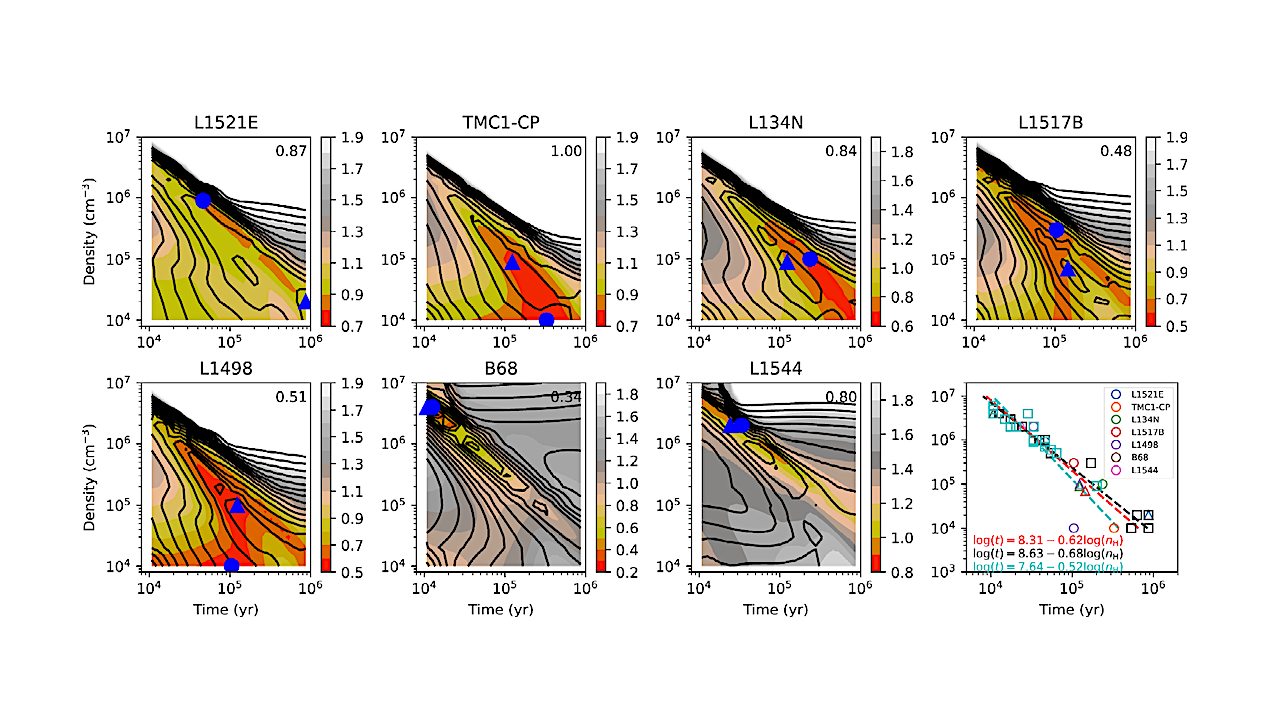
Average difference (D ¯) between models and observations over model time (x-axis) and model density (y-axis) for the seven objects except the last panel which is for the determined best values for the objects. The colors and contours are for static models with and without PAHs, respectively. The contours with levels of D ¯ min (value labeled) to 2.0 by a step of 0.1. A cutoff of D ¯ = 2.0 is applied. In the first seven panels, the empty circle and triangle indicate the best values from the models with and without PAHs respectively. In the last panel, the determined best values for PGCCs are also shown with unfilled black squares (without PAHs) and cyan circles (with PAHs) which were adopted from Fig. B.2. The black, cyan and red lines are linear fits in log-log space for the fit data without PAHs, with PAHs and the combined one of the former two, respectively. — Astronomy & Astrophysics
Context. Although the role of PAHs have been highlighted in recent years, it is crucial to verify their functions at different evolutionary stages of dark cloud cores.
Aims. Fitting molecular abundances with gas-grain chemical models has revealed shorter chemical ages for denser cold dark cloud cores. To deepen the understanding of chemical ages and the functions of PAHs, we investigated the influence of PAHs in our chemical models by fitting observational data.
Methods. We collected observed molecular abundances (at least five species per core) from the literature for 39 cold dense cloud cores (T < 25 K and 104 ≤ nH ≤ 107 cm−3). Using a gas-grain chemical model, we fit the molecular abundances of the 39 samples to determine the best-fit chemical ages and discuss the role of PAHs in an evolutionary view.
Results. We find an anticorrelation between the gas density and the fit chemical age through molecular abundance fitting. The best-fit chemical ages of the low-density cores (<7 × 104 cm−3) are comparable to the dynamical ages, which can be a good alternative indicator of physical age.
However, for high-density cores (>7 × 104 cm−3), the chemical age is far from the physical age and therefore useless. The inclusion of PAHs do not change the estimation of the chemical ages much, which indicates the small effect of PAHs on average. However, we identified molecular tracers that are sensitive to PAHs at different evolutionary stages, thus revealing their diagnostic potential for chemical evolution.
The role of polycyclic aromatic hydrocarbons in astrochemical modeling at different evolutionary stages of cold dense cloud cores, Astronomy & Astrophysics (A&A) (open access)
Astrobiology, Astrochemistry,











Related Posts
Stay Informed With the Latest & Most Important News
Previous Post
Next Post



Advertisement
-
 01Two Black Holes Observed Circling Each Other for the First Time
 -
 02From Polymerization-Enabled Folding and Assembly to Chemical Evolution: Key Processes for Emergence of Functional Polymers in the Origin of Life
 -
 03Astronomy 101: From the Sun and Moon to Wormholes and Warp Drive, Key Theories, Discoveries, and Facts about the Universe (The Adams 101 Series)
 -
 04True Anomaly hires former York Space executive as chief operating officer
 -
 05Φsat-2 begins science phase for AI Earth images
 -
 06Hurricane forecasters are losing 3 key satellites ahead of peak storm season − a meteorologist explains why it matters
 -
 07Binary star systems are complex astronomical objects − a new AI approach could pin down their properties quickly