
Now Reading: Sun-watcher SOHO celebrates thirty years
-
01
Sun-watcher SOHO celebrates thirty years


02/12/2025
98 views
2 likes
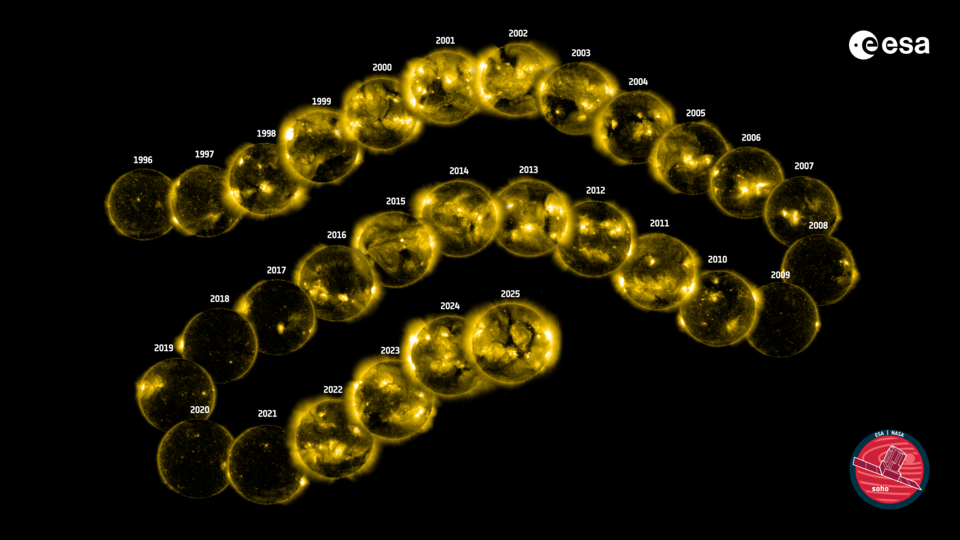
On 2 December 1995 the ESA/NASA Solar and Heliospheric Observatory (SOHO) blasted into space – on what was supposed to be a two-year mission.
From its outpost 1.5 million km away from Earth in the direction of the Sun, SOHO enjoys uninterrupted views of our star. It has provided a nearly continuous record of our Sun’s activity for close to three 11-year-long solar cycles.
“It is testament to the ingenuity of our engineers, operators and scientists, and to international collaboration, that this mission has exceeded all expectations,” says Prof. Carole Mundell, ESA Director of Science. “SOHO has overcome nail-biting challenges to become one of the longest-operating space missions of all time.”
“The SOHO mission is a great example of the incredible partnerships between NASA and ESA,” adds Nicky Fox, associate administrator, Science Mission Directorate at NASA Headquarters in Washington. “Congratulations to the NASA and ESA teams on an amazing thirty years working together.”
The mission has not been without drama. Two-and-a-half years after launch, the spacecraft suffered a critical error, spinning out of control and losing contact with Earth. An international rescue team worked tirelessly for three months to locate and recover it.
Then, in November & December 1998, the spacecraft’s stabilising gyroscopes failed and a new race to save the mission began. By February 1999, new software enabled the spacecraft to fly without the need for gyroscopes, and it has been revolutionising solar science ever since.
“SOHO pioneered new fields in solar science. It is a game-changer in the study of space weather, providing real-time monitoring of the Sun to forecast potentially dangerous solar storms heading towards Earth, and its legacy continues to guide future missions,” says Daniel Müller, ESA Project Scientist for SOHO and Solar Orbiter.
“SOHO is still producing high-quality data on a daily basis, and with hundreds of papers being published every year, its scientific productivity remains very high.”
Daniel’s new paper ‘SOHO’s 30-year legacy of observing the Sun’ is published in Nature Astronomy on Tuesday 2 December 2025. Text continues after image


Here are five highlights from the last five years:
1. A single plasma conveyor belt
SOHO led the way in ‘helioseismology’. Akin to studying how seismic waves traverse Earth during an earthquake, helioseismology probes the inside of the Sun by studying how sound waves reverberate through it. Early in its career, SOHO provided the first images of plasma flows (electrically charged material) beneath the Sun’s surface, offering a unique window into its layered interior.
Thanks to SOHO’s long lifetime, scientists have used helioseismology to solve an enduring mystery: plasma flows along a single loop, or cell, in each of the Sun’s hemispheres – not multiple cells as previously thought.
The data show that it takes about 22 years for plasma to complete an entire loop around this single ‘conveyor belt’, flowing from the surface near the equator up to the poles, then traveling back down deep inside towards the equator. This matches the timeline of the Sun’s magnetic cycle, explaining how sunspots – regions where intense magnetic fields break through the Sun’s surface – emerge progressively closer to the equator over the solar cycle.
2. Does the Sun shine steadily?
The amount of energy that floods out of the Sun is a fundamental quantity in understanding the impact of solar heating on Earth’s atmosphere and climate. SOHO’s three decades of data, in combination with older measurements, provide unrivalled measurements spanning nearly fifty years.
The total energy output of the Sun changes very little – on average, by only 0.06% over the solar cycle. By contrast, the variation in extreme ultraviolet radiation is substantial, doubling between solar minimum and maximum. Solar extreme ultraviolet radiation significantly influences the temperature and chemistry in Earth’s upper atmosphere, but is not a direct driver of the global warming trends observed near Earth’s surface.
3. Solar storm monitoring made law
SOHO has played such a pivotal role in the development of real-time space weather monitoring systems that it was signed into United States law in October 2020.
The ‘Promoting Research and Observations of Space Weather to Improve the Forecasting of Tomorrow’ (PROSWIFT) act SOHO’s Large Angle and Spectrometric Coronagraph (LASCO) instrument.
LASCO is a coronagraph, a telescope with a disc masking the centre of view. By blocking out the direct light coming from the Sun, the instrument can see light from the surrounding atmosphere, called the corona. This allows us to see coronal mass ejections – large eruptions of solar material and magnetic fields – as they set off from the Sun, providing up to three days warning of potentially disruptive incoming space weather reaching Earth.
4. 5000 comets – and counting!
The telescope’s prowess as a comet hunter was unplanned, but turned out to be an unexpected success. Thanks to the screening effect of SOHO’s coronagraph, ‘sungrazer’ comets – those that approach the Sun at very close distances – also become visible.
Not all comets seen by SOHO are sungrazers. For example, it also beautifully captured Comet Tsuchinshan–ATLAS, also called the Great Comet of 2024, a non-periodic comet from the outer reaches of the Solar System.
SOHO discovered its 5000th comet in March 2024, making it the most prolific comet-discoverer in history. Most of these have been found by citizen scientists worldwide through the Sungrazer Project. The observations have provided valuable data on the movement, composition and dust production of comets.
5. Enabling future discoveries
SOHO’s success has shaped the next generation of solar observatories, both in terms of their technology and scientific objectives, as well as being a role model for open data policies and international collaboration.
For example, the ESA-led Solar Orbiter mission is imaging the solar poles from higher latitude and flying much closer to the Sun, with many of its instruments being successors of SOHO’s. Similarly, NASA’s Solar Dynamics Observatory carries improved versions of SOHO’s instruments to continue the legacy that SOHO began in areas of full-disc imaging and helioseismology. Moreover, SOHO frequently contributes to ‘multipoint’ measurements, providing essential context for Solar Orbiter and NASA’s Parker Solar Probe as they fly along their own unique orbits around the Sun.
Even more recently, ESA’s Proba-3 took to the skies to open up new views of the Sun’s faint corona, while the Agency’s upcoming Vigil mission will be the first to monitor the Sun from the ‘side’, detecting solar storms before they roll into SOHO’s line-of-sight.
“SOHO is an all-round shining success, thanks to the dedication of the teams keeping this incredible machine flying,” says Daniel. “Its science remains valuable and relevant, serving generations of scientists, and I’m certain that its legacy will continue to guide solar science for decades to come.”
Notes for editors
‘SOHO’s 30-year legacy of observing the Sun’ by Müller et al. is published today in Nature Astronomy.
For more information please contact:
ESA Media Relations
media@esa.int










Related Posts

Stay Informed With the Latest & Most Important News
Previous Post
Next Post


Advertisement
-
 01Two Black Holes Observed Circling Each Other for the First Time
 -
 02From Polymerization-Enabled Folding and Assembly to Chemical Evolution: Key Processes for Emergence of Functional Polymers in the Origin of Life
 -
 03Astronomy 101: From the Sun and Moon to Wormholes and Warp Drive, Key Theories, Discoveries, and Facts about the Universe (The Adams 101 Series)
 -
 04True Anomaly hires former York Space executive as chief operating officer
 -
 05Φsat-2 begins science phase for AI Earth images
 -
 06Hurricane forecasters are losing 3 key satellites ahead of peak storm season − a meteorologist explains why it matters
 -
 07Binary star systems are complex astronomical objects − a new AI approach could pin down their properties quickly