
Now Reading: Zhuque-3 reaches orbit on test flight, first stage lost during landing attempt
-
01
Zhuque-3 reaches orbit on test flight, first stage lost during landing attempt


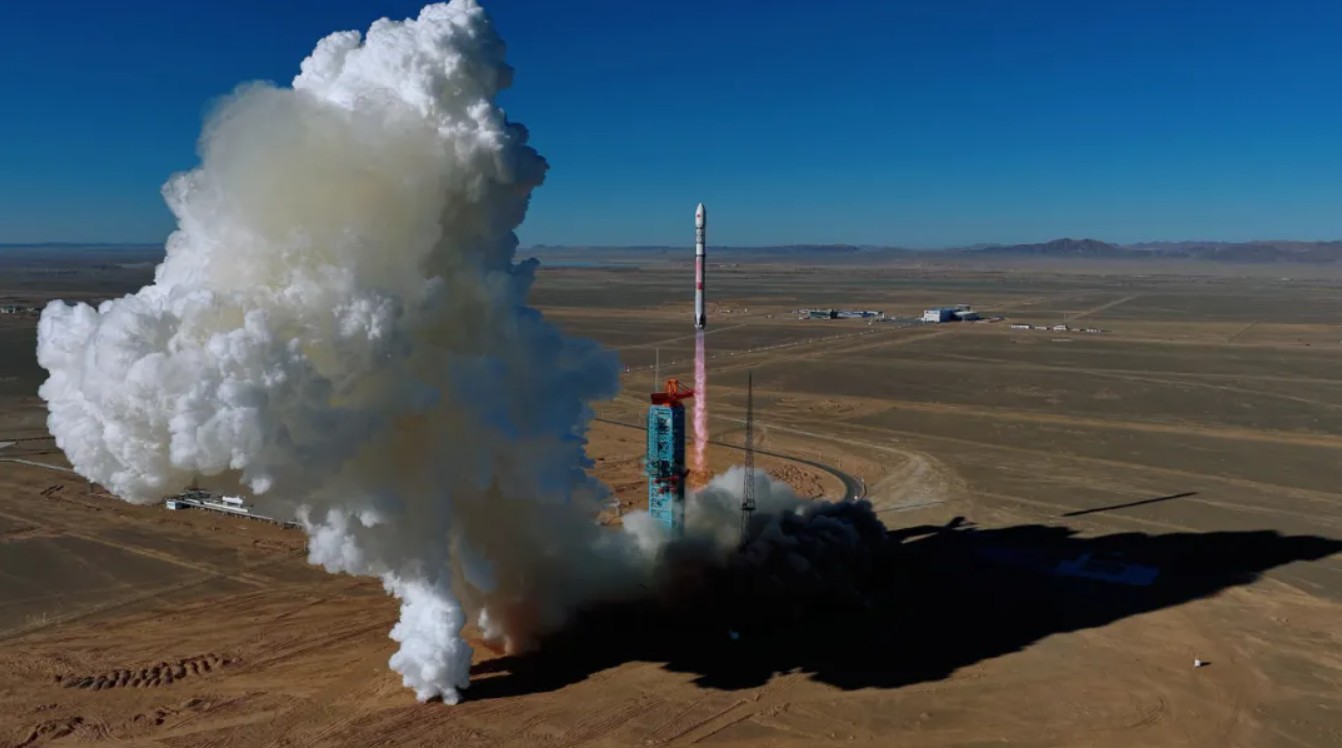

HELSINKI — China’s Landspace carried out the first launch of its reusable Zhuque-3 rocket late Tuesday, successfully achieving orbit, but failing with a first stage landing attempt.
The first Zhuque-3 lifted off at around 11:02 p.m. Eastern, Dec. 2 (0402 UTC, Dec. 3) from a Landspace pad at the Dongfeng Commercial Space Innovation Test Zone within the national Jiuquan Satellite Launch Center. The rocket successfully climbed off the pad and into a blue sky above the spaceport in the Gobi Desert.
The first stage performed a reentry for a first-ever Chinese orbital launch and landing attempt at a pad around 390 kilometers downrange in Minqin county, Gansu province. Footage circulating on Chinese social media appears to show an anomalous combustion shortly after the landing burn began, seeing the booster catch fire on descent and smash into the pad.
Landspace said in a statement that the debris landed on the edge of the recovery pad, resulting in a failed recovery test, adding that specific cause is under further investigation.
Shortly after the landing attempt, images from mission control showed a screen indicating that the second stage had continued, powered by a single Tianque 15A vacuum engine, and achieved orbit. There was no indication from Landspace or Chinese media reports of any payload aboard the rocket.
The mission is a milestone for Chinese spaceflight, marking the country’s first attempt at recovery of a stage from an orbital launch. The mission indicates China is close to obtaining a key capability for lowering launch costs and enabling rapid commercial cadence.
The successful flight could pave the way for commercial firm Landspace to begin launching batches of satellites for China’s megaconstellation projects, while also providing valuable data and experience for future recovery attempts.
Landspace’s Zhuque-3 is a two-stage, stainless steel rocket with a diameter of 4.5 meters and a mass at liftoff of about 570 metric tons. The rocket stands approximately 66 meters tall on the pad, with its first stage powered by nine Tianque-12A methane-liquid oxygen engines.
The operational Zhuque-3 is to have a payload capacity to low Earth orbit (LEO) of 21,000 kilograms when expendable, or up to 18,300 kg when the first stage is recovered downrange, making it comparable to the Falcon 9 in terms of payload capacity. The Zhuque-3 (Vermillion Bird-3) is also China’s first large stainless-steel methalox rocket, implicitly paralleling SpaceX’s Starship manufacturing approach.
Landspace says the rocket possesses the capability to deploy multiple satellites for internet constellations with a single launch, providing strong transport capacity support for major national aerospace projects and satellite internet deployment.
The company thanked the China National Space Administration (CNSA), Jiuquan spaceport, the Communist Party of China and a range of local and provincial governments for their backing and support.
The Zhuque-3 test flight was China’s 77th orbital launch attempt of 2025. China’s main space contractor is preparing its new reusable Long March 12A at Jiuquan. The rocket could make its first orbital launch and landing attempt at some time in December.










Related Posts



Stay Informed With the Latest & Most Important News
Previous Post
Next Post
Previous Post

Next Post




Advertisement
-
 01Two Black Holes Observed Circling Each Other for the First Time
 -
 02From Polymerization-Enabled Folding and Assembly to Chemical Evolution: Key Processes for Emergence of Functional Polymers in the Origin of Life
 -
 03Astronomy 101: From the Sun and Moon to Wormholes and Warp Drive, Key Theories, Discoveries, and Facts about the Universe (The Adams 101 Series)
 -
 04True Anomaly hires former York Space executive as chief operating officer
 -
 05Φsat-2 begins science phase for AI Earth images
 -
 06Hurricane forecasters are losing 3 key satellites ahead of peak storm season − a meteorologist explains why it matters
 -
 07Binary star systems are complex astronomical objects − a new AI approach could pin down their properties quickly