
Now Reading: Large Magellanic Cloud bursts with baby stars | Space photo of the day for Dec. 3, 2025
-
01
Large Magellanic Cloud bursts with baby stars | Space photo of the day for Dec. 3, 2025

Large Magellanic Cloud bursts with baby stars | Space photo of the day for Dec. 3, 2025

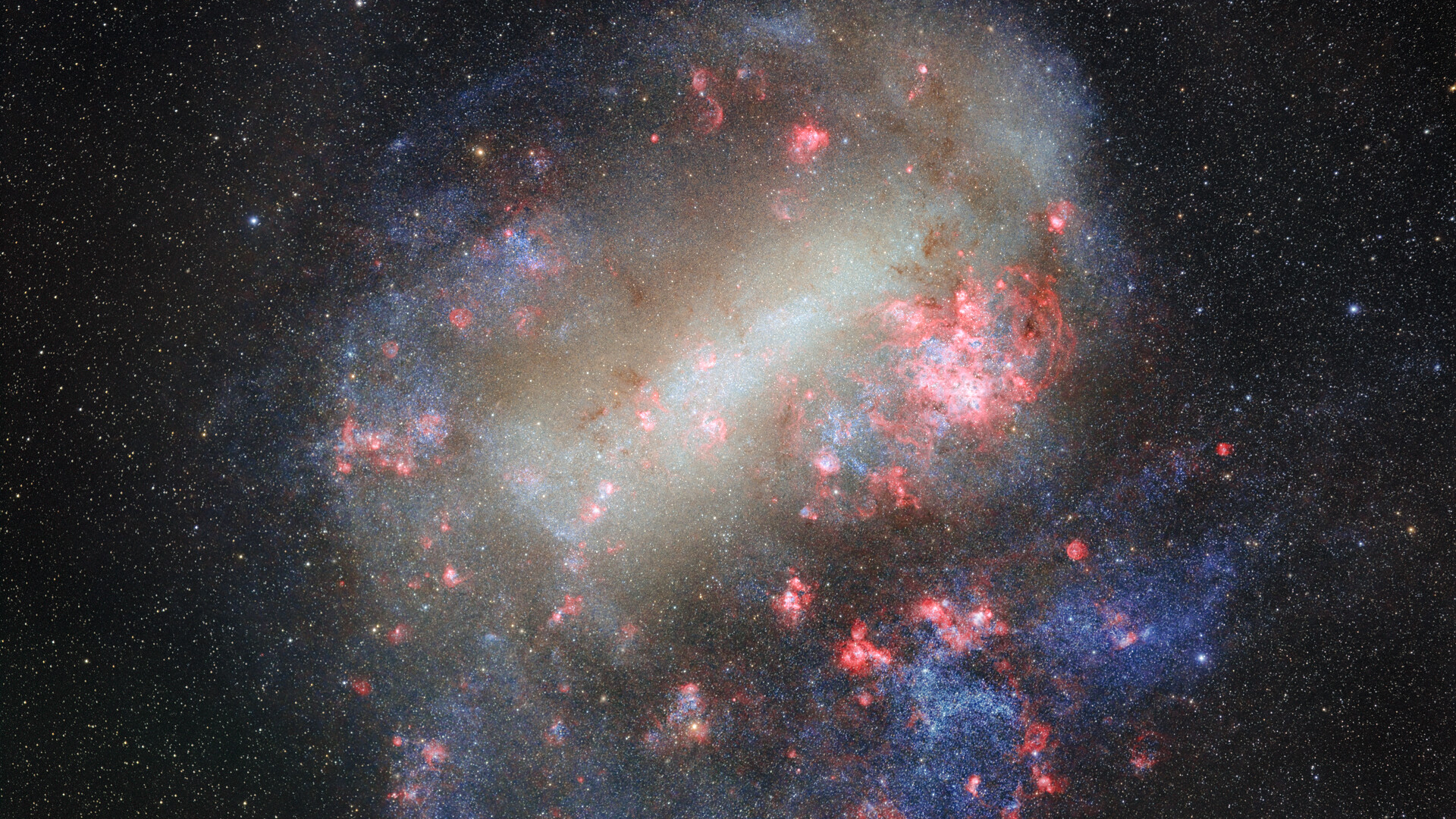
It’s not easy to capture stunning space views. At least, that was the case for photographer and NOIRLab Audiovisual Ambassador Petr Horálek. Using a commercial camera and a wide-aperture telephoto lens, Horálek photographed the Large Magellanic Cloud galaxy over three nights from Cerro Pachón in Chile, the home of Gemini South, part of the U.S. National Science Foundation’s International Gemini Observatory.
The long integration time, spanning around four hours, allowed faint galactic features to emerge: the luminous central bar, wisps of star-forming regions, and the soft surrounding glow of billions of stars.
What is it?
The Large Magellanic Cloud (LMC) is one of the Milky Way’s closest and most intriguing companions. Visible primarily from the Southern Hemisphere, this dwarf galaxy hangs in the night sky as a faint, cloud-like patch, large enough to spot with the naked eye yet small compared to our own galaxy. While the Milky Way contains anywhere from 100 billion to 400 billion stars, the LMC holds roughly 20 billion, placing it among the more massive members of the Milky Way’s entourage of 60+ known satellite galaxies.
Despite its size, the LMC commands cosmic attention. Classified as an irregular galaxy, it lacks the coherent spiral structure that defines the Milky Way. Its central bar appears off-center, suggesting that the LMC was likely once a barred spiral galaxy, only to have its graceful arms distorted over time by gravitational interactions. Those interactions—particularly with the Milky Way and the neighboring Small Magellanic Cloud (SMC) — have pulled at its structure, warping its disk and rearranging its stars and gas.
These gravitational tugs of war may have altered the galaxy’s shape, but they have also sparked another phenomenon: intense star formation.
Where is it?
This image was taken from Cerro Pachón in Chile, though the Large Magellanic Cloud is located around 160,000 light-years from Earth.

Why is it amazing?
Irregular galaxies are often fertile grounds for star birth, and the LMC is no exception. In fact, it hosts the most active star-forming region in the Local Group: the famed 30 Doradus nebula, better known as the Tarantula Nebula. This cosmic nursery contains some of the most massive and most luminous stars ever observed, forming at extraordinary rates as dense clouds of gas collapse under their own gravity.
One reason for this vibrant activity lies in the ongoing interaction between the LMC and the SMC. The LMC, being the more massive partner, has been caught in the act of “stealing” gas and stars from the SMC, an astrophysical heist that significantly reshapes both galaxies.
As material is siphoned from the SMC, it collides with the LMC’s own reservoirs of gas, generating shock fronts, compressing clouds, and forming a sprawling gaseous bridge between the two galaxies. These collisions create ideal conditions for star formation, fueling both the LMC’s glowing nebulae and the star-rich structures that span the intergalactic space between the clouds.
Want to learn more?
You can learn more about the Large Magellanic Cloud and stellar nurseries.










Related Posts

Stay Informed With the Latest & Most Important News
Previous Post
Next Post




Advertisement
-
 01Two Black Holes Observed Circling Each Other for the First Time
 -
 02From Polymerization-Enabled Folding and Assembly to Chemical Evolution: Key Processes for Emergence of Functional Polymers in the Origin of Life
 -
 03Astronomy 101: From the Sun and Moon to Wormholes and Warp Drive, Key Theories, Discoveries, and Facts about the Universe (The Adams 101 Series)
 -
 04True Anomaly hires former York Space executive as chief operating officer
 -
 05Φsat-2 begins science phase for AI Earth images
 -
 06Hurricane forecasters are losing 3 key satellites ahead of peak storm season − a meteorologist explains why it matters
 -
 07Binary star systems are complex astronomical objects − a new AI approach could pin down their properties quickly