
Now Reading: An Asgard Archaeon With Internal Membrane Compartments
-
01
An Asgard Archaeon With Internal Membrane Compartments


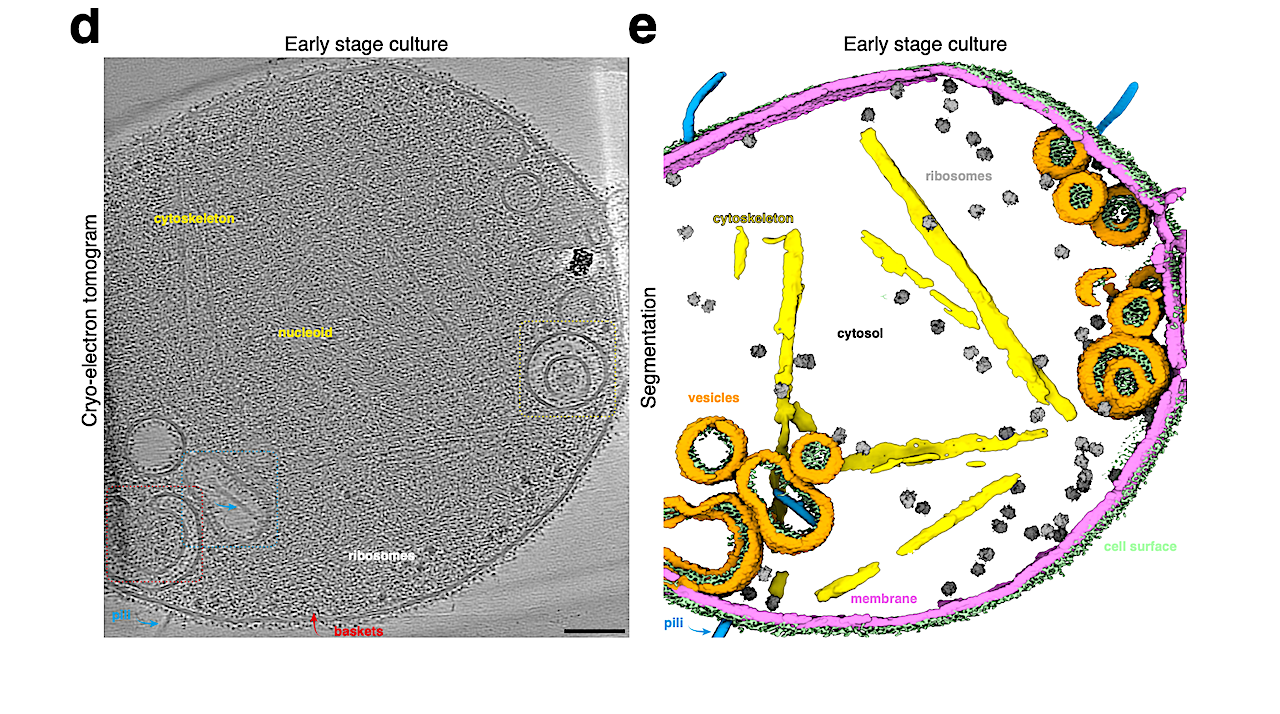
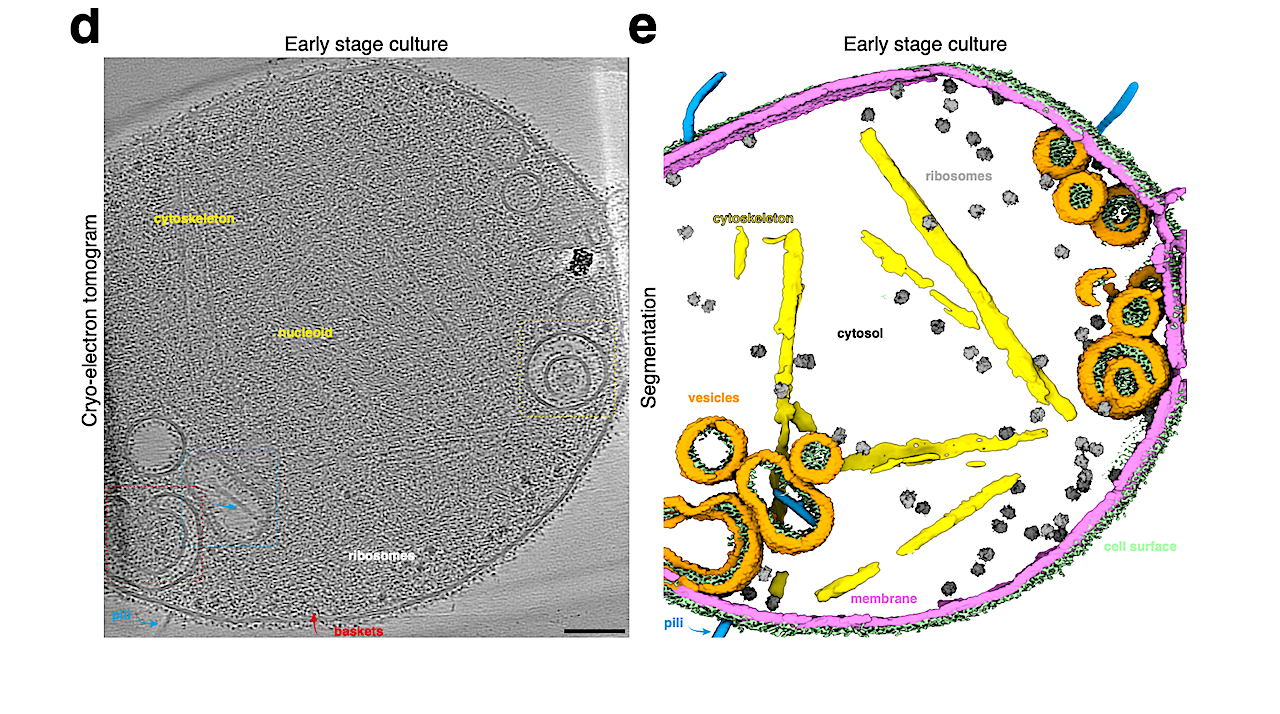
(d) Cryo-ET slice through a cell body of early-log phase Ca. Y. umbracryptum with multiple intracellular vesicles. Scale bar: 100 nm. (e) Semantic segmentation of the tomogram shown in panel d) depicting the cell membrane (pink), cell-surface proteins (pale green), pili (blue), ribosomes (grey), cytoskeletal filaments (yellow) and intracellular vesicles (orange). Scale bar: 100 nm. — biorxiv.org
The emergence of eukaryotes from a merger between an archaeon and a bacterial cell ~two billion years ago involved a profound change in cellular organisation.
While the order in which different features of the eukaryotic cell arose remains a matter of controversy(1-3), close archaeal relatives of eukaryotes have recently been identified that possess homologues of eukaryotic trafficking machinery(4,5) and a complex cell architecture(6,7).
The members of this phylum, the Asgard archaea (syn. Prometheoarchaeota) described so far, however, lack internal membrane-bound compartments, and therefore have shed little light on origins of the hallmark eukaryotic endomembrane system. Here we report the cell biological analysis of a member of the Heimdallarchaeia, Candidatus “Y. umbracryptum” in enriched mixed microbial communities.
Possessing a small genome encoding few homologues of eukaryotic membrane remodelling machinery(8), Ca. Y. umbracryptum cells in late-stage cultures resemble previously described Asgard archaea with extensive cellular protrusions.
Surprisingly, during early stages of culture growth Ca. Y. umbracryptum cells have fewer protrusions but possess numerous intracellular vesicles, most of which have a luminal surface that morphologically resembles the outer coat of the plasma membrane. These data alter our view of eukaryogenesis by identifying a close archaeal relative of eukaryotes with an endomembrane system, whose appearance changes with cell state.

Satellite image of Australia showing the location of Shark Bay and satellite image of Shark Bay showing the location of the sample site, taken on day of sampling (top left). Satellite images were retrieved from NASA’s Earth Science Data and Information System (ESDIS). Image of the smooth microbial mats in the Hamelin Pool inter-tidal zone (top left). Image of the smooth microbial mat sample used as the initial inoculum (bottom). — biorxiv.org
An Asgard archaeon with internal membrane compartments, biorxiv.org
Astrobiology, microbiology,











Related Posts
Stay Informed With the Latest & Most Important News
Previous Post
Next Post



Advertisement
-
 01Two Black Holes Observed Circling Each Other for the First Time
 -
 02From Polymerization-Enabled Folding and Assembly to Chemical Evolution: Key Processes for Emergence of Functional Polymers in the Origin of Life
 -
 03Astronomy 101: From the Sun and Moon to Wormholes and Warp Drive, Key Theories, Discoveries, and Facts about the Universe (The Adams 101 Series)
 -
 04True Anomaly hires former York Space executive as chief operating officer
 -
 05Φsat-2 begins science phase for AI Earth images
 -
 06Hurricane forecasters are losing 3 key satellites ahead of peak storm season − a meteorologist explains why it matters
 -
 07Binary star systems are complex astronomical objects − a new AI approach could pin down their properties quickly