
Now Reading: Isaacman, senators emphasize urgency in returning humans to the moon
-
01
Isaacman, senators emphasize urgency in returning humans to the moon


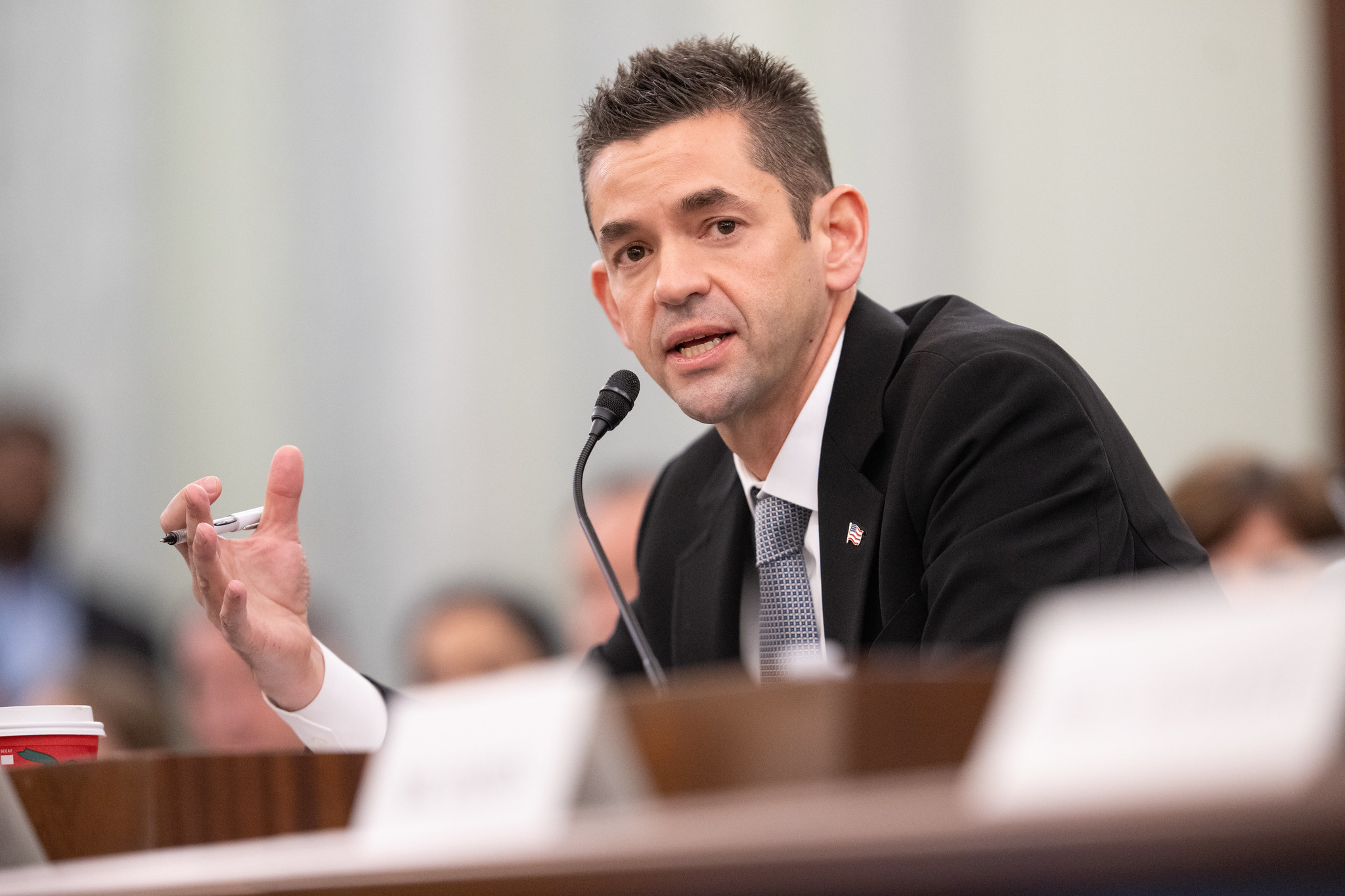

WASHINGTON — Leaders of the Senate Commerce Committee said they hope to swiftly confirm Jared Isaacman as NASA administrator during a hearing where he delivered a “message of urgency” about returning astronauts to the moon before China.
At a Dec. 3 confirmation hearing by the Senate Commerce Committee for Isaacman’s renomination, committee Chairman Sen. Ted Cruz, R-Texas, said he believed Isaacman could be confirmed by the full Senate before the end of the year.
“The United States must remain the unquestioned leader in space exploration, and this imperative is why we need to confirm your nomination as expeditiously as possible,” Cruz said. “My hope is that you’ll be confirmed and in this role before the end of this year.”
The committee’s ranking member, Sen. Maria Cantwell, D-Wash., agreed. “I hope to get you in this position before the end of the year,” she said. The committee is scheduled to vote Dec. 8 to advance his nomination to the full Senate.
Isaacman, renominated last month after the White House withdrew his original nomination in late May, said that while his first confirmation hearing in April focused on introducing himself and outlining NASA’s challenges, this hearing carried a different tone.
“This time, I’m here with a message of urgency,” he said. “We are in a great competition with a rival that has the will and means to challenge American exceptionalism across multiple domains, including in the high ground of space.”
He was referring to China and its plan to land astronauts on the moon by the end of the decade. “This is not a time for delay but a time for action,” he said. “Because if we fall behind, if we make a mistake, we may never catch up, and the consequences could shift the balance of power here on Earth.”
Isaacman offered few details about how he might accelerate a human return to the moon. One major change since his April hearing was the passage in July of a budget reconciliation bill that provided nearly $10 billion for NASA, much of it supporting Artemis programs such as the Space Launch System, Orion and Gateway. The administration’s 2026 budget request, released in May, called for canceling Gateway and ending SLS and Orion after Artemis 3.
“Congress has given clear direction and substantial funding to achieve this goal,” said Cruz, who wrote the NASA funding section of the reconciliation bill. “Mr. Isaacman, I believe, will prioritize stability, accountability and respect for the men and women who make the agency’s missions possible.”
Isaacman later confirmed he would carry out the provisions of the reconciliation bill. “I absolutely believe the current architecture, with SLS, is the fastest path to achieving our near-term lunar objectives, which should be to return to the moon before our great rival,” he told Cruz.
Another change since his first hearing was NASA Acting Administrator Sean Duffy’s October announcement that the agency would “open up” SpaceX’s Artemis 3 lander contract because of Starship development delays. SpaceX and Blue Origin have since both submitted proposals aimed at accelerating lander development.
Asked by Cantwell about recompeting the contracts, Isaacman said he believed the companies were already in a de facto competition. “I don’t think it was lost on either one of those organizations that the first company that is capable of delivering a lander to take American astronauts to the lunar surface and back is the one that this nation is going to go with,” he said.
Isaacman defended “Project Athena,” a document he drafted during his first nomination that later leaked. It suggested reevaluating NASA’s plans for a sustained lunar presence and proposed commercializing Earth science missions, with climate research shifting to academia.
Project Athena “was a draft document that I continued to update based on my interactions” with NASA personnel and others, he told Sen. Andy Kim, D-N.J. “It was always something meant to be refined with actual data should I have been confirmed, but I do stand behind everything in the document.”
He avoided specifics on NASA’s 2026 budget request, which sought to cut the agency’s overall budget by nearly 25%, with science and space technology facing cuts near 50%. Appropriations bills in the House and Senate have rejected most of those reductions but differ on final funding levels in areas like science.
“A lot has changed since then,” he said of the budget proposal when asked by Sen. John Hickenlooper, D-Colo. “This is something that, if I am confirmed, I’d love to get my arms around.”
One repeat topic from April was Isaacman’s relationship with Elon Musk. Sen. Ed Markey, D-Mass., again asked whether Musk was present when then President-elect Donald Trump first offered Isaacman the NASA role. Isaacman again declined to directly answer. He also declined to disclose the value of his private astronaut mission contracts with SpaceX for Inspiration4 and Polaris Dawn.
Isaacman would not speculate on why the White House renominated him, but acknowledged donating about $2 million to Republican political action committees over the summer, saying the contributions were tied to his consideration of a possible political career.
He emphasized that his relationship with Musk is strictly that of a SpaceX customer, just like NASA’s. “It’s funny: in a world where everybody has a phone with a camera on it, there are no pictures of us at dinner, at a bar, on an airplane or on a yacht, because they don’t exist,” he said.










Related Posts
Stay Informed With the Latest & Most Important News





Advertisement
-
 01Two Black Holes Observed Circling Each Other for the First Time
 -
 02From Polymerization-Enabled Folding and Assembly to Chemical Evolution: Key Processes for Emergence of Functional Polymers in the Origin of Life
 -
 03Astronomy 101: From the Sun and Moon to Wormholes and Warp Drive, Key Theories, Discoveries, and Facts about the Universe (The Adams 101 Series)
 -
 04True Anomaly hires former York Space executive as chief operating officer
 -
 05Φsat-2 begins science phase for AI Earth images
 -
 06Hurricane forecasters are losing 3 key satellites ahead of peak storm season − a meteorologist explains why it matters
 -
 07Binary star systems are complex astronomical objects − a new AI approach could pin down their properties quickly