
Now Reading: A Window For Water-hydrogen Demixing On Warm Metal-rich Sub-Neptunes
-
01
A Window For Water-hydrogen Demixing On Warm Metal-rich Sub-Neptunes


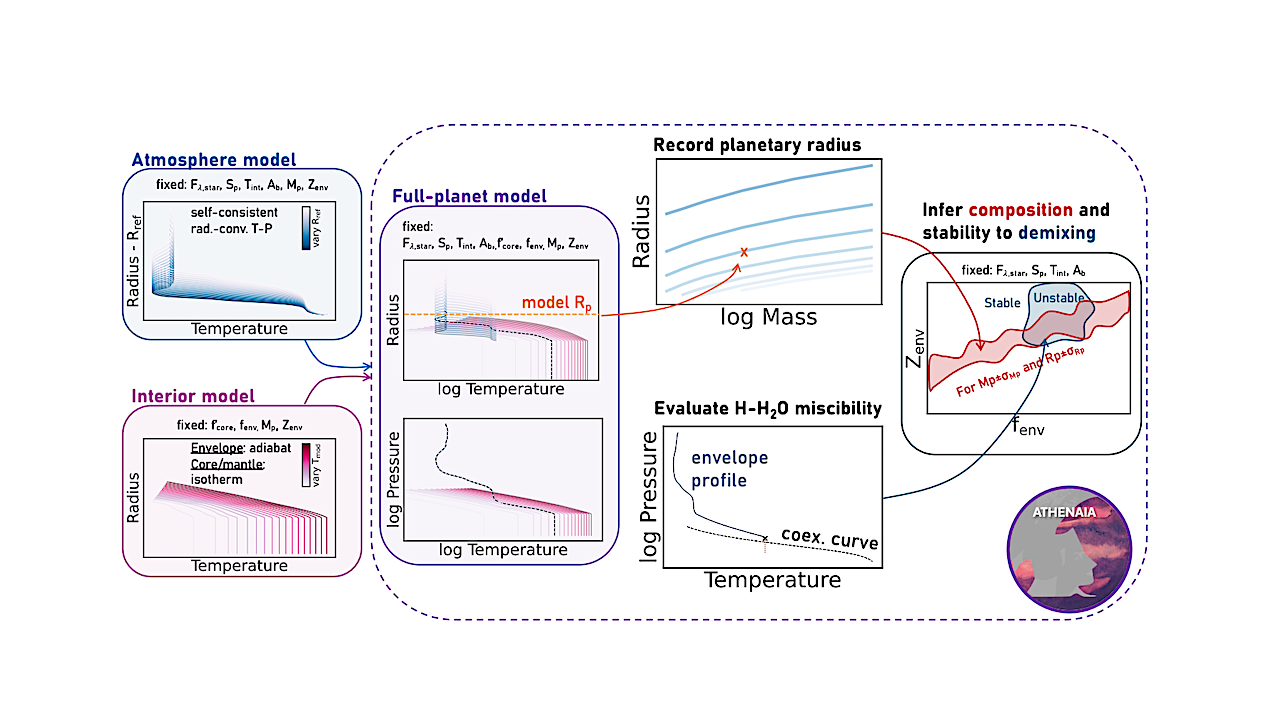
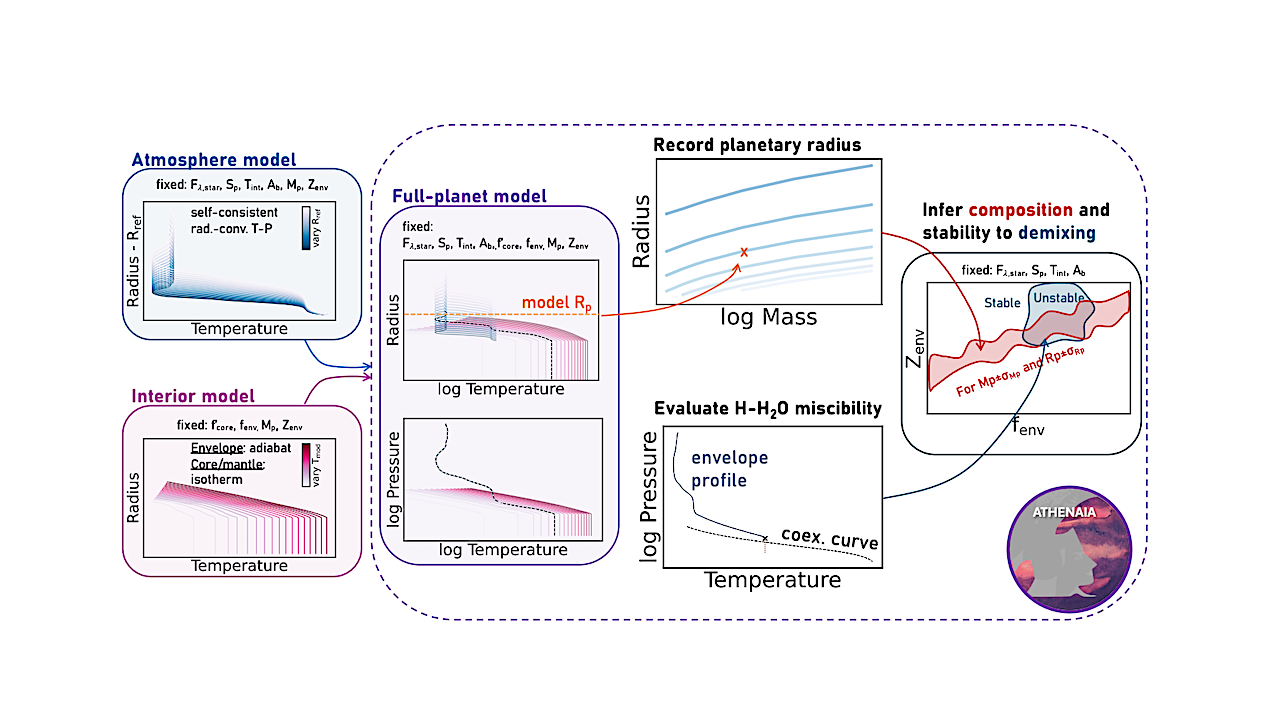
Illustration of the workflow for the construction of coupled interior-atmosphere models with ATHENAIA. For each composition, atmosphere models are calculated with SCARLET (top left) and interior models following the model from Thorngren & Fortney (2019). Then we couple them with ATHENAIA by finding the Rref (atmosphere model) and Tmod (interior model) that minimize δTPR (see Eq. 5). The radius at 20 mbar is extracted to construct constant-composition mass-radius curves, while the pressure-temperature profile of the envelope is used to evaluate the stability to demixing by comparing to the corresponding H-H2O coexistence curve (dashed). Finally (right panel), given planetary mass and radius, the range of potential compositions is mapped to fenv −Zenv space (red) and compared to the map of conditions where envelopes are (un)stable against demixing (blue). — astro-ph.EP
Sub-Neptunes represent the largest exoplanet demographic, yet their bulk compositions remain poorly understood.
Recent studies suggested that only very cold planets, such as Uranus and Neptune, could experience stratification of volatiles in their envelopes, implying that the envelopes of warmer sub-Neptunes instead have fully-miscible compositions.
Here, we present ATHENAIA, an interior-atmosphere composition inference framework we leverage to assess the potential for water-hydrogen demixing on the Teq=350 K planet TOI-270 d, and more broadly for warm sub-Neptunes, using radiative-convective atmosphere models coupled to interior models.
We find that the higher temperatures at which hydrogen and water demix in water-rich environments, combined with the shallower adiabatic gradients of water-rich envelopes, open a window for demixing on sub-Neptunes with bulk envelope metallicities of ∼100 to 700× solar, compatible with TOI-270 d. Demixing is easier to achieve on more massive and colder planets, but still broadly affects warm (330 to 500 K) metal-rich sub-Neptunes.
Therefore, combining atmosphere metallicities with models of fully-miscible envelopes may lead to underestimated bulk envelope metallicities and mass fractions. Further, our modeling of TOI-270 d’s envelope and interior reveals that, for a typical internal energy budget Tint of 25 K, the envelope-mantle boundary conditions likely preclude the presence of a molten magma ocean.
This work encourages a reconsideration of the current paradigm for linking sub-Neptune atmospheres to their interiors and motivates further evolutionary modeling describing the onset of metallicity gradients in sub-Neptune envelopes.
Caroline Piaulet-Ghorayeb, Daniel P. Thorngren, Eliza M.-R. Kempton, Justin Lipper, Leslie Rogers, Fernanda Correa Horta, Shi Lin Sun
Comments: 19 pages, 10 figures, 2 tables, in review at AAS Journals
Subjects: Earth and Planetary Astrophysics (astro-ph.EP); Solar and Stellar Astrophysics (astro-ph.SR)
Cite as: arXiv:2512.01805 [astro-ph.EP] (or arXiv:2512.01805v1 [astro-ph.EP] for this version)
https://doi.org/10.48550/arXiv.2512.01805
Focus to learn more
Submission history
From: Caroline Piaulet-Ghorayeb
[v1] Mon, 1 Dec 2025 15:39:33 UTC (2,674 KB)
https://arxiv.org/abs/2512.01805
Astrobiology,










Related Posts
Stay Informed With the Latest & Most Important News



Advertisement
-
 01Two Black Holes Observed Circling Each Other for the First Time
 -
 02From Polymerization-Enabled Folding and Assembly to Chemical Evolution: Key Processes for Emergence of Functional Polymers in the Origin of Life
 -
 03Astronomy 101: From the Sun and Moon to Wormholes and Warp Drive, Key Theories, Discoveries, and Facts about the Universe (The Adams 101 Series)
 -
 04True Anomaly hires former York Space executive as chief operating officer
 -
 05Φsat-2 begins science phase for AI Earth images
 -
 06Hurricane forecasters are losing 3 key satellites ahead of peak storm season − a meteorologist explains why it matters
 -
 07Binary star systems are complex astronomical objects − a new AI approach could pin down their properties quickly