
Now Reading: Machine Learning For Exoplanet Discovery: Validating TESS Candidates and Identifying Planets in the Habitable Zone
-
01
Machine Learning For Exoplanet Discovery: Validating TESS Candidates and Identifying Planets in the Habitable Zone

Machine Learning For Exoplanet Discovery: Validating TESS Candidates and Identifying Planets in the Habitable Zone

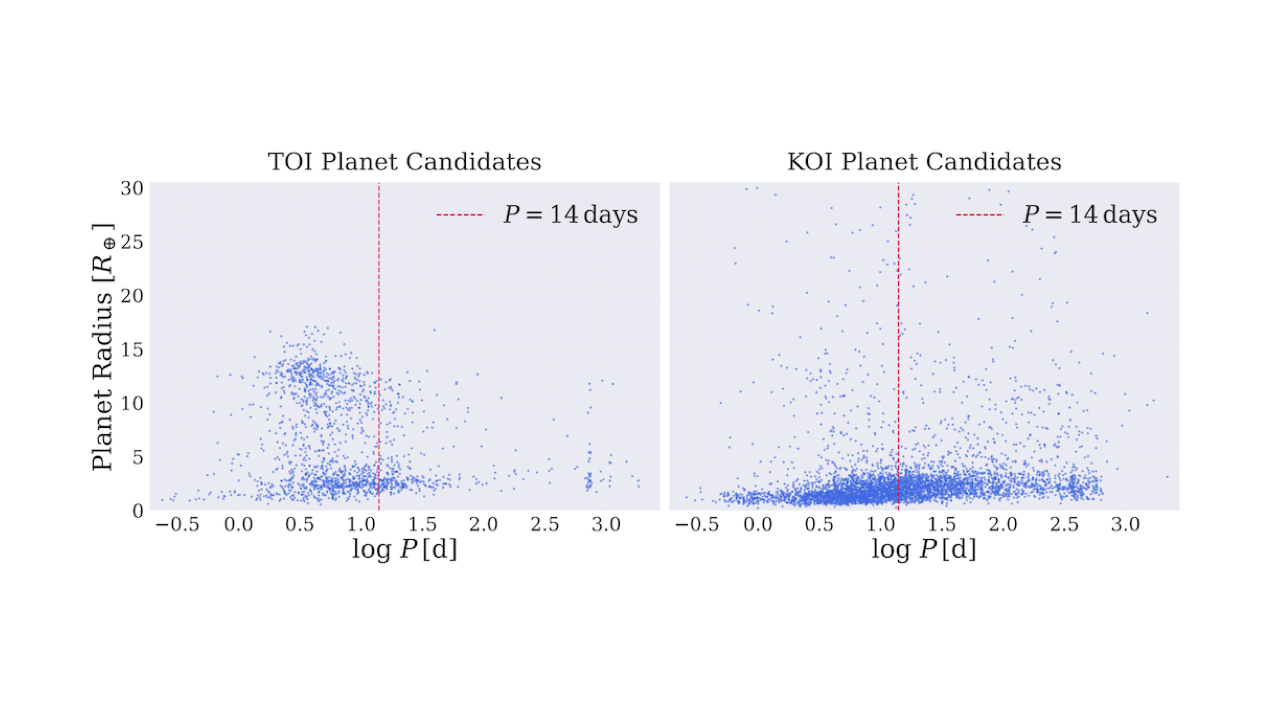
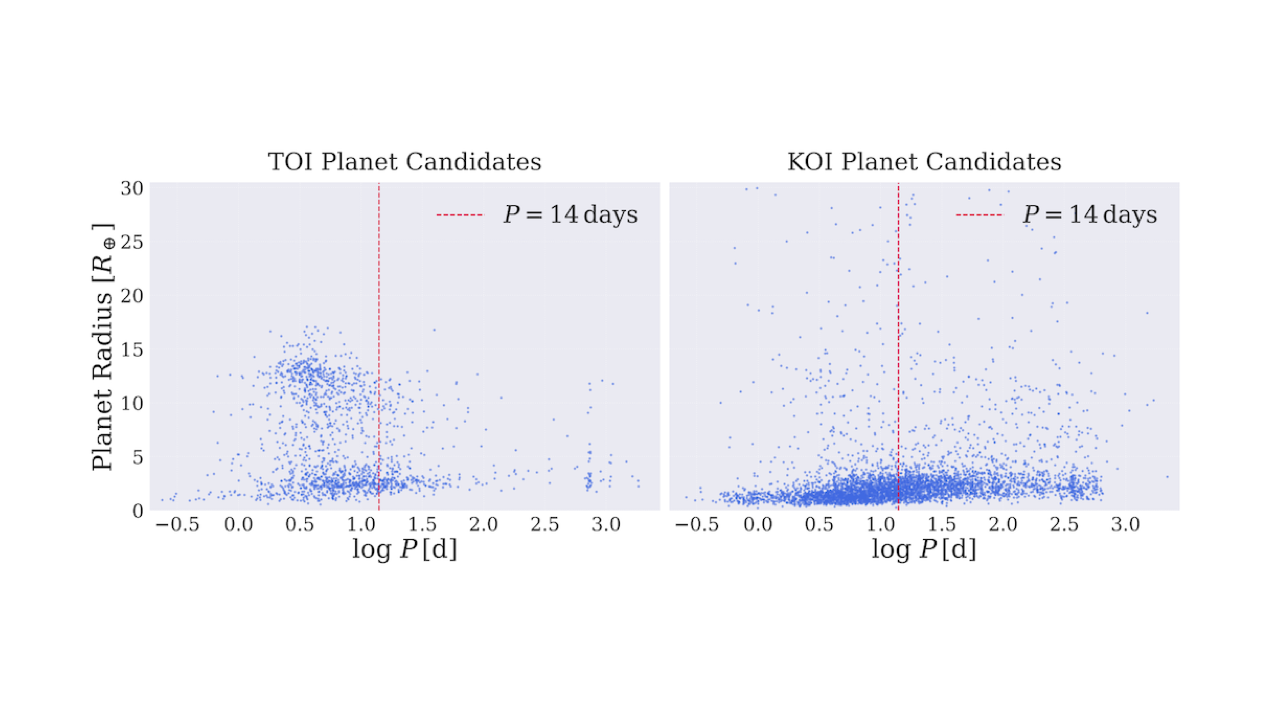
Side-by-side comparison of TOI (left) and KOI (right) radius vs orbital period.
The red dashed line marks the 14-day orbital period. TOI detected more giant planets
with shorter orbital periods, while KOI detected more smaller planets with longer orbital
periods. — astro-ph.EP
The high-precision photometry from NASA’s Kepler and TESS missions has revolutionized exoplanet detection, enabling the discovery of over 5500 confirmed exoplanets via the transit method and around 10000 additional candidates awaiting validation.
However, confirming these candidates as true planets demands meticulous vetting and follow-up observations, which hampers the discovery of exoplanets in large-scale datasets. To address this challenge, we developed a machine learning framework trained on Kepler’s catalog of confirmed exoplanets and false positives to accurately identify true planetary candidates.
Our model uses transit properties, planetary characteristics, and host stellar parameters as training features. The optimized model achieved 83.9% accuracy in cross-validation. When applied to 3987 TESS candidates with complete observational data, the model identified 1595 new high-confidence planets and correctly recovered 86% (358/418) of all previously confirmed TESS exoplanets in a blinded validation test.
Our analysis revealed 100 previously unrecognized multi-planet systems, including five systems–that host habitable-zone exoplanets. Additionally, we identified 15 more planets within the habitable zone of a single system, suggesting strong potential for liquid water stability under conservative planetary albedo assumptions.
This work demonstrates that machine learning can accelerate exoplanet validation while maintaining scientific rigor. Our modular design enables direct adaptation to future photometric missions like PLATO or Earth 2.0.
Sarah Huang, Chen Jiang
Comments: 37 pages, 12 figures, 9 tables
Subjects: Earth and Planetary Astrophysics (astro-ph.EP); Instrumentation and Methods for Astrophysics (astro-ph.IM); Solar and Stellar Astrophysics (astro-ph.SR)
Cite as: arXiv:2512.00967 [astro-ph.EP] (or arXiv:2512.00967v1 [astro-ph.EP] for this version)
https://doi.org/10.48550/arXiv.2512.00967
Focus to learn more
Submission history
From: Sarah Huang
[v1] Sun, 30 Nov 2025 16:30:07 UTC (336 KB)
https://arxiv.org/abs/2512.00967
Astrobiology, AI, exoplanet,











Related Posts
Stay Informed With the Latest & Most Important News
Previous Post
Next Post


Advertisement
-
 01Two Black Holes Observed Circling Each Other for the First Time
 -
 02From Polymerization-Enabled Folding and Assembly to Chemical Evolution: Key Processes for Emergence of Functional Polymers in the Origin of Life
 -
 03Astronomy 101: From the Sun and Moon to Wormholes and Warp Drive, Key Theories, Discoveries, and Facts about the Universe (The Adams 101 Series)
 -
 04True Anomaly hires former York Space executive as chief operating officer
 -
 05Φsat-2 begins science phase for AI Earth images
 -
 06Hurricane forecasters are losing 3 key satellites ahead of peak storm season − a meteorologist explains why it matters
 -
 07Binary star systems are complex astronomical objects − a new AI approach could pin down their properties quickly