
Now Reading: SpaceX gains approval to advance Starship launch facility construction at Cape Canaveral
-
01
SpaceX gains approval to advance Starship launch facility construction at Cape Canaveral

SpaceX gains approval to advance Starship launch facility construction at Cape Canaveral

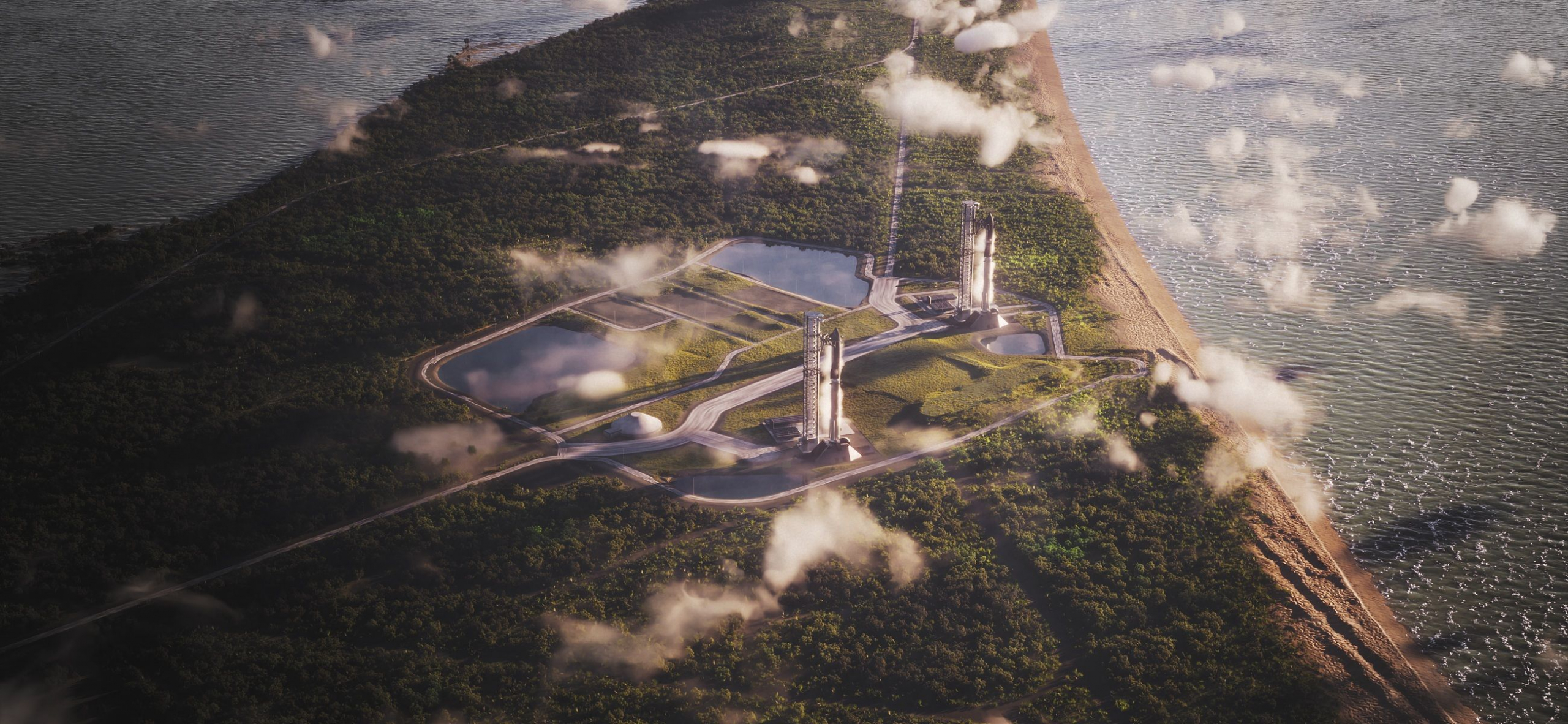

SpaceX has secured environmental clearance to proceed with the construction of its Starship launch facility at Cape Canaveral’s Space Launch Complex-37 (SLC-37). This approval follows the completion of a Final Environmental Impact Statement (EIS), which revealed limited changes from the initial draft but provided significant details about the project’s scope, including information on the planned launch pads and updated statistics concerning propellant storage.
The newly approved EIS permits SpaceX to conduct as many as 76 Starship launches annually from the SLC-37 site. Additionally, the company anticipates performing 76 static fire tests for both the ships and boosters each year, assuming that every vehicle undergoes a static fire before its inaugural flight. However, as demonstrated with the Falcon 9 program, it is expected that the frequency of these tests will decrease as operations progress. Under the terms of the EIS, this ambitious launch schedule could translate to approximately 152 landings at SLC-37 each year, with launches occurring during both day and night. SpaceX has also accounted for a 20% scrub rate, which allows for potential weather issues or mechanical challenges.
The EIS outlines that landings for both ships and boosters will primarily take place at the launch site. However, it leaves the door open for occasional drone ship landings, which would be used for performance optimization but remain unlikely, as SpaceX currently lacks operational drone ships suited for this purpose. The clearance at SLC-37 provides SpaceX with a second launch location for Starship, while efforts to finalize an EIS for the LC-39A site are underway and expected to conclude early next year.
Although SpaceX has made strides toward beginning construction, the company still needs to finalize the lease agreement for the SLC-37 site and acquire a vehicle operator’s license before launching from the new pads. Preliminary work has begun, including the demolition of the previous SLC-37B structure, which was used for Delta IV Heavy launches. With the old infrastructure cleared, focus will soon shift to building the foundation for two launch towers, a process likely to begin with the installation of Continuous Flight Auger piles for the bases and flame trench.
On-site development plans include constructing two launch pads equipped with necessary water deluge systems, isolation and purging hardware, launch towers, and a designated stormwater pond for each pad. Notably, construction is already underway at Roberts Road, where one of the towers and its associated mechanisms are being fabricated. The majority of the tower sections are reportedly complete, with only the installation of internal infrastructure remaining.
In terms of propellant storage, the final EIS discloses that SpaceX intends to maintain significant quantities of fuel at SLC-37. Capacities are estimated at 16,500 tons for Liquid Oxygen, 6,500 tons for Liquid Nitrogen, and 5,000 tons for Liquid Methane. This volume would provide enough material for approximately 2.5 launches, mirroring expected capacities at LC-39A post-construction. Additionally, to streamline methane production, SpaceX plans to establish on-site facilities that will purify natural gas and convert it to liquid methane, supporting both operational energy needs and fueling for Starship.
Furthermore, to produce various necessary gases for operations, SpaceX will set up an Air Separation Unit near the horizontal integration facility at SLC-37. This unit will extract and condense atmospheric gases into liquid form for cryogenic storage, ensuring sufficient supply for upcoming launches.
The planned site still lacks specific provisions for catch towers, landing pads, and static fire stands, but such elements will likely be added as construction progresses. The recently completed EIS provides a detailed breakdown of the leased land areas, confirming that SpaceX will have considerable space around SLC-37 for developing necessary infrastructure.
Overall, while the EIS projects a 12-month timeline for construction completion, past experiences suggest that this may be overly optimistic, as similar projects have taken longer. If construction begins in early 2026, SpaceX anticipates potentially having four or five functioning Starship launch pads by mid to late 2027, further bolstering its ambitions for both national defense and its Artemis program commitments.










Related Posts

Stay Informed With the Latest & Most Important News
Previous Post
Next Post




Advertisement
-
 01Two Black Holes Observed Circling Each Other for the First Time
 -
 02From Polymerization-Enabled Folding and Assembly to Chemical Evolution: Key Processes for Emergence of Functional Polymers in the Origin of Life
 -
 03Astronomy 101: From the Sun and Moon to Wormholes and Warp Drive, Key Theories, Discoveries, and Facts about the Universe (The Adams 101 Series)
 -
 04True Anomaly hires former York Space executive as chief operating officer
 -
 05Φsat-2 begins science phase for AI Earth images
 -
 06Hurricane forecasters are losing 3 key satellites ahead of peak storm season − a meteorologist explains why it matters
 -
 07Binary star systems are complex astronomical objects − a new AI approach could pin down their properties quickly