
Now Reading: Sun unleashes intense X-class solar flare, triggering radio blackouts across Australia
-
01
Sun unleashes intense X-class solar flare, triggering radio blackouts across Australia

Sun unleashes intense X-class solar flare, triggering radio blackouts across Australia

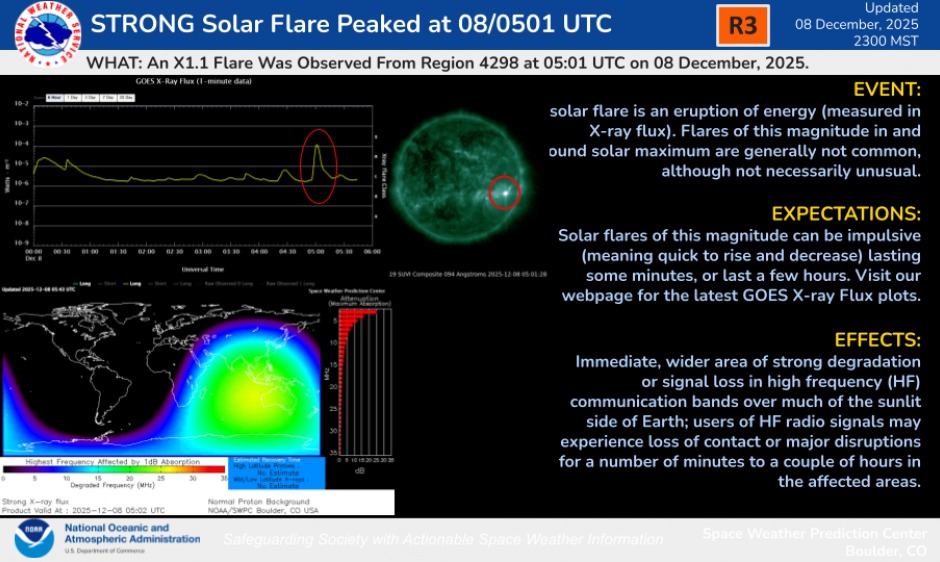
The sun erupted with a powerful X1.1-class solar flare in the early hours of this morning (Dec. 8), briefly knocking out radio communications across Australia and parts of southeast Asia.
A coronal mass ejection (CME) — a plume of plasma and magnetic field — was hurled into space alongside the eruption. However, early analyses of satellite coronagraph imagery suggest this CME is not Earth-directed.

The solar flare occurred during an already active week on the sun. Several CMEs from earlier solar flares are forecast to impact Earth between Dec. 8-9, prompting space weather forecasters at NOAA’s Space Weather Prediction Center and the U.K. Met Office to issue geomagnetic storm watches, including a chance of strong-moderate (G2-G3) level storming, which could see northern lights visible at high to mid-latitudes.
What are solar flares?
Solar flares are caused when magnetic energy builds up in the sun’s atmosphere and is released in an intense burst of electromagnetic radiation.
They are categorized by size into lettered groups according to strength:
- X-class: The strongest
- M-class: 10 times weaker than X
- C, B and A-class: Progressively weaker, with A-class flares typically having no noticeable effect on Earth.
Within each class, a numerical value indicates the flare’s relative strength. The Dec. 8 flare came in at X.1.1, making it an X-class event.
How does it cause radio blackouts?
When radiation from a solar flare reaches Earth, it ionizes the upper atmosphere which can disrupt shortwave radio communications on the sunlit side of the planet.
Normally, high-frequency radio waves travel long distances by bouncing off the ionosphere’s higher, thinner layers. But during a strong flare, the lower, denser parts of the ionosphere become highly ionized instead. Radio waves passing through these layers collide more often with particles, losing energy as they go. As a result, high-frequency radio signals can fade, become distorted or disappear entirely according to NOAA.










Related Posts

Stay Informed With the Latest & Most Important News


Advertisement
-
 01Two Black Holes Observed Circling Each Other for the First Time
 -
 02From Polymerization-Enabled Folding and Assembly to Chemical Evolution: Key Processes for Emergence of Functional Polymers in the Origin of Life
 -
 03Astronomy 101: From the Sun and Moon to Wormholes and Warp Drive, Key Theories, Discoveries, and Facts about the Universe (The Adams 101 Series)
 -
 04True Anomaly hires former York Space executive as chief operating officer
 -
 05Φsat-2 begins science phase for AI Earth images
 -
 06Hurricane forecasters are losing 3 key satellites ahead of peak storm season − a meteorologist explains why it matters
 -
 07Binary star systems are complex astronomical objects − a new AI approach could pin down their properties quickly