
Now Reading: Northern lights may be visible in 17 states (and maybe more) tonight
-
01
Northern lights may be visible in 17 states (and maybe more) tonight


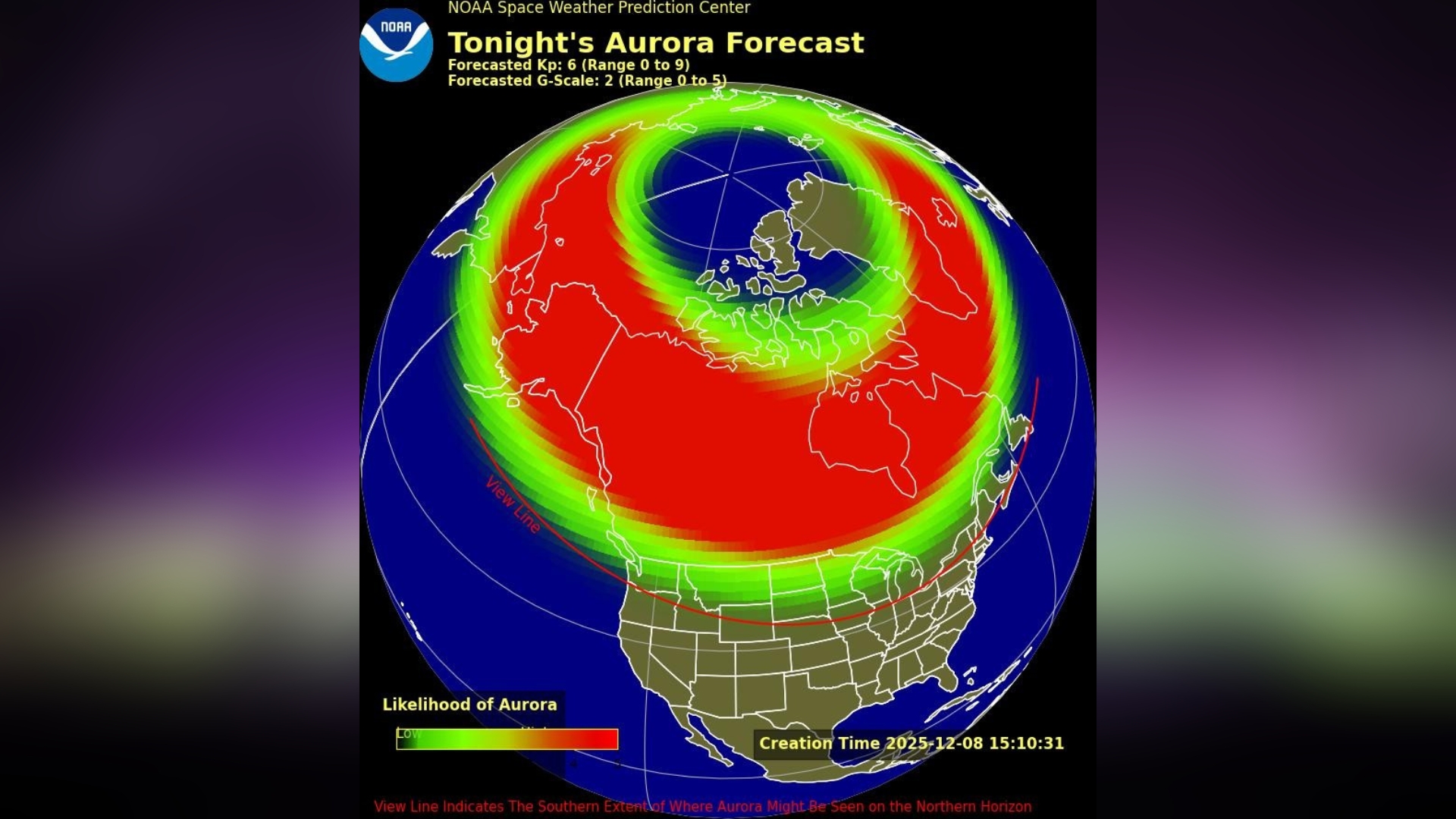
Heads up aurora chasers! The northern lights could put on a show across the U.S. tonight and tomorrow as a coronal mass ejection (CME) is forecast to hit Earth, according to the National Oceanic and Atmospheric Administration’s (NOAA) Space Weather Prediction Center.
The full-halo CME was released during an M8.1 solar flare on Dec. 6, and is expected to impact Earth early to midday on Dec. 8, potentially causing periods of strong (G3) geomagnetic storming.
Where can I see the northern lights tonight?

States that could see auroras tonight
Based on the latest NOAA aurora forecast map, the following 17 states appear fully or partially above the aurora view line:
- Alaska
- North Dakota
- Minnesota
- Montana
- Wisconsin
- South Dakota
- Michigan
- Idaho
- Washington
- Maine
- Vermont
- New Hampshire
- Iowa
- Oregon
- Wyoming
- New York
- Illinois
The list ranks states from most likely to least likely to see auroras based on proximity to and coverage within the auroral zone.
But remember, auroras can be fickle creatures. The list is based on current forecast data, but if conditions strengthen and skies are clear, auroras could reach farther south than expected. Then again, if conditions don’t align, we might end up with a “nothing burger” and no auroras at all! We shall have to wait patiently and see.
Northern hemisphere aurora forecast courtesy of the U.K. Met Office
What time should I look for the northern lights tonight?
The northern lights may be seen from 17 U.S. states tonight (Dec. 8-9) as soon as it gets dark, so it’s worth keeping an eye on the sky throughout the evening.
According to NOAA’s 3-day forecast, geomagnetic storm activity is expected to be best at the following times:
- 4:00 p.m. – 10:00 p.m. EST (2100-0300 GMT): Minor G1 level storming possible
- 10:00 p.m. – 1:00 a.m. EST (0300-0600 GMT Dec. 9): Moderate G2 level storming possible
- 1:00 a.m. – 10:00 a.m. EST Dec. 9 (0600-1500 GMT) Moderate and strong G2/G3 level storming possible
- 10:00 a.m. – 7 p.m. EST Dec. 9 (1500-0000 GMT) Minor G1 level storming possible.
How can I see the northern lights from where I live?
If you live in one of the 17 U.S. states forecasted to catch a glimpse of the northern lights tonight, there are a few things you can do to give yourself the best chance of seeing them.
Find a north-facing vantage point with a clear view of the northern horizon, as far from light pollution as possible.
Use your phone camera to scan the sky, as a phone camera is great at picking up faint auroras before your eyes spot them. This will give you a good idea of which direction to focus your attention.
Try and let your eyes adapt to the dark for at least 30 minutes; this will help your night vision develop.
Wear warm clothing! Part of the fun of aurora hunting is the chase. Be prepared to sit or stand for hours if conditions are looking promising, as you won’t want to miss the show when it starts!
We recommend downloading a space weather app that provides aurora forecasts based on your location. One option I use is “My Aurora Forecast & Alerts,” available for both iOS and Android. However, any similar app should work well. I also use the “Space Weather Live” app, which is available on iOS and Android, to get a deeper understanding of whether the current space weather conditions are favorable for aurora sightings. Want to capture the perfect photo? Our how to photograph auroras guide can help.










Related Posts

Stay Informed With the Latest & Most Important News
Previous Post
Next Post


Advertisement
-
 01Two Black Holes Observed Circling Each Other for the First Time
 -
 02From Polymerization-Enabled Folding and Assembly to Chemical Evolution: Key Processes for Emergence of Functional Polymers in the Origin of Life
 -
 03Astronomy 101: From the Sun and Moon to Wormholes and Warp Drive, Key Theories, Discoveries, and Facts about the Universe (The Adams 101 Series)
 -
 04True Anomaly hires former York Space executive as chief operating officer
 -
 05Φsat-2 begins science phase for AI Earth images
 -
 06Hurricane forecasters are losing 3 key satellites ahead of peak storm season − a meteorologist explains why it matters
 -
 07Binary star systems are complex astronomical objects − a new AI approach could pin down their properties quickly