
Now Reading: Validation Of A Third Earth-sized Planet In The TOI-2267 Binary System
-
01
Validation Of A Third Earth-sized Planet In The TOI-2267 Binary System


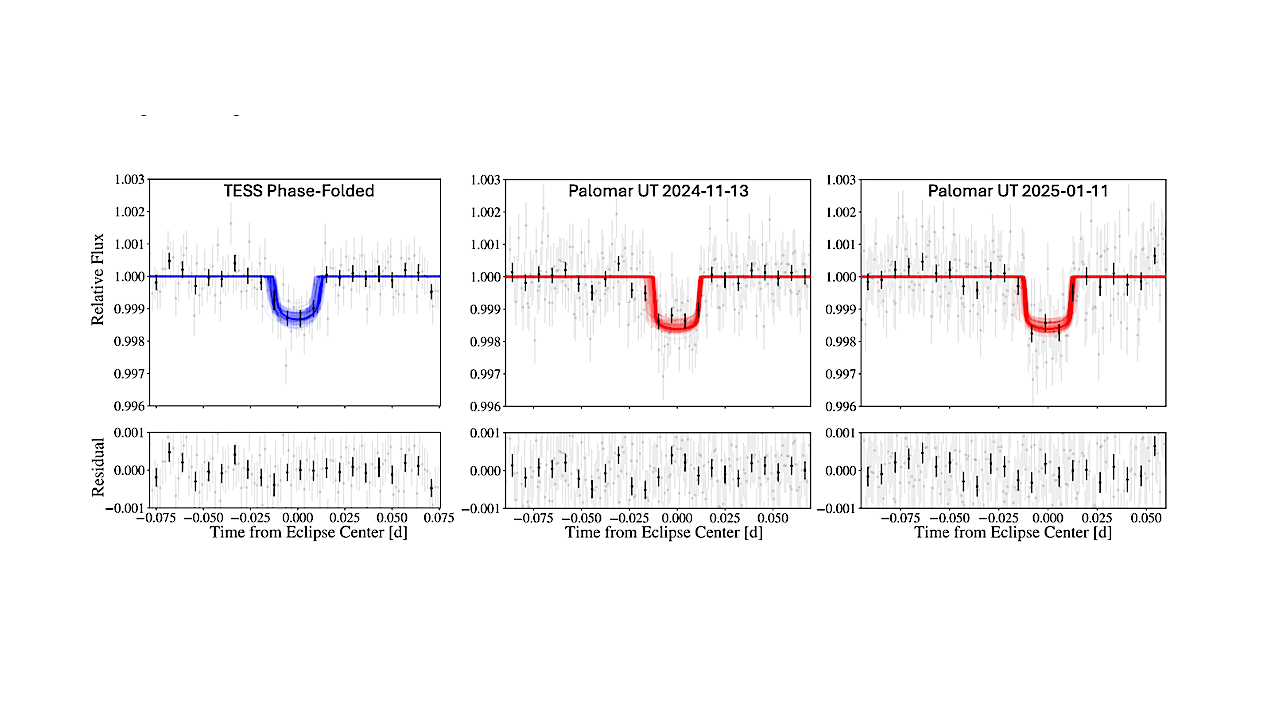
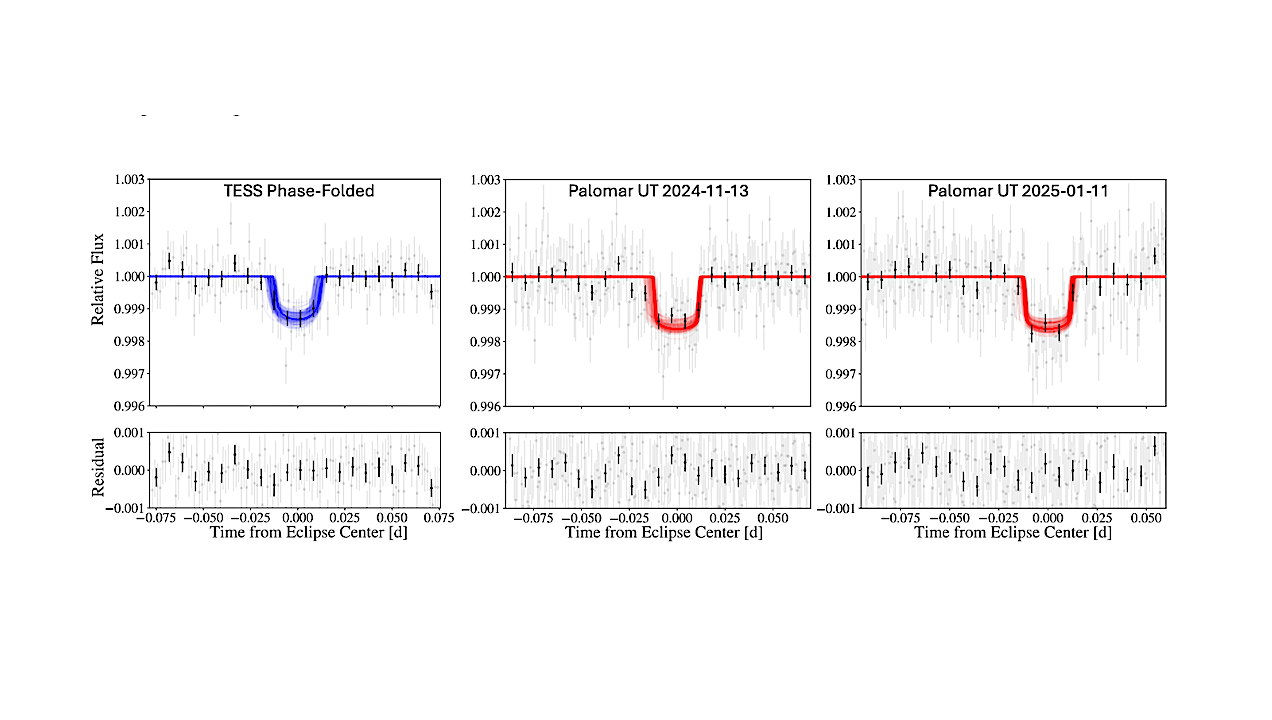
Phased-folded and 2-minute binned TESS light curve (left panel) and detrended Palomar/WIRC light curves (middle and right panels) for the two transit observations of TOI-2267 d. Residuals after the best-fit transit light curve model has been subtracted are shown in the lower panels. Unbinned data are shown as grey circles, with 10 minute binned points overplotted as black circles. The best joint-fit transit models are overplotted as blue lines for the TESS data and red lines for the Palomar data, with 100 random draws from the posterior distribution to illustrate the typical model uncertainty. All detrended light curves are available electronically as data behind the figure. — astro-ph.EP
We report the validation of a third terrestrial exoplanet in the nearby (22 pc) TOI-2267 system.
TOI-2267 is a binary system with stellar components TOI-2267A (M5, 3030 K) and TOI-2267B (M6, 2930 K), with an on-sky separation of 0.”384 (8 au projected separation). TOI-2267 hosts two Earth-sized planets (TOI-2267 b, 1.00±0.11R⊕, and TOI-2267 c, 1.14±0.13R⊕, if orbiting the primary star; or 1.22±0.29R⊕ and 1.36±0.33R⊕, respectively, if orbiting the secondary star) with orbital periods of 2.3 and 3.5 days.
This system also contains a third Earth-sized planet candidate with an orbital period of 2.0 days that was previously identified as a likely planet with a low false-positive probability, but could not be firmly validated due to the lack of independent observations beyond TESS data.
We combine two new transit observations from the 5.1m Hale Telescope at Palomar Observatory with archival TESS data and high-resolution imaging to statistically validate the planetary nature of TOI-2267 d (0.98±0.09R⊕ if orbiting the primary star, or 1.77±0.43R⊕ if orbiting the secondary star) using the updated TRICERATOPS+ pipeline. We attempt to determine the host star for TOI-2267 d using transit shape stellar density analysis, but are unable to conclusively assign a host.
Our validation of TOI-2267 d suggests that TOI-2267 is either the first known double transiting M dwarf binary system, or hosts three planets in an extremely compact orbital configuration.
Michael Greklek-McKeon, Jonathan Gomez Barrientos, Heather A. Knutson, Sebastián Zúñiga-Fernández, Francisco J. Pozuelos, Morgan Saidel, W. Garrett Levine, Renyu Hu, Fei Dai, Tansu Daylan, John P. Doty, David R. Rodriguez, Joseph D. Twicken, David W. Latham, Jon M. Jenkins, Richard P. Schwarz
Comments: Accepted for publication in The Astronomical Journal. 14 pages, 4 figures, 2 tables. Light curve data is available in the arXiv source files
Subjects: Earth and Planetary Astrophysics (astro-ph.EP)
Cite as: arXiv:2512.10007 [astro-ph.EP] (or arXiv:2512.10007v1 [astro-ph.EP] for this version)
https://doi.org/10.48550/arXiv.2512.10007
Focus to learn more
Submission history
From: Michael Greklek-McKeon
[v1] Wed, 10 Dec 2025 19:00:39 UTC (19,279 KB)
https://arxiv.org/abs/2512.10007
Astrobiology,










Related Posts


Stay Informed With the Latest & Most Important News
Previous Post
Next Post



Advertisement
-
 01Two Black Holes Observed Circling Each Other for the First Time
 -
 02From Polymerization-Enabled Folding and Assembly to Chemical Evolution: Key Processes for Emergence of Functional Polymers in the Origin of Life
 -
 03Astronomy 101: From the Sun and Moon to Wormholes and Warp Drive, Key Theories, Discoveries, and Facts about the Universe (The Adams 101 Series)
 -
 04True Anomaly hires former York Space executive as chief operating officer
 -
 05Φsat-2 begins science phase for AI Earth images
 -
 06Hurricane forecasters are losing 3 key satellites ahead of peak storm season − a meteorologist explains why it matters
 -
 07Binary star systems are complex astronomical objects − a new AI approach could pin down their properties quickly