
Now Reading: Good news for lunar bases? Earth’s atmosphere leaks all the way out to the moon
-
01
Good news for lunar bases? Earth’s atmosphere leaks all the way out to the moon


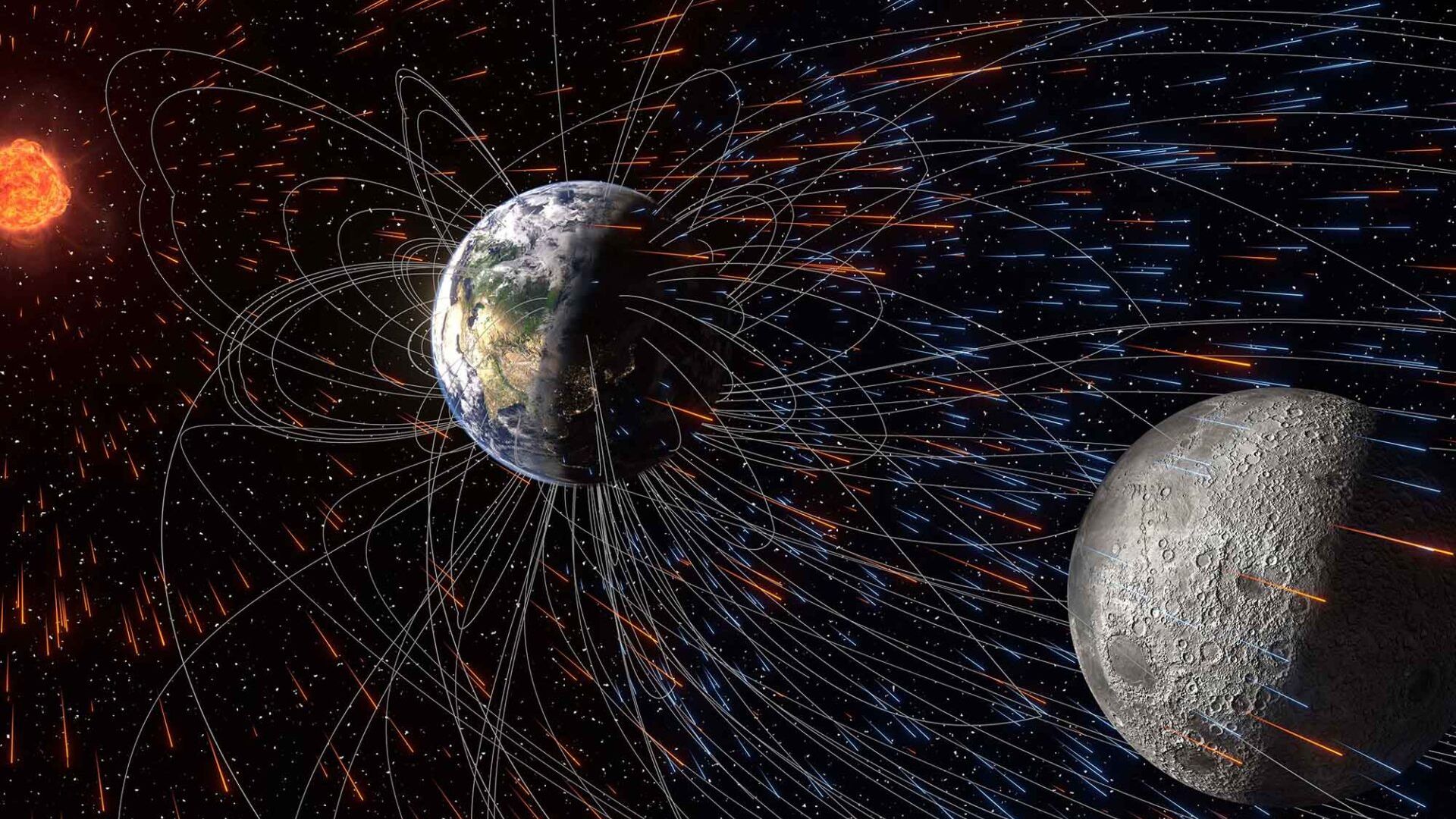
Atoms and molecules from Earth’s atmosphere have been traveling across space to settle on the moon for billions of years, new research has found, explaining a lunar mystery that goes back to the Apollo missions.
Not only do the findings point to a way in which a historical record of Earth’s atmosphere could be deposited on the moon, but they also imply a healthy abundance of elements that could be useful to humans should we ever set up a lunar base.
So, in 2005, scientists at the University of Tokyo proposed that some of the volatiles have come from Earth, as particles leaking out from our planet’s upper atmosphere when they receive a nudge from energetic particles riding the solar wind. However, the Tokyo scientists believed this could only have happened in the early days of Earth’s history, before our planet had a chance to develop a strong global magnetic field that they thought would block particles from escaping.
However, a team at the University of Rochester now suggest that this assessment was wrong.
The Rochester team, led by graduate student Shubhonkar Paramanick and astronomy professor Eric Blackman, used computer simulations to model when these volatile particles could have reached the moon based on two different scenarios.
One scenario depicted the early Earth, when our planet’s magnetic field was weak and the solar wind was much stronger, describing the period in Earth’s history when the Tokyo team reckoned that our atmosphere was more susceptible to being lost to space. The other scenario represented the modern Earth environment, with a stronger planetary field and a weaker solar wind emanating from the older sun.
Somewhat unexpectedly, the Rochester team found that the modern Earth scenario was actually more adept at transporting Earth’s atmospheric particles to the moon.
That’s because the simulations showed that, rather than blocking the particles’ escape route, the Earth’s magnetic field provided a highway for the particles. Some of our planet’s magnetic-field lines are long enough to reach all the way to the moon.
In 2024, researchers at the University of Oxford found evidence in 3.7-billion-year-old iron-rich rocks in Greenland that the ancient Earth had a magnetic field comparable in strength to today. This is the oldest evidence we have of Earth’s magnetic field, so from at least that time, and possibly earlier, through to today Earth’s atmosphere has been leaking bit by bit into space and onto the moon.
“By combining data from particles preserved in lunar soil with computational modeling of how the solar wind interacts with Earth’s atmosphere, we can trace the history of Earth’s atmosphere and its magnetic field,” said Blackman in a statement.
This means that the lunar regolith could still hold a very long-term record of Earth’s atmospheric history, which in turn could teach us about how Earth’s climate, environment and even life has changed over billions of years. Furthermore, the insights gained don’t have to be confined to our planet.
“Our study may also have broader implications for understanding early atmospheric escape on planets like Mars, which lacks a global magnetic field today but had one similar to Earth in the past, along with a likely thicker atmosphere,” said Paramanick. “By examining planetary evolution alongside atmospheric escape across different epochs, we can gain insight into how these processes shape planetary habitability.”
Elsewhere in the solar system, Pluto‘s thin atmosphere also leaks onto its largest moon, Charon, although Pluto does not have an intrinsic magnetic field with which to transport its atmospheric particles. Instead, it is Charon’s gravity that tugs at the particles in Pluto’s atmosphere, with Pluto’s weak gravity allowing the atmospheric particles to be stolen away.
This swapping of atmospheric atoms and molecules could also have positive repercussions for a future human presence on the moon. Water, for example, has obvious uses. (Water was also brought to the moon long ago by asteroid and comet impacts.) The fact that the stream of particles from Earth to the moon has been flowing for so long means that more volatiles than scientists expect might have built up on the lunar surface, just waiting for astronauts to extract them. In a way, it could be the ultimate down payment toward a human presence on the moon.
Then findings were published on Dec. 11 in the journal Communications Earth & Environment.










Related Posts
Stay Informed With the Latest & Most Important News
Previous Post
Next Post


Advertisement
-
 01Two Black Holes Observed Circling Each Other for the First Time
 -
 02From Polymerization-Enabled Folding and Assembly to Chemical Evolution: Key Processes for Emergence of Functional Polymers in the Origin of Life
 -
 03Astronomy 101: From the Sun and Moon to Wormholes and Warp Drive, Key Theories, Discoveries, and Facts about the Universe (The Adams 101 Series)
 -
 04True Anomaly hires former York Space executive as chief operating officer
 -
 05Φsat-2 begins science phase for AI Earth images
 -
 06Hurricane forecasters are losing 3 key satellites ahead of peak storm season − a meteorologist explains why it matters
 -
 07Binary star systems are complex astronomical objects − a new AI approach could pin down their properties quickly