
Now Reading: Diversity In The Haziness And Chemistry Of Temperate Sub-Neptunes
-
01
Diversity In The Haziness And Chemistry Of Temperate Sub-Neptunes


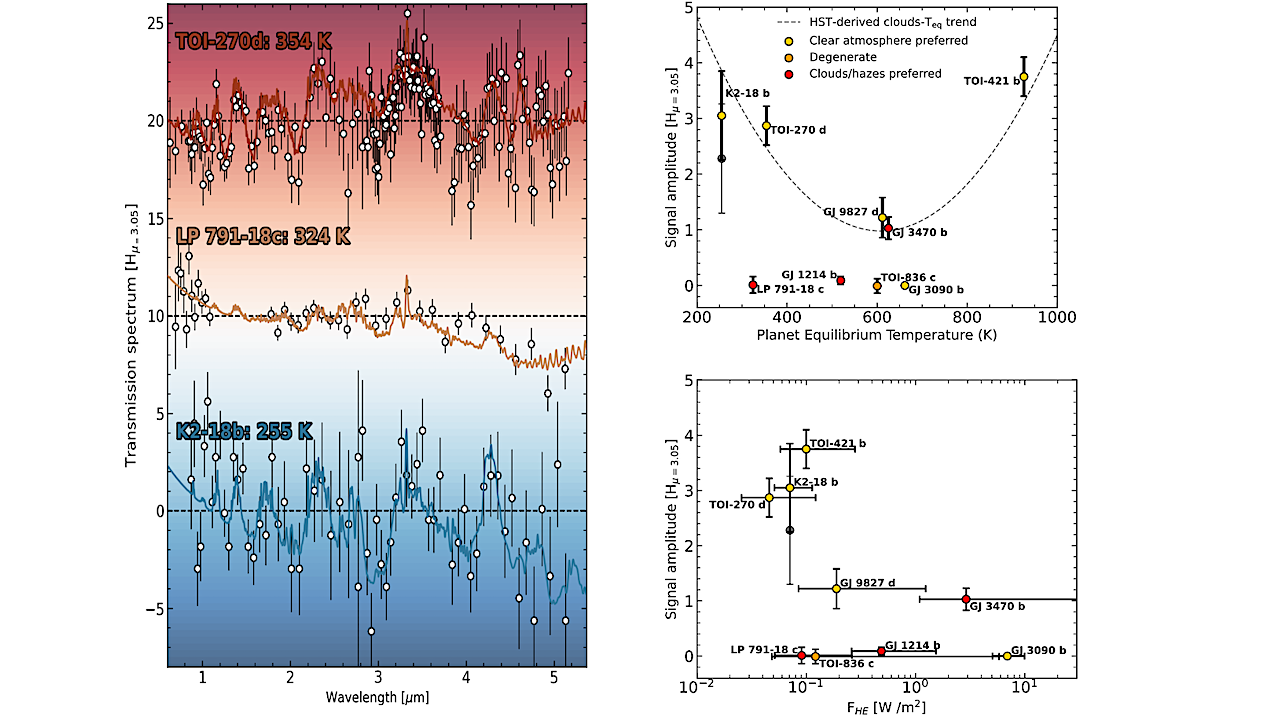

Diversity in sub-Neptune transmission spectra. a. The JWST transmission spectra of TOI-270 d12, K2-18 b9 , and LP 791-18 c are shown with their 1σ error bars and respective best-fit models. The transmission spectra are shown in units of scale heights for a 3.05 amu mean molecular weight, and are color coded as a function of their equilibrium temperature (for AB=0.3). b. Retrieved atmospheric signal strength with 1σ error bars for JWST-characterized sub-Neptunes as a function of their equilibrium temperature (for full heat redistribution and 0.3 Bond albedo). SubNeptunes are colored depending on whether the atmosphere characterization revealed the upper atmosphere to be mostly clear (yellow), mostly cloudy or hazy (red), or whether it is still unknown (orange). The grey point shows the retrieved signal strength of K2-18 b when no detector offsets are allowed in the retrieval. The equilibrium temperature trend proposed to be a consequence of clouds from the HST survey of sub-Neptunes is shown as the dashed line. c. The retrieved atmospheric signal strength for characterized sub-Neptunes as a function of the high-energy (X-ray to UV) irradiation of each planet are shown with their respective 1σ error bars.– astro-ph.EP
Recent transit observations of K2-18b and TOI-270d revealed strong molecular absorption signatures, lending credence to the idea that temperate sub-Neptunes (Teq=250-400K) have upper atmospheres mostly free of aerosols.
These observations also indicated higher-than-expected CO2 abundances on both planets, implying bulk compositions with high water mass fractions. However, it remains unclear whether these findings hold true for all temperate sub-Neptunes.
Here, we present the JWST NIRSpec/PRISM 0.7-5.4μm transmission spectrum of a third temperate sub-Neptune, the 2.4R⊕ planet LP 791-18c (Teq=355K), which is even more favorable for atmospheric characterization thanks to its small M6 host star. Intriguingly, despite LP 791-18c’s radius, mass, and equilibrium temperature being in between those of K2-18b and TOI-270d, we find a drastically different transmission spectrum.
While we also detect methane on LP 791-18c, its transit spectrum is dominated by strong haze scattering and there is no discernible CO2 absorption. Overall, we infer a deep metal-enriched atmosphere (246-415×solar) for LP 791-18c, with a CO2-to-CH4 ratio smaller than 0.07 (at 2σ), indicating less H2O in the deep envelope of LP 791-18c and implying a relatively dry formation inside the water ice-line.
These results show that sub-Neptunes that are near-analogues in density and temperature can show drastically different aerosols and envelope chemistry, and are intrinsically diverse beyond a simple temperature dependence.

Comparison of the treatment of the spot-crossing event. a. Example light-curve fit using the Gaussian spot model. The top panel shows the systematics-corrected lightcurve for the 0.90-0.92 µm bin with the best-fitting transit model with (red) and without (dotted black) the Gaussian spot model. The bottom panel shows the residuals with the best fitting model. The data is binned per 16 second increments for visual clarity. b. White-light-curve fit using the spotrod model. The top panel shows the systematics-corrected white-light curve with the bestfitting model, including the modelled spot crossing event. The bottom panel shows the residuals of the fit. Again, the data is shown in 16 s bins for clarity. c. Graphical representation of the spot crossing event inferred from the spotrod fit shown in b. d. Transmission spectra obtained from both methods using the same R=50 spectroscopic bins. Because of a slightly different set of orbital parameters used in the Spotrod spectroscopic fit, it is offset by 50 ppm. Both spectra are fully consistent within their displayed 1σ error bars, and show no systematic discrepant trends. — astro-ph.EP
Pierre-Alexis Roy, Björn Benneke, Marylou Fournier-Tondreau, Louis-Philippe Coulombe, Caroline Piaulet-Ghorayeb, David Lafrenière, Romain Allart, Nicolas B. Cowan, Lisa Dang, Doug Johnstone, Adam B. Langeveld, Stefan Pelletier, Michael Radica, Jake Taylor, Loïc Albert, René Doyon, Laura Flagg, Ray Jayawardhana, Ryan J. MacDonald, Jake D. Turner
Comments: Paper published in Nature Astronomy at this https URL. This preprint is the original submitted version before peer-review
Subjects: Earth and Planetary Astrophysics (astro-ph.EP)
Cite as: arXiv:2512.10876 [astro-ph.EP] (or arXiv:2512.10876v1 [astro-ph.EP] for this version)
https://doi.org/10.48550/arXiv.2512.10876
Focus to learn more
Related DOI:
https://doi.org/10.1038/s41550-025-02723-3
Focus to learn more
Submission history
From: Pierre-Alexis Roy
[v1] Thu, 11 Dec 2025 18:04:43 UTC (8,382 KB)
https://arxiv.org/abs/2512.10876
Astrobiology, Exoplanet,










Related Posts
Stay Informed With the Latest & Most Important News
Previous Post
Next Post
Advertisement
-
 01Two Black Holes Observed Circling Each Other for the First Time
 -
 02From Polymerization-Enabled Folding and Assembly to Chemical Evolution: Key Processes for Emergence of Functional Polymers in the Origin of Life
 -
 03Astronomy 101: From the Sun and Moon to Wormholes and Warp Drive, Key Theories, Discoveries, and Facts about the Universe (The Adams 101 Series)
 -
 04True Anomaly hires former York Space executive as chief operating officer
 -
 05Φsat-2 begins science phase for AI Earth images
 -
 06Hurricane forecasters are losing 3 key satellites ahead of peak storm season − a meteorologist explains why it matters
 -
 07Binary star systems are complex astronomical objects − a new AI approach could pin down their properties quickly