
Now Reading: EraDrive raises $5.3 million for software-hardware kits to enhance satellite autonomy
-
01
EraDrive raises $5.3 million for software-hardware kits to enhance satellite autonomy

EraDrive raises $5.3 million for software-hardware kits to enhance satellite autonomy

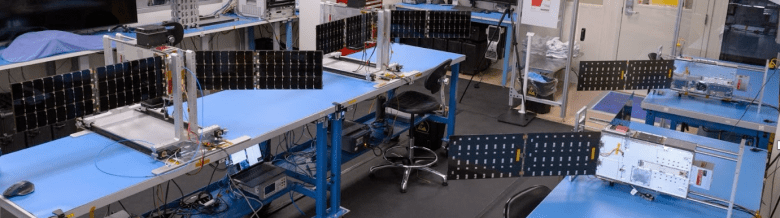
SAN FRANCISCO – EraDrive, a Stanford University spinoff developing software and hardware for satellite autonomy, raised $5.3 million in an oversubscribed seed round, the startup announced Dec. 16.
“EraDrive is very much about this idea of the self-driving spacecraft,” Justin Kruger, EraDrive chief technology officer and co-founder, told SpaceNews.
EraDrive is developing a software-hardware module “based on vision and AI at the edge” to make satellites autonomous and aware of their surroundings, said Sumant Sharma, EraDrive CEO and co-founder.
Through partnerships with defense contractors, satellite manufacturers and component suppliers, EraDrive intends to supply hardware-software modules “to hundreds and thousands of satellites across all orbit regimes,” Sharma said. “The EraDrive module collects vision data, which are exchanged with other on-orbit modules and with the ground, to feed into the most powerful space-traffic-intelligence system known to mankind.”
Partners are evaluating EraDrive’s software-hardware modules for missions including non-cooperative rendezvous and inspection, persistent surveillance and vision-based positioning, navigation and timing, according to the news release.
Investors
Hackstack Ventures led EraDrive’s seed round. Participants included Harpoon Ventures, Brave Capital, Point Nine, 2100 Ventures and Entropy Industrial Capital.
“EraDrive is one of the first teams we’ve seen that treats autonomy in orbit the way the best companies treat autonomy on the ground: real perception, real decision-making at the edge, and a clear data flywheel that compounds over time,” Haystack general partner Semil Shah said in a statement. “We believe they can become a foundational layer for how satellites operate in the next decade.”
The investment will help EraDrive accelerate development of hardware, including cameras and optics for space situational awareness in low-Earth, geostationary orbit and beyond Earth orbit. EraDrive kits pair optical elements with compute, timing, communications and flight software in “a compact payload,” the news release said.

Formation Flying
Satellites equipped with the EraDrive modules can “sense nearby objects, understand the local orbital context, and execute high-level goals” like safe separation, orbital station-keeping, collision avoidance, rendezvous and proximity operations, pointing at targets and maintaining formations “with minimal supervision from the ground,” the news release said.
“With the EraDrive modules, we’re giving spacecraft the ability to see, decide, and act for themselves so operators can safely scale from tens of assets to hundreds and eventually thousands,” Sharma said in a statement.
Ricardo Sequerra, Point Nine partner said in a statement that autonomy has transformed cars, factories and logistics. “Space is the next frontier, and it comes with even harsher constraints and higher stakes.”
In addition to enhancing autonomy for individual satellites, EraDrive co-founders say proliferation of their software-hardware kits will improve space traffic coordination.
“Our goal is to not just enable autonomy for individual satellites, but to aggregate data from those kits in a similar way to Google Maps aggregating data from individual cars to create a network where we can do space traffic monitoring, space traffic management in an autonomous way,” Kruger said.
Self-Driving Satellites
EraDrive’s definition of self-driving spacecraft is based on terminology and classification related to self-driving cars.
“Most satellites today run maneuvers computed on the ground and replayed on board,” said Simone D’Amico, EraDrive co-founder and chief strategy officer. “They have a very limited capability to react to events.”
In contrast, self-driving satellites can achieve high-level goals with minimal supervision from the ground. “The key distinction is that the autonomous spacecraft is able to sense, to understand the environment, identify behavior and threats and react to that environment,” D’Amico said.
Over the long term, EraDrive seeks to develop “cognitive spacecraft,” meaning operators will interface with spacecraft using natural language, D’Amico said. For example, a satellite operator could direct a satellite to de-tumble an unfamiliar satellite. “Then the satellite, on its own, will be able to make decisions in order to do that safely and efficiently,” he added.
Similarly, a satellite viewing its surroundings could interpret the behavior of nearby spacecraft to inform operators “this satellite is receding from me or this satellite is approaching me,” D’Amico said.










Related Posts

Stay Informed With the Latest & Most Important News
Previous Post
Next Post
Advertisement
-
 01Two Black Holes Observed Circling Each Other for the First Time
 -
 02From Polymerization-Enabled Folding and Assembly to Chemical Evolution: Key Processes for Emergence of Functional Polymers in the Origin of Life
 -
 03Astronomy 101: From the Sun and Moon to Wormholes and Warp Drive, Key Theories, Discoveries, and Facts about the Universe (The Adams 101 Series)
 -
 04True Anomaly hires former York Space executive as chief operating officer
 -
 05Φsat-2 begins science phase for AI Earth images
 -
 06Hurricane forecasters are losing 3 key satellites ahead of peak storm season − a meteorologist explains why it matters
 -
 07Binary star systems are complex astronomical objects − a new AI approach could pin down their properties quickly