
Now Reading: MAVEN telemetry shows changes to spacecraft orbit and rotation
-
01
MAVEN telemetry shows changes to spacecraft orbit and rotation


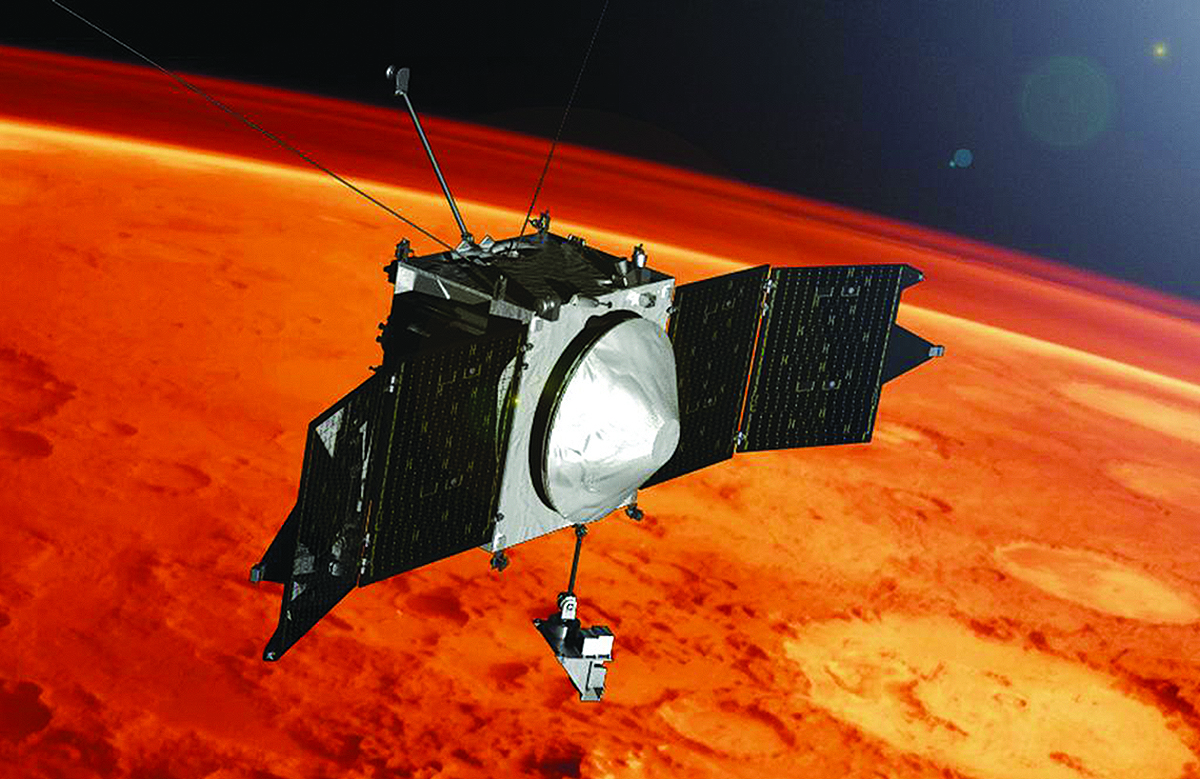

WASHINGTON — New analysis suggests that problems with NASA’s MAVEN Mars orbiter may be more serious than a simple communications glitch.
NASA said Dec. 9 that it lost contact with the spacecraft three days earlier after MAVEN failed to resume communications following a pass behind Mars as viewed from Earth. At the time, the agency provided few details and did not indicate the problem extended beyond the spacecraft’s communications systems.
In a Dec. 15 update, NASA said it obtained a “brief fragment of tracking data” from the spacecraft during a radio science experiment on Dec. 6, the day contact was lost. That data indicated the spacecraft was rotating and was not in its expected orbit.
“Analysis of that signal suggests that the MAVEN spacecraft was rotating in an unexpected manner when it emerged from behind Mars,” NASA said. “Further, the frequency of the tracking signal suggests MAVEN’s orbital trajectory may have changed.”
NASA said it is evaluating the cause of the signal loss while continuing efforts to restore contact. One industry official, speaking on background, said NASA’s description would be consistent with MAVEN experiencing an “energetic event,” such as a ruptured fuel tank or propellant line, that could both spin the spacecraft and impart thrust, altering its orbit.
NASA officials attending the annual meeting of the American Geophysical Union, a major Earth and space sciences conference, did not provide additional details about the spacecraft’s condition. “Our heart is deeply with the MAVEN team right now as they face their challenges and work through that,” Jaime Favors, director of NASA’s space weather program, said during a town hall at the conference Dec. 15.
Recovery efforts will be complicated by an upcoming solar conjunction, when Mars passes behind the sun as viewed from Earth. That will limit radio communications with all spacecraft at Mars for a few weeks in January.
MAVEN, short for Mars Atmosphere and Volatile Evolution, launched in November 2013 and entered orbit around Mars in September 2014. Its primary science mission is to study the planet’s upper atmosphere and its interactions with the solar wind, including how Mars’ atmosphere escapes into space.
The spacecraft has also served as a communications relay for the Curiosity and Perseverance rovers on the surface. NASA said in its latest statement that it will rely more heavily on Mars Odyssey, Mars Reconnaissance Orbiter and the European Space Agency’s ExoMars Trace Gas Orbiter to provide relay services while MAVEN remains unavailable.










Related Posts

Stay Informed With the Latest & Most Important News
Previous Post
Next Post





Advertisement
-
 01Two Black Holes Observed Circling Each Other for the First Time
 -
 02From Polymerization-Enabled Folding and Assembly to Chemical Evolution: Key Processes for Emergence of Functional Polymers in the Origin of Life
 -
 03Astronomy 101: From the Sun and Moon to Wormholes and Warp Drive, Key Theories, Discoveries, and Facts about the Universe (The Adams 101 Series)
 -
 04True Anomaly hires former York Space executive as chief operating officer
 -
 05Φsat-2 begins science phase for AI Earth images
 -
 06Hurricane forecasters are losing 3 key satellites ahead of peak storm season − a meteorologist explains why it matters
 -
 07Binary star systems are complex astronomical objects − a new AI approach could pin down their properties quickly