
Now Reading: The Oxygen Valve on Hydrogen Escape Since the Great Oxidation Event
-
01
The Oxygen Valve on Hydrogen Escape Since the Great Oxidation Event


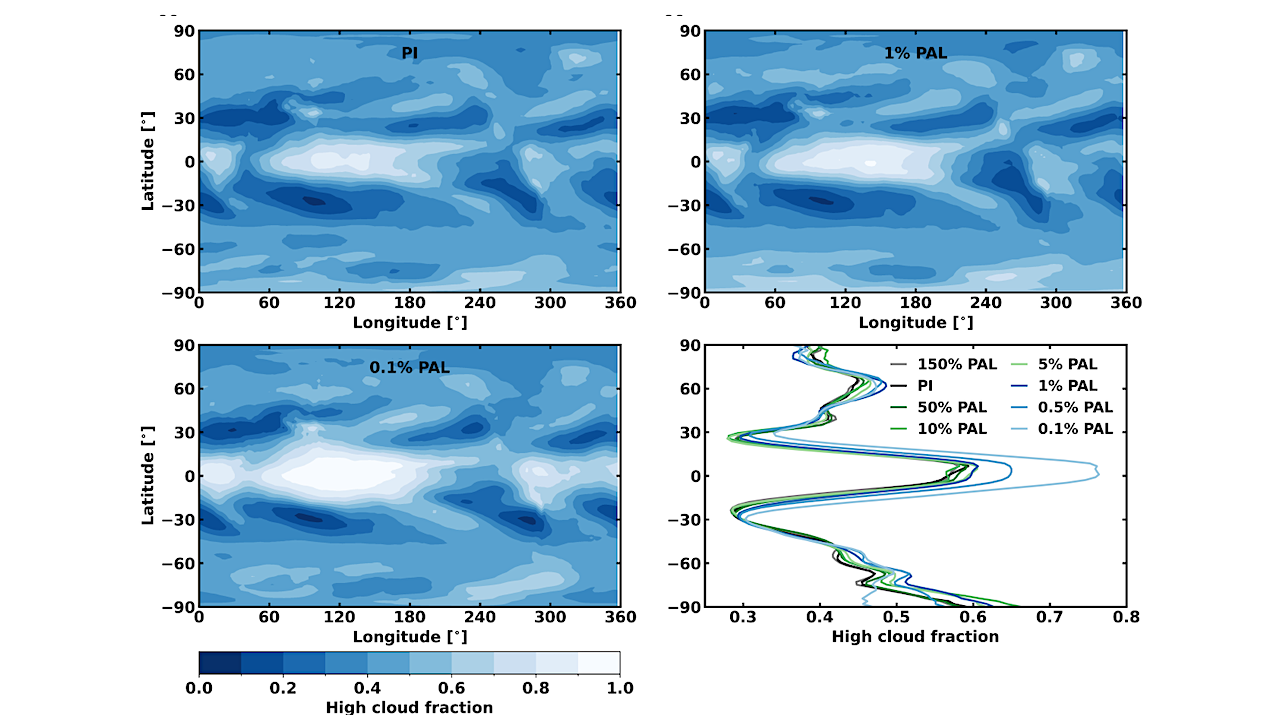
The top left, top right, and bottom left panels show the high cloud fraction as a function of longitude and latitude for the PI, 1% PAL, and 0.1% PAL scenarios, respectively. Bottom right: The high cloud fraction (high clouds are defined as clouds at pressures 400 hPa) is averaged over longitude and shown as a function of latitude in the top panel for all the WACCM6 simulations. — astro-ph.EP
The Great Oxidation Event (GOE) was a 200 Myr transition circa 2.4 billion years ago that converted the Earth’s anoxic atmosphere to one where molecular oxygen (O2) was abundant (volume mixing ratio >10−4).
This significant rise in O2 is thought to have substantially throttled hydrogen (H) escape and the associated water (H2O) loss. Atmospheric estimations from the GOE onward place O2 concentrations ranging between 0.1% to 150% PAL, where PAL is the present atmospheric level of 21% by volume.
In this study we use WACCM6, a three-dimensional Earth System Model to simulate Earth’s atmosphere and predict the diffusion-limited escape rate of hydrogen due to varying O2 post-GOE.
We find that O2 indirectly acts as a control valve on the amount of hydrogen atoms reaching the homopause in the simulations: less O2 leads to decreased O3 densities, reducing local tropical tropopause temperatures by up to 18 K, which increases H2O freeze-drying and thus reduces the primary source of hydrogen in the considered scenarios. The maximum differences between all simulations in the total H mixing ratio at the homopause and the associated diffusion-limited escape rates are a factor of 3.2 and 4.7, respectively. The prescribed CH4 mixing ratio (0.8 ppmv) sets a minimum diffusion escape rate of ≈2×10¹⁰ mol H yr−1, effectively a negligible rate when compared to pre-GOE estimates (∼1012−1013 mol H y−1).
Because the changes in our predicted escape rates are comparatively minor, our numerical predictions support geological evidence that the majority of Earth’s hydrogen escape occurred prior to the GOE. Our work demonstrates that estimations of how the hydrogen escape rate evolved through Earth’s history requires 3D chemistry-climate models which include a global treatment of water vapour microphysics.
Gregory J. Cooke, Dan R. Marsh, Catherine Walsh, Felix Sainsbury-Martinez, Marrick Braam
Comments: 32 pages, 7 figures, 1 table. Revised after first review in Climate of the Past this https URL
Subjects: Earth and Planetary Astrophysics (astro-ph.EP); Geophysics (physics.geo-ph)
Cite as: arXiv:2512.09844 [astro-ph.EP] (or arXiv:2512.09844v1 [astro-ph.EP] for this version)
https://doi.org/10.48550/arXiv.2512.09844
Focus to learn more
Submission history
From: Gregory Cooke
[v1] Wed, 10 Dec 2025 17:23:09 UTC (3,119 KB)
https://arxiv.org/abs/2512.09844
Astrobiology











Related Posts

Stay Informed With the Latest & Most Important News
Previous Post
Next Post



Advertisement
-
 01Two Black Holes Observed Circling Each Other for the First Time
 -
 02From Polymerization-Enabled Folding and Assembly to Chemical Evolution: Key Processes for Emergence of Functional Polymers in the Origin of Life
 -
 03Astronomy 101: From the Sun and Moon to Wormholes and Warp Drive, Key Theories, Discoveries, and Facts about the Universe (The Adams 101 Series)
 -
 04True Anomaly hires former York Space executive as chief operating officer
 -
 05Φsat-2 begins science phase for AI Earth images
 -
 06Hurricane forecasters are losing 3 key satellites ahead of peak storm season − a meteorologist explains why it matters
 -
 07Binary star systems are complex astronomical objects − a new AI approach could pin down their properties quickly