
Now Reading: Dwarf stars in a glittering sky
-
01
Dwarf stars in a glittering sky


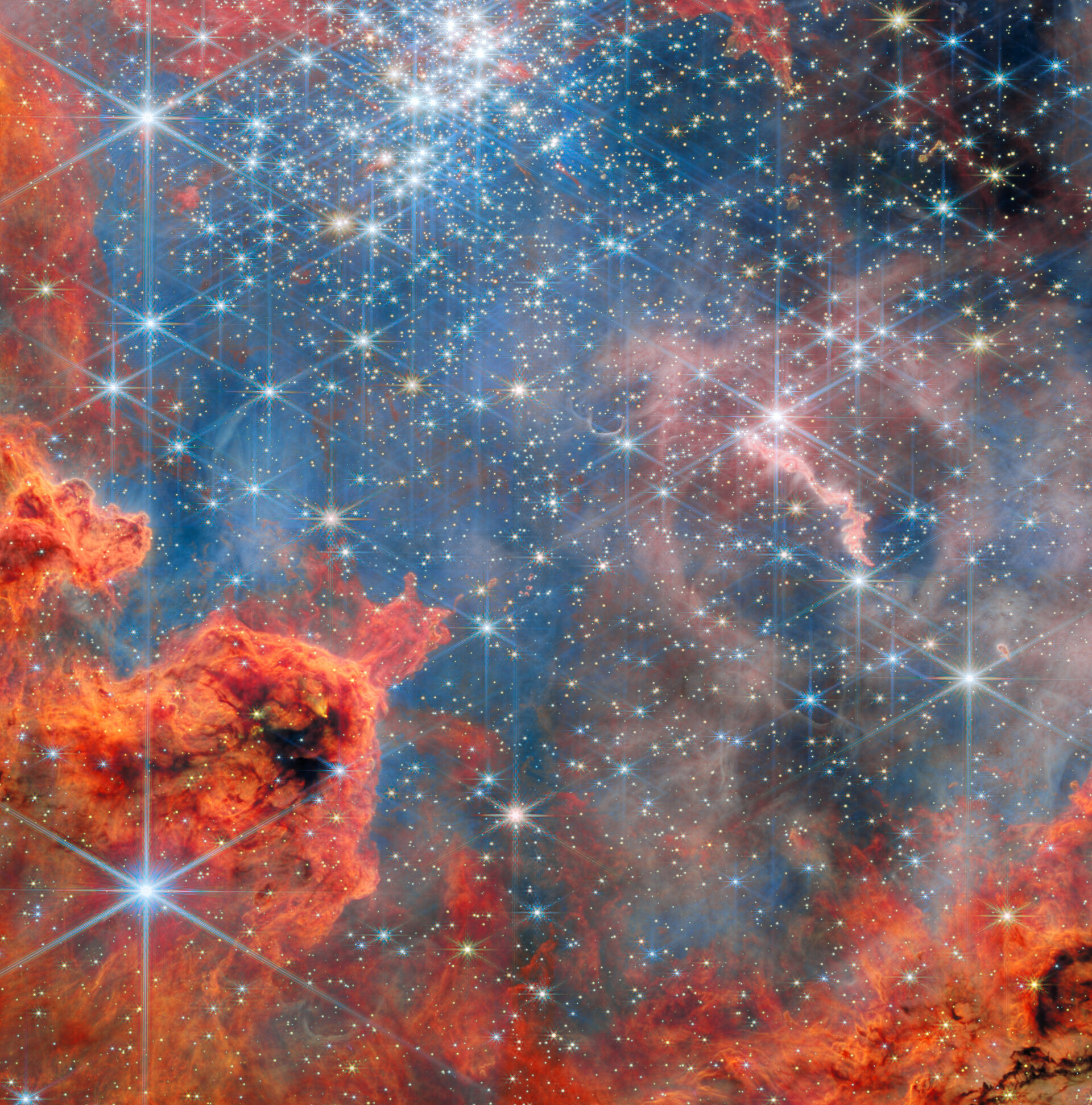

The final ESA/Webb Picture of the Month feature for 2025 showcases a festive-looking region filled with glowing clouds of gas and thousands of sparkling stars. This star cluster, known as Westerlund 2, resides in a stellar breeding ground known as Gum 29, located 20 000 light-years away from Earth in the constellation Carina (the Keel).
This image of Westerlund 2 uses data from NASA/ESA/CSA James Webb Space Telescope’s Near-InfraRed Camera (NIRCam) and Mid-InfraRed Instrument (MIRI). The cluster measures between 6 light-years and 13 light-years across, and is host to some of our Milky Way galaxy’s hottest, brightest, and most massive stars. It was also the feature of Hubble’s 25th anniversary image in 2015.
This new Webb image captures the bright, brilliant cluster near the top that is packed with young, massive stars whose intense light shapes the entire scene. Below and around them, swirls of orange and red gas form sculpted walls and tangled clouds – material that is being pushed, eroded, and illuminated by the cluster’s powerful radiation. Threaded throughout the view are countless tiny stars just beginning to shine, some still surrounded by the gas and dust from which they formed. The soft blues and pinks are wisps of thinner material drifting between the denser clouds. Scattered across the field are also many bright stars much closer to us, whose sharp, star-shaped patterns are created by Webb’s optics. The result is a vivid portrait of a stellar nursery in action, where intense energy from newborn stars carves dramatic shapes into the surrounding nebula and drives the ongoing cycle of star formation.
These new Webb observations of Westerlund 2 have revealed, for the first time, the full population of brown dwarfs in this extremely massive young star cluster, including objects as small as about 10 times the mass of Jupiter. This data is allowing astronomers to find several hundred stars with discs in various evolutionary states to facilitate our understanding of how discs evolve and how planets form in such massive young clusters. This image was developed using data from Webb’s programme #3523 (M. Guarcello) as part of the Extended Westerlund 1 and 2 Open Clusters Survey (EWOCS).
[Image Description: A cluster of stars inside a large nebula. The clouds of gas and dust are predominantly bright red in colour and wispy, akin to flames. They are clumped in the bottom-left corner. Other clouds, deeper in the cluster behind many of the stars, appear pale pink. The stars are concentrated in the top half of the image and are mostly small, bright white and six-pointed. They cast blue light over the nebula. Other stars with very long spikes surrounding them lie in the foreground.]
Links










Related Posts
Stay Informed With the Latest & Most Important News
Previous Post
Next Post


Advertisement
-
 01Two Black Holes Observed Circling Each Other for the First Time
 -
 02From Polymerization-Enabled Folding and Assembly to Chemical Evolution: Key Processes for Emergence of Functional Polymers in the Origin of Life
 -
 03Astronomy 101: From the Sun and Moon to Wormholes and Warp Drive, Key Theories, Discoveries, and Facts about the Universe (The Adams 101 Series)
 -
 04True Anomaly hires former York Space executive as chief operating officer
 -
 05Φsat-2 begins science phase for AI Earth images
 -
 06Hurricane forecasters are losing 3 key satellites ahead of peak storm season − a meteorologist explains why it matters
 -
 07Binary star systems are complex astronomical objects − a new AI approach could pin down their properties quickly