
Now Reading: Geminid meteors streak under green sky | Space photo of the day for Dec. 19, 2025
-
01
Geminid meteors streak under green sky | Space photo of the day for Dec. 19, 2025


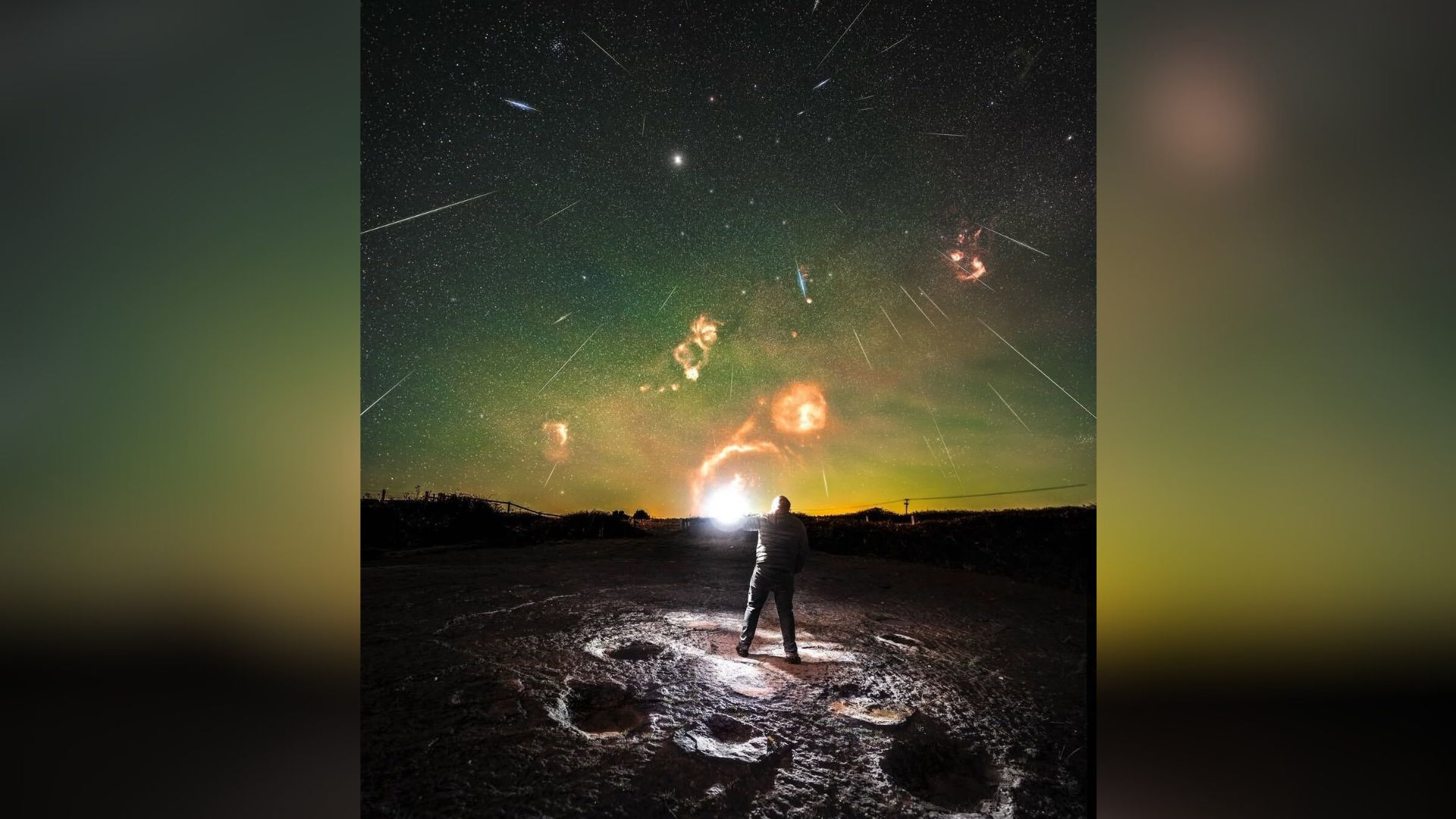
Every December, Earth plows through a dusty lane of debris in space, and the night becomes illuminated by streaks of meteors. This year’s Geminids meteor shower peaked around Dec. 13, with generally favorable viewing thanks to a relatively dim moon.
The beauty of the Geminids was captured by astrophotographers worldwide, including well-known astrophotographer Josh Dury.
What is it?
A meteor isn’t a “falling star” but instead a piece of space grit, usually no bigger than a grain of sand, hitting the Earth’s atmosphere at tens of miles per second and vaporizing in a bright, brief flare.
The point from which the Geminids appear to originate (also called the radiant) sits in the constellation Gemini, near the bright star Castor, which is why the meteor shower is named the Geminids.
Where is it?
This image was taken near the Yucatán Peninsula in Mexico.

Why is it amazing?
According to Dury’s instagram post on this image: “The Geminids are strange; unlike most meteor showers, they are not debris from a comet, but rather – an asteroid.” The asteroid in question is 3200 Phaethon, which is known to act more like a comet than an asteroid.
“This narrative of asteroid fragments raining down conjured the image for me of the extinction of the dinosaurs when the Chicxulub asteroid impacted with the Earth,” Dury told Space.com. “Utilizing this year’s meteor shower over the fossilized dinosaur tracks, I was able to reconstruct the morbid scene that might well have been the final scene before life on earth changed as we know it.”
Want to learn more?
You can learn more about meteor showers and astrophotography.










Related Posts

Stay Informed With the Latest & Most Important News
Previous Post
Next Post

Advertisement
-
 01Two Black Holes Observed Circling Each Other for the First Time
 -
 02From Polymerization-Enabled Folding and Assembly to Chemical Evolution: Key Processes for Emergence of Functional Polymers in the Origin of Life
 -
 03Astronomy 101: From the Sun and Moon to Wormholes and Warp Drive, Key Theories, Discoveries, and Facts about the Universe (The Adams 101 Series)
 -
 04True Anomaly hires former York Space executive as chief operating officer
 -
 05Φsat-2 begins science phase for AI Earth images
 -
 06Hurricane forecasters are losing 3 key satellites ahead of peak storm season − a meteorologist explains why it matters
 -
 07Binary star systems are complex astronomical objects − a new AI approach could pin down their properties quickly