
Now Reading: Long March 12A reaches orbit in first reusable launch attempt, but landing fails
-
01
Long March 12A reaches orbit in first reusable launch attempt, but landing fails


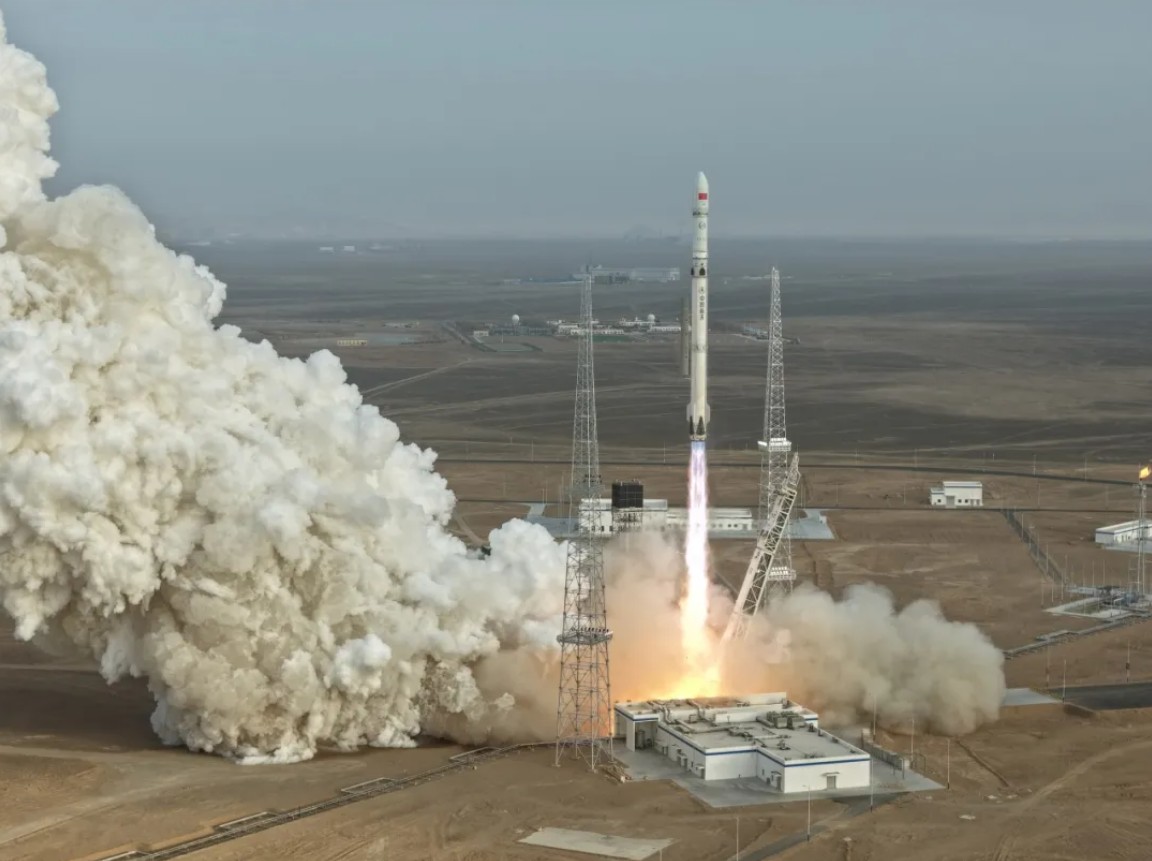

HELSINKI — A first launch of the Long March 12A Chinese state-owned reusable rocket reached orbit late Monday, but attempted recovery of the first stage downrange failed.
The Long March 12A rocket lifted off at 9:00 p.m. Eastern, Dec. 22 (0200 UTC, Dec. 23) from a dedicated pad at Jiuquan spaceport’s Dongfeng Commercial Space Innovation Test Zone. Amateur footage of the launch quickly appeared on Chinese social media.
The first stage was expected to perform a reentry burn after separation and target a landing at a pad located around 250 kilometers downrange in Minqin county, Gansu province. Apparent images and satellite imagery shared on social media suggested that the landing was unsuccessful, potentially landing around two km away from the pad.
Initial reports suggested the rocket had reached orbit, but official confirmation from China’s space authorities did not follow until more than two hours after launch. Despite the failed landing attempt, SAST said it obtained crucial engineering data under actual flight conditions, laying an important foundation for subsequent launches and reliable stage recovery, according to a state-affiliated report. A comprehensive review and technical reassessment will follow.
The Long March 12A is a 70.4-meter-long, 3.8-meter-diameter rocket powered by methane-liquid oxygen engines. It has a takeoff mass of 437 metric tons.
It was developed by the Shanghai Academy of Spaceflight Technology (SAST) under the China Aerospace Science and Technology Corporation (CASC), the country’s state-owned main space contractor. SAST performed a high altitude launch and splashdown test in January without providing comment on the outcome, while CASC has also been experimenting with grid fins on rockets since at least 2019.
CASC is also preparing to debut Long March 10 series reusable rockets in 2026, including for eventual crewed launches.
Monday’s Long March 12A launch was China’s 88th orbital launch attempt of 2025, following a Long March 5 launch of the classified TJS-23 satellite from Wenchang spaceport, Dec. 20.
China’s reusability efforts
The launch and landing attempt follows China’s first orbital first stage recovery effort Dec. 3. That saw the Zhuque-3 rocket developed by commercial firm Landspace also reach orbit but suffer an anomaly during the landing burn. Zhuque-3 and Long March 12A are just a couple of launchers from a fleet of rockets being developed in China to demonstrate reusability.
That recovery attempt signaled significant progress in China’s efforts to achieve reusable launch, according to Martin Sippel, head of launch vehicle systems analysis at DLR. “They are arriving very close to their intended landing site. The stage appears to enter intact down to low supersonic speeds, which is definitely progress,” Sippel said of the Zhuque-3 landing attempt. “They are trying quite a lot in a single step. What they have achieved in the last two or three years is already impressive, and this attempt clearly represents progress.”
Sippel believes Landspace can make a successful recovery in the future. The next step, however, would be refurbishment and eventual relaunching of a recovered first stage.
“When SpaceX first reflown a stage, they spent months refurbishing it, and the cost was roughly half that of producing a new stage,” Sippel notes. Refurbishment will enable a much higher flight rate, which is key to China’s plans including building megaconstellations.
“China is going to launch large constellations, and reusable launch vehicles are probably the most efficient way to do this,” Sippel states, who also notes an aspect of prestige in the efforts. “They also want to show that China has the most advanced space transportation technology, similar to the US. This is clearly an important aspect.” Landspace is currently thought to be targeting April for a next launch and landing attempt with the Zhuque-3 rocket.










Related Posts


Stay Informed With the Latest & Most Important News
Previous Post
Next Post





Advertisement
-
 01Two Black Holes Observed Circling Each Other for the First Time
 -
 02From Polymerization-Enabled Folding and Assembly to Chemical Evolution: Key Processes for Emergence of Functional Polymers in the Origin of Life
 -
 03Astronomy 101: From the Sun and Moon to Wormholes and Warp Drive, Key Theories, Discoveries, and Facts about the Universe (The Adams 101 Series)
 -
 04True Anomaly hires former York Space executive as chief operating officer
 -
 05Φsat-2 begins science phase for AI Earth images
 -
 06Hurricane forecasters are losing 3 key satellites ahead of peak storm season − a meteorologist explains why it matters
 -
 07Binary star systems are complex astronomical objects − a new AI approach could pin down their properties quickly