
Now Reading: Apollo 8 Earthrise photo anniversary today
-
01
Apollo 8 Earthrise photo anniversary today


EarthSky’s 2026 lunar calendar is available now. Get yours today! Makes a great gift.
Earthrise photo changed human perspective
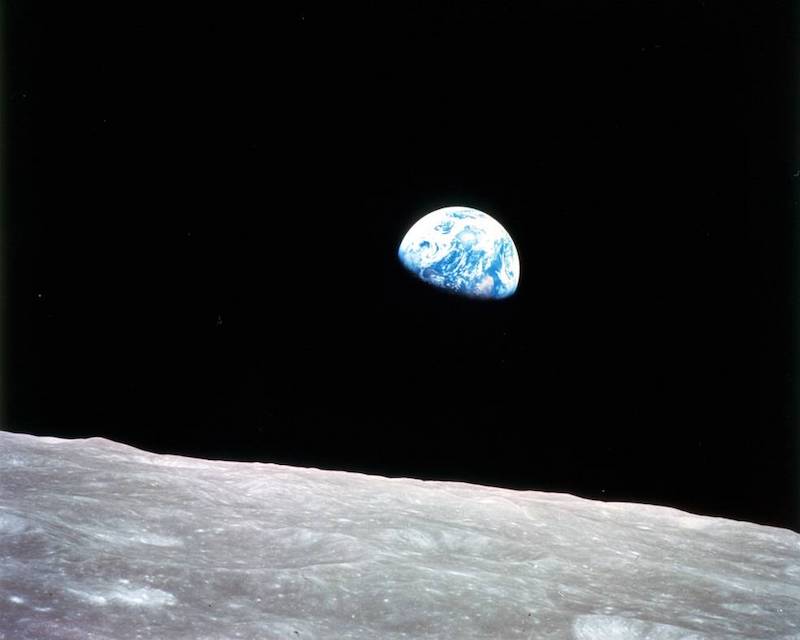
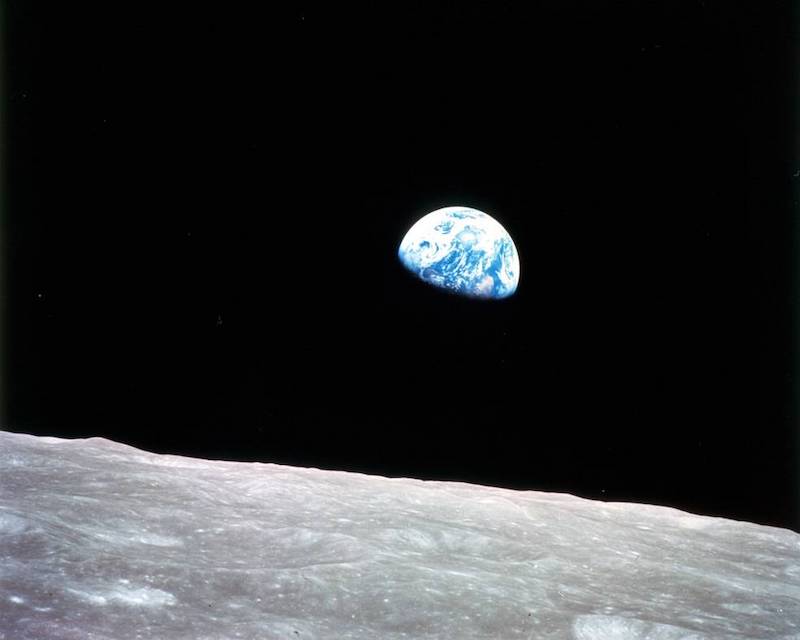
On Christmas Eve in 1968, William Anders, aboard the Apollo 8 spacecraft, turned his camera toward Earth and captured a photo that’s now legendary. It was a photo that showed humans a new perspective, with the moon in the foreground and Earth floating in distant space.
NASA’s Scientific Visualization Studio released the video below on the 45th anniversary of the photo now known as Earthrise. The position of Apollo 8 and what the astronauts saw through the windows of the spacecraft are recreated and matched with audio from the flight.
You can hear the voices of the Apollo 8 astronauts: Commander Frank Borman and crew members William A. Anders and James A. Lovell. On the astronauts’ fourth orbit of the moon, Borman performed a roll maneuver of their craft, which put them in position to catch the Earth ascending over the lunar horizon. The video relays the exciting moments as they are surprised with the view for the first time and grapple to get color film to capture the momentous photograph, while joking that the image was not part of their schedule.
An iconic moment in history
Dan Rather described the iconic image in his book “What Unites Us.” He explains how it captures the peaceful Earth in the darkness of space and what was really happening on the planet at that moment of history:
This image, so peaceful and yet so breathtaking, was taken at the end of a turbulent year. It was Christmas Eve 1968, but from up there you would never know that a hot war was raging in Vietnam or that a Cold War was dividing Europe. You wouldn’t know of the assassinations of Dr. Martin Luther King Jr. or Bobby Kennedy. From that distance, people are invisible, and so are cities, countries, and national boundaries. All that separates us ethnically, culturally, politically, and spiritually is absent from the image. What we see is one fragile planet making its way across the vastness of space.
With the click of a shutter, our spaceship Earth and everyone aboard were captured by the first humans to venture beyond the bounds of Earth’s gravity, giving us a better picture of our home. At the end of the Christmas Eve broadcast from lunar orbit in 1968, astronaut Frank Borman, commander of Apollo 8, signed off:
Good night, good luck and God bless all of you, all of you on the good Earth.
Coming back home
As mission controllers waited, Lovell confirmed the successful firing that would carry the crew home by December 27:
Please be informed there is a Santa Claus.
Here’s Apollo 8 entering our atmosphere on December 27, 1968.
#OTD 1968 – Apollo 8 returns! Reentry captured by an aircraft at 40,000 ft. To the Moon and back, the greatest pioneering voyage in the history of humankind was a resounding success. Absolutely inspirational. #Apollo8 #Apollomas #NASA #Space
— Michael Ingles (@mickingles.bsky.social) 2024-12-27T13:12:24.655Z
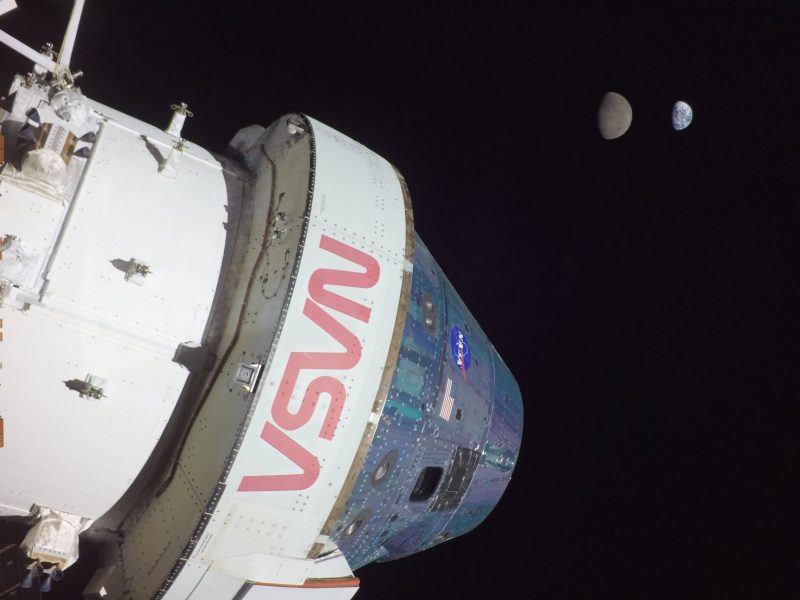
And 55 years later, another iconic sight
Anders died in a plane crash
Anders died on June 7, 2024, when the plane he was piloting alone crashed. AP reported that the plane:
… plummeted into the waters off the San Juan Islands in Washington state. He was 90. His son, retired Air Force Lt. Col. Greg Anders, confirmed the death to The Associated Press. ‘The family is devastated,’ he said. ‘He was a great pilot and we will miss him terribly.’
Anders will not be forgotten because his photo of Earthrise helped people realize how small and fragile our planet appears, from a space-based perspective. The photo helped spur the environmental movement of the late ’60s and early ’70s, which has continued to today.
Bottom line: Astronaut William Anders took this iconic photo of Earthrise on the fourth orbit of the moon aboard Apollo 8 on December 24, 1968.
Read more about the Apollo missions
The post Apollo 8 Earthrise photo anniversary today first appeared on EarthSky.










Related Posts


Stay Informed With the Latest & Most Important News
Previous Post
Next Post



Advertisement
-
 01Two Black Holes Observed Circling Each Other for the First Time
 -
 02From Polymerization-Enabled Folding and Assembly to Chemical Evolution: Key Processes for Emergence of Functional Polymers in the Origin of Life
 -
 03Astronomy 101: From the Sun and Moon to Wormholes and Warp Drive, Key Theories, Discoveries, and Facts about the Universe (The Adams 101 Series)
 -
 04True Anomaly hires former York Space executive as chief operating officer
 -
 05Φsat-2 begins science phase for AI Earth images
 -
 06Hurricane forecasters are losing 3 key satellites ahead of peak storm season − a meteorologist explains why it matters
 -
 07Binary star systems are complex astronomical objects − a new AI approach could pin down their properties quickly