
Now Reading: Aerospace Firms Transform Historic Cape Canaveral Launch Pads for Next-Gen Rocketry
-
01
Aerospace Firms Transform Historic Cape Canaveral Launch Pads for Next-Gen Rocketry

Aerospace Firms Transform Historic Cape Canaveral Launch Pads for Next-Gen Rocketry

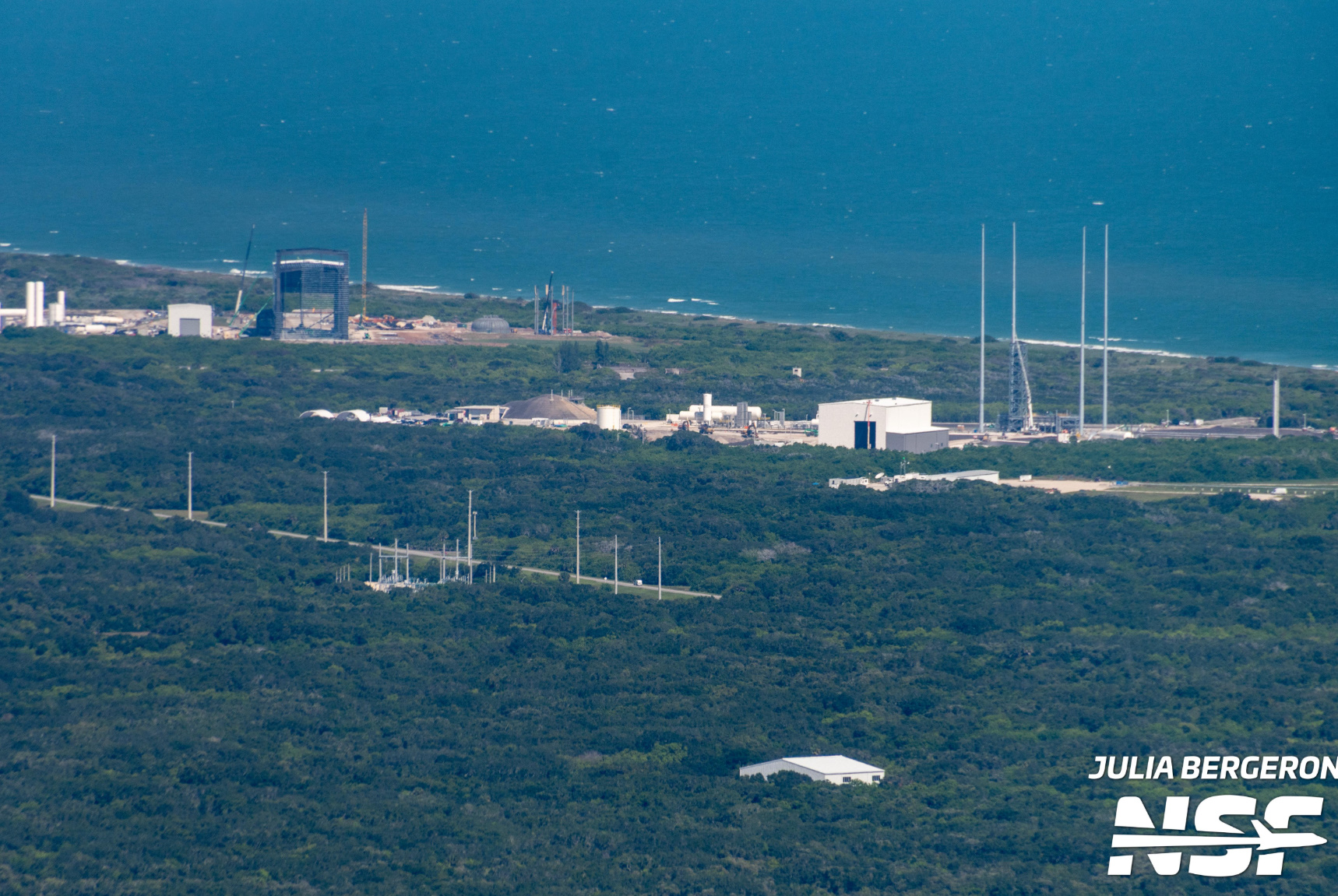

In a significant boost to the future of space travel, two pioneering aerospace firms are revamping historic launch pads along Florida’s Space Coast to launch their innovative reusable rockets. Stoke Space and Relativity Space are transforming Launch Complex 14 and Launch Complex 16, respectively, both located at Cape Canaveral Space Force Station, into state-of-the-art facilities that promise to redefine access to space.
Stoke Space is making impressive strides at Launch Complex 14, a site steeped in history as the launch pad used by John Glenn during his 1962 mission that made him the first American to orbit the Earth. After decades of dormancy, the complex is on the brink of operational readiness for the company’s fully reusable Nova rocket. Aerial views captured in recent flyovers reveal the launch pad approaching completion, buoyed by the installation of propellant and commodity pipelines and the successful testing of a water deluge system designed to protect the site during launches.
Inside, the Horizontal Integration Facility, which will be used for rocket assembly, remains mostly empty but is prepared for future use, showing signs of thorough preparations with graded terrain and the removal of heavy equipment. Stoke Space announced its ambitious timeline, aiming for Nova’s inaugural flight in early 2026, bolstered by a substantial $510 million funding round secured in October 2025 to facilitate the activation of LC-14 and enhance production capabilities.
Next door, Relativity Space is undertaking significant renovations at Launch Complex 16 to prepare for its medium-to-heavy lift Terran R rocket, set for its first flight in late 2026. Reports from aerial imagery indicate marked progress, particularly with the construction of a towering water tower crucial for protecting the facility during launches. The tank is currently undergoing final assembly and is expected to stand at around 93 meters when completed.
Additional enhancements include considerable advancements in the Horizontal Integration Facility, which is now more than halfway clad, and a series of new propellant tanks aligned with the design of the Terran R architecture. Preparations for storing liquid methane have also begun, with the addition of a flare stack designed to manage emissions from the tank facilities. Meanwhile, older infrastructure from the previously retired Terran 1 program is being phased out to make way for new developments.
As construction progresses at both sites, the advancements underscore the burgeoning commercial space sector centered at Cape Canaveral. With Stoke Space and Relativity Space on track to deploy their reusable launch systems, the transformation of these historic launch pads signals a new era in space exploration, emphasizing the Space Coast’s evolution into a hub for groundbreaking aerospace innovation.










Related Posts


Stay Informed With the Latest & Most Important News
Previous Post
Next Post






Advertisement
-
 01Two Black Holes Observed Circling Each Other for the First Time
 -
 02From Polymerization-Enabled Folding and Assembly to Chemical Evolution: Key Processes for Emergence of Functional Polymers in the Origin of Life
 -
 03Astronomy 101: From the Sun and Moon to Wormholes and Warp Drive, Key Theories, Discoveries, and Facts about the Universe (The Adams 101 Series)
 -
 04True Anomaly hires former York Space executive as chief operating officer
 -
 05Φsat-2 begins science phase for AI Earth images
 -
 06Hurricane forecasters are losing 3 key satellites ahead of peak storm season − a meteorologist explains why it matters
 -
 07Binary star systems are complex astronomical objects − a new AI approach could pin down their properties quickly